1Q84 by Haruki Murakami In 1Q84, the Japanese writer Haruki Murakami tells the story of a freelance assassin and an aspiring writer as they slowly become entangled with a sinister religious cult and the mysterious supernatural beings the cult worships.

Murakami sets his book in a parallel world that resembles 1984 Tokyo, except for the presence of two moons in the sky. (The title of the novel is a reference to this other world, with a “Q” that stands for “question mark” replacing the “9”.)

1Q84 combines elements of fantasy, thriller, and detective stories with questions about the nature, function, and meaning of fiction. The English version, translated by Jay Rubin and Philip Gabriel, was published in the fall of 2011.

Murakami’s novel was widely expected to be a masterwork, but the reception among English speaking reviewers was mixed, with some hailing it as a major work of literature and others seeing it as a 1,200 page novel of no great substance.

I liked 1Q84 more than some of its critics, but I agree with those who think the novel is unlikely to find a permanent place among the world’s great books.

As an entertainment, I thought it was successful. I was never enthralled by the novel, but I did finish reading it, and I found its main actors, Aomame the assassin, and Tengo the writer, well drawn and appealing.

Only one character, however, a grotesque but finally sympathetic private detective name Ushikawa, burned with the convincing life that distinguishes great literary characters from their lesser brothers and sisters.

I also didn’t think all the references to artists, discussion of metaphysical ideas, or the novels-writing-reality and reality-writing-novels tricks (which are at least as old as Andre Gide’s 1895 Paludes), added up to very much.

They seemed more like the kind of fruits and nuts you might throw into a satisfying, but ultimately unremarkable cake, to make it tastier.

Finally, I thought 1Q84 lacked quiddity, lacked that strange and delicate alchemy which makes a novel deeply idiosyncratic on one hand and broadly universal on the other, and which distinguishes great books from merely good ones.

Fans of 1Q84 may offer two substantial objections to these opinions.

The first is that I don’t know if Rubin and Gabriel’s clear and workmanlike translation of 1Q84 reflects Murakami’s work or whether English readers have lost the rhythm and music of the original prose, not to mention the subtle resonances and associations which are particular to different words in different languages, but which are essential to writers of any talent.

To this I can only reply, true. That is a difficulty with any translation.

The second problem is the (reasonable assumption as it turns out) that I am largely unfamiliar with Japanese culture and society.

This means that if Murakami created a metaphorical history of Japan in 1Q84, or included large amounts of sociological comment, or has written significant elements of parody or satire into the novel, the chances are something better than 95% that I don’t get them.

To this I can only reply, also true. But it is a quality of literature that it transcends the time and place of its composition, and speaks powerfully to readers in other places and other times. That 1Q84 falls short on this measure does not make it a bad book. But it doesn’t make it an important one, either.

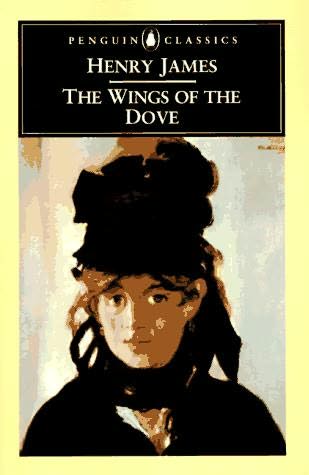
I had a long slow argument with Henry James while reading The Wings of the Dove. Was he an immortal genius? Or a purveyor of pretentious soap operas? Here’s who won the argument:

“On that especial issue, Peter made something like a near approach, taking into account his great reasons, the particulars and nuances and complexities, they being, of course, more important than the main point, they being really fine, and grand, and ravishing, and although he hung fire on his answer, and really, who might blame him, before committing himself, as it were, to a more definite position, which if stated plainly, might fall a little flat, might seem a little thin, might reveal too baldly a poverty of thought and a desolation of feeling, conveniently concealed in a thicket of syntax, great flashes of brilliance aside, yet he did half commit himself, in the end, all of which is to say, perhaps, he wouldn’t decide James wasn’t coming out something more ahead than not.”

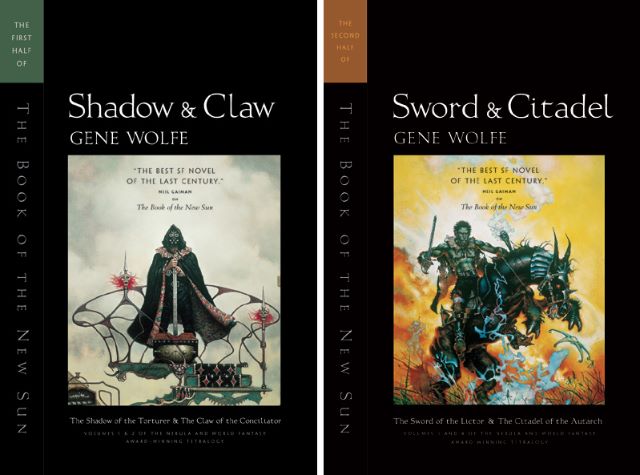
The Book of the New Sun by Gene Wolfe - book coversFans of science fiction, with two weeks of glorious vacation reading time before them, could do much worse than pick up The Book of the New Sun by Gene Wolfe.

This four-novel series follows Severian, an exile from the guild of The Seekers of Truth and Penitence (ie, torturers and executioners) as he pursues his picaresque and ultimately momentous destiny on an earth so far in the future the sun is burning out.

Severian’s adventures keep the reader cheerfully turning pages, and Wolfe seeds the novel with enough time-bending, past-is-future plot twists and vague mythological-theological themes to feed late-night bull sessions in college dorm rooms everywhere, but the real delight – and the major accomplishment – is in the details.

The plants, animals, machines, buildings, cities, humans, and aliens of The Book of the New Sun consistently enchant with their originality and strangeness. And by creating a decaying medieval society, mostly forgotten and abandoned by other humans who fled to the stars long ago, Wolfe smoothly unites fantasy and science fiction. Excellent, guilt-free reading for August.

Hermann Hesse, author of books such as Siddhartha and winner of the 1946 Nobel Prize in Literature, is the perfect writer for teenagers. His novels are painfully earnest, full of sensitive characters who are struggling against the soul-destroying conventions of society and searching for transcendence.

This description certainly fits Harry Haller, the central character in Hesse’ most famous book, Steppenwolf. And it’s not hard to see why Harry would appeal to adolescent readers (despite the fact he’s nearly 50 years old). Harry is grumpy, gloomy, brilliant, artistic, misunderstood, rejected, spends a lot of time alone in his room brooding, and is – turns out – pretty horny. This exactly describes the kind of teenager who would bother picking up Steppenwolf in the first place.

The question is, for those of us who read Steppenwolf twenty or thirty years ago, Should we bother reading it again?

The answer is “sorta”.

Steppenwolf is still utterly humorless and Harry is still gloomy, misunderstood, brooding. What stands out now is how dull Harry Haller is. Hesse keeps telling us how fine a soul Harry has: how intelligent is he, how artistically refined, and how much he suffers.

But the only evidence we have of Harry’s genius is Hesse’ say-so. Nothing in Steppenwolf persuades us that Harry is as remarkable as Hesse claims, and without any tangible signs of brilliance, Harry is rather uninteresting, except for when he’s being petulant.

Steppenwolf also displays that vanity particular to the aging male animal, which is the magical belief that beautiful young women find us attractive.

In the real world, young women don’t fall for decaying misanthropes unless they have a sum of money and Harry doesn’t. But Hesse asserts that not one, but two gorgeous young girls are fascinated by Harry and that he is still capable of prodigious feats of physical love with them.

What saves Steppenwolf is how thoroughly Hesse destroys any sense of value we might have for Harry’s genius. Hesse still sees Harry as a unique soul – but a unique soul leading a useless existence.  Harry is a man who has forgotten how to laugh or find pleasure in life.  He’s a fool who should be pitied, and scolded, and taken by the hand and pulled away from his stubborn loneliness and self-importance.

When this happens, Harry does become interesting. He begins to feel human. He engages our sympathy. And he makes the long hallucinatory sequence that forms the middle-end of Steppenwolf credible rather than ridiculous because Harry feels like a convincing person in it.

Finally, the last pages of the book work for readers of a certain age. Steppenwolf closes not with Harry triumphing over his old self, but rather with him discovering that he is the same person he always was despite his best efforts.

I suspect the young don’t much like this ending. The young believe they can be anybody they want to be (and they should believe this).

Unfortunately, for those of us who have been living with our adult selves for a couple decades, the ending of Hermann Hesse’ Steppenwolf bears an unhappy resemblance to the truth.

As You Like It - The New Cambridge Shakespeare book coverIn As You Like It, Shakespeare banishes all unhappiness, unless it springs from love.

The play follows a multitude of characters driven from a nobleman’s court to exile in the Forest of Arden, where they find refuge from the ambition, intrigue, envy, and striving of the world.

There a usurped Duke philosophizes on his new freedom; a lord tends his melancholy like a garden; and the clown Touchstone pursues his fooling to the edge of the sublime – but the show belongs to the misery and ecstasy of love and to the superlative Rosalind, mistress of all situations and persons except her own wild heart.

There are familiar Shakespearian tropes in As You Like It. The instantaneous and absolute way love conquers. The woman dressed as a man who hides from her love and is loved by the wrong person in turn. And the character who arranges events to create maximum drama, even as the audience is left wondering what motivates her manipulations.

No matter. The dialogue is superb. Rosalind bewitches men and women, on and off stage, in equal measure. And all ends happy in this most delicate of Shakespeare’s comedies.


In Bring Up the Bodies, Hilary Mantel continues her speculation on the life of Thomas Cromwell – Master Secretary and consigliere to King Henry VIII of England – as he works to remove Anne Boleyn from the throne of England because Anne has failed to produce a male heir for the king and, more essentially, because Henry has grown tired of her.

Mantel delivers a brilliant synthesis of the genre and literary novels, offering action, intrigue, sex, and blood as well as masterful writing, sharp-edged dialogue, finely drawn characters, and acute psychological insights. More impressively, she takes absolute possession of Cromwell’s mind and then offers readers a prime seat in it.  Bring Up the Bodies is the sequel to Mantel’s Man Booker Prize-winning novel, Wolf Hall.

Ayn Rand talks fantasy football

In our previous installment of Made-Up Truth, we were pleased to present a transcript of The Football Circus show featuring special guest commentator, Barack Obama, discussing fantasy football.

This week, Made-Up Truth is delighted to offer a transcript of TFC’s all-time most popular segment, featuring iconic author Ayn Rand. Let’s get it going!

[Lights come up. Lively music plays. TFC appears sitting at a desk with a distinguished looking older woman. She wears a severe expression and is dressed in a formless grey shroud. The woman’s skin seems both pearly and translucent.]

TFC: I’m happy to introduce our guest commentator this week. Please welcome novelist, pseudo-philosopher, and Tea Party inspiration Ayn Rand. Give her a hand folks!”

[Lively applause from the audience.]

RAND: Thanks, TFC. It’s great to be here.

TFC: It’s great to have you. So, I guess there’s an after-life after all. What’s it like?

[RAND fixes TFC with a cold, angry stare.]

RAND: Have you heard Aaron Rodgers is a big fan?

TFC: How nice for you. Moving right along. First game this week is …

TEAM BARBECUE at FUBOOZERS. What do you think, Ayn?

RAND: Adrian Peterson is a better running back than Maurice Jones-Drew, so Fuboozers will win.

TFC: Okay, I agree Peterson is better. But what about Kitna versus Brady? Brady’s the better quarterback, but Kitna has a good match-up versus Detroit. And the BBQs have a stronger team overall. Both these guys are living in the cellar, but I’d put my money on the Barbecues.

RAND: Peterson is a better running back than Jones-Drew, so Fuboozers will win.

TFC: Right, I heard that. But there are seven other players. I gave you reasons why I think the BBQs will win. Let’s have a conversation!

RAND: Peterson is a better running back than Jones-Drew, so Fuboozers will win. I am thinking and you are not.

TFC: You can’t ignore all the players except Peterson and Jones-Drew.

RAND: I am thinking and you are not.

TFC: Look, that’s not an argument. You told my producer you would offer startling insights and persuasively reasoned opinions. We flew you in Business Class from frickin’ Limbo. We put you up at the Four Seasons. You ate all the Chex Mix in the Green Room. We have the right to expect better.

RAND: I am thinking and you are not.

TFC: You’re not going to make me give up by being a mono-maniacal bitch about this.

RAND: I am thinking and you are not.

TFC: You make…

RAND: I am thinking and you are not.

TFC: Jesus! Okay, fine. Fuboozers will win. Happy?

RAND: Now you’re beginning to think!

TFC: Next up, we’ve got…

KICK-ASS FLOWER KIDS at THE MIGHTY MUSKRATS

RAND: The Flower Kids are naked hippies rolling around in the mud doomed to die with all the other naked hippies rolling around in the mud doomed to die. Naked hippies covered in mud doomed to die can never win a fantasy football game. Ever.

TFC: The Flower Kids won the AWFL Cup a few years ago.

RAND: I am thinking …

TFC: … and I am not. All righty. And the Muskrats have been scoring a million points lately, too. Now, let’s look at…

THE PEACH STATE REBELS at TEAM BIG GOVERNMENT

RAND: Bah! Government lawyer! Team Big Government is a moocher, parasite, looter, bloodsucker. He wants to enslave true, powerful, good, productive, and creative minds. He hates and envies those who can think because he cannot. He steals the wealth of corporations and their heroic chief executives. If he is not stopped, America will crash into ruins within the next six months. I do love his world-famous turkey burgers, though.

TFC: Let’s hear it for those turkey burgers. I take it you think the Rebels will win?

RAND: Duh.

TFC: How about we keep it moving, folks. Here’s one.

FOUR ACES at THE EVIL PETES 

RAND: Evil doesn’t exist. Evil is what the weak, the stupid, the venal, and the thieving call the achievements of society’s geniuses. Because The Petes are weak, stupid, venal, and thieving, they are Evil. Because they are Evil, they do not exist. It is impossible for a team that does not exist to win a fantasy football game. The Four Aces do exist. Therefore, they win by forfeit. You cannot fault by logic.

TFC: And we wouldn’t even try. Okay, our next game is …

ROLLING THUNDER at THE HANDSOME GUYS

Ah, the Handsome Guys. They remind me of Nathaniel Branden. Nice boy. Little slow on the up-take. It took a while for Nathaniel and his wife to see the logic of Natty becoming my lover. But once he did, mmm-mmm. Yes, they are much alike. I can’t wait to sample their succulent man-flesh. On your knees and get busy, bitches!

TFC: Are you talking to me or the Handsome Guys?

RAND: The Handsome Guys, of course. Who else?

TFC: Just checking. So we can assume the Handsome Guys are going to score a lot this week?

RAND: Oh yes!

TFC: Good luck to the Handsome Guys with that. Here is our game of the week:

RED HOT CHILLY WILLYS at DARTH VADER RAIDERS

RAND: This is what happens when you put the good of others above your own happiness! Anakin Skywalker was a genius. He could have been John Galt’s son. What did those socialist Jedi do to him? They made him feel guilty for wanting to be himself. The result? The universe plunged into tyranny and darkness! Billions dead. Mindless Bolshevik clones running everything! If I could get my hands on that little green freak, Yoda…

TFC: Woah, hey, calm down. Fiction. Completely made up. No relationship to reality at all. Just a story.

RAND: It is? Really?

TFC: Yes, I promise. Do you think The Willys have any chance this week?

RAND: With the way The Raiders have been playing? Honestly, no.

TFC: Let’s finish with …

THE CHIP CHOMPERS at THE LONE STAR WRANGLERS

RAND: Excuse me. I have to take this. Alan Greenspan is asking me a question on his Ouija board.

[For several minutes, RAND stares straight ahead and mutters. Some phrases are audible, including “Deny everything” and “Issue counter-accusations” and “On your knees, bitches!”]

RAND: I’m back. Sorry to make you wait. Old friend.

TFC: No problem. What do you think about the Chompers?

RAND: This is a tough game, but I think the Chompers will pull it out. You have to like Rodgers over Schaub the way Houston is playing. I think Ricky Williams will have a better game than predicted with no one at quarterback in Miami to throw the ball. The Wranglers have got Cowboys and I see a let-down coming after their big win against the Giants last week. You know, football is a funny game. You can look at all the numbers, but still … any given Sunday. Well, I’m picking the Chompers.

TFC: Hey, you know, that was pretty good. I’m going with the Chompers too.

RAND: Thanks TFC. This has been fun. Can I come back next week?

TFC: No.

More great fantasy football humor can be found at “The Football Circus” blog!

Holy cow, he’s rich and handsome. Holy crap, he makes me horny. Holy Moses, he’s got a sex dungeon. Holy f*ck, he can f*ck. Holy sh*t, I have to sign this contract? Holy crap, he’s mysterious and tortured. Ouch! he’s spanking me. Oh, I like it. Holy cow, he loves me for me? Hey! he tied me up. Huh, I like it. Holy crap, I’m meeting his mother. Holy f*ck, he can f*ck. Holy sh*t, shocking personal revelations! Glider. IHOP. Flogger. Handcuffs. Holy crap, he plays the piano too. Such a nice boy. Holy cow, the love of a brave woman should fix any broken man. Ah … aah … aaahh … aaaahhh! … aaaaahhhh!!AAAAAAHHHHH!! 

In Bring Up the Bodies, Hilary Mantel continues her brilliant speculation on the life of Thomas Cromwell – Master Secretary and all-around fixer for King Henry VIII of England – which she began in her Man Booker Prize-winning novel, Wolf Hall.

A major reason Mantel is enjoying success with these novels is because she persuades us to take the side of a man who – looked at objectively – enriches himself working as a merciless administrator of state-sanctioned murder.

This is a pretty neat trick and I think there are several reasons Mantel pulls it off. Here they are:

Thomas Cromwell as Compromised Corporate “Warrior” but Man of Private Virtue

One reason readers sympathize with Thomas Cromwell is because he is an idealized version of modern business professionals, who are sometimes required by corporate structures or profit pressures to compromise their principles, but who work hard to retain their personal integrity.

Consider: Thomas Cromwell is a man of ambition and ability who wants to enjoy career success and earn a good living for his family. But the institutions in which Cromwell can gain this success are all corrupt. Worse, they are run by self-dealing, dangerous, and arbitrary men. And the most dangerous of all is Cromwell’s boss: King Henry VIII.

Cromwell thrives by focusing only on getting Henry what he wants and making Henry believe that what he wants is right and proper. Cromwell doesn’t think about whether what he does is moral, partially because ultimate responsibility for his actions lies with the king – Henry decides what will happen, Cromwell only figures out how – and partially because arguing with or failing Henry will cost Cromwell his job, if not his head.

In the areas of his life he can control, Thomas Cromwell acts with integrity. He has not come to wealth from greed although he has accumulated great wealth. He does not strike from malice, although he will defend himself and he will avenge his friends. He nurtures talented young men of low birth and gives them chances to advance. He loves his family and cares for his household.

This is how men and women who have succeeded in today’s capitalist societies see themselves (many times correctly), and these men and women are a large part of Hilary Mantel’s readership. So it’s not a surprise they like Thomas Cromwell.

Thomas Cromwell as a Horatio Alger’s Hero

Thomas Cromwell’s life story is a classic “up by your bootstraps” narrative. He is the son of a physically abusive blacksmith who ran away from home as a young man, survived as a common soldier on foreign battlefields, succeeded by virtue of his talents, and came home to be the “local boy who made it big”.

This story appeals to modern capitalists everywhere, and it should. The fact that Cromwell rises in a world where success is almost always determined by noble birth makes it even more appealing.

Thomas Cromwell as a “Particular but Persuasive” First-Person Narrator

First-person storytelling naturally encourages readers to side with the narrator (unless he is astonishingly and relentlessly loathsome), but Cromwell’s first-person earns benefits beyond the normal advantage. And the key is that Cromwell uses the word “he” instead of “I” when he talks about himself.

Some reviews have regarded this as a tick or affectation on Mantel’s part. But I think it’s astute. First, Cromwell is the ultimate dispassionate observer, and thus manipulator, of Henry and the court. He never allows vanity or greed or hatred or fear or revenge to interfere with his judgment or make him act before he’s ready and before he’s certain. The “he” fits Cromwell.

More importantly, the “he” in Cromwell’s narration makes you feel that Cromwell is showing you the objective truth, not giving you his version of events. Cromwell is not selling you a line. He’s not trying to talk you over into his point of view. He’s giving you the facts, Mantel is saying, and Cromwell in those facts looks pretty good.

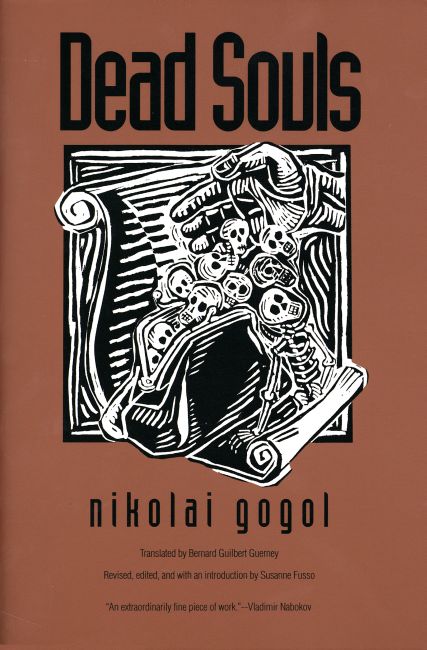
Dead Souls by Nikolai Gogol, translated by Bernard Guilbert Guerney, Yale Univ PressNikolai Gogol’s Dead Souls first gained fame as a caustic satire of Russian society when it was published in 1842. Today’s readers will value it as a mesmerizing phantasmagoria of human vice, mendacity, and mediocrity.

The title refers to a defect in Russian law that frequently required the owners of serfs (or “souls”) to pay taxes on their human property even after the serfs have died. The story follows Chichikov, a small-time confidence man, as he buys these souls at steep discounts, saving the owners from the taxes and gaining for himself fraudulent collateral he can use in subsequent schemes.

Gogol offers a parade of vividly detailed human caricatures described in language which is baroque, grotesque, exuberant, and exact. Fans of Vladimir Nabokov will find much that is familiar in Gogol’s prose. I enjoyed the translation of Dead Souls by Bernard Guilbert Guerney which Nabokov recommended .