Posts Tagged ‘Literature’

brief wondrous life oscar wao junot diaz reviewWhen artists are really good, I tend to curse at them. G-dd-mn Jane Austen. G-dd-mn Beethoven. G-dd-amn Billy Wilder. Now I’ve got a new name on my curse list. G-dd-mn Junot Diaz.

The Brief, Wondrous Life of Oscar Wao principally concerns its title character, his sister Lola, and their mother, although it does also tell the story of their extended family as well as that of its ostensible narrator, Yunior.

Diaz’ novel is that rare find – a work of current fiction that entirely lives up to its hype. The number of successful elements it delivers is simply ridiculous:

Big vivid characters that make a big splash on the page? Check.

Big vivid characters that are also richly imagined, convincing, and affecting? Check.

Multi-generational saga? Check.

Lots of sex but no sex scenes (thank you Junot!)? Check.

Healthy dollops of magical realism? Check.

Locations exotic to the typical American reader of literary fiction: hard scrabble New Jersey and the Dominican Republic? Check.

A narrative voice that is part gangster, part geek, and part grad student? Check.

A whole bunch of fanboy references to comic books, science fiction, and fantasy novels (oh god not again)? Check.

A great deal of untranslated Spanish dialogue, narration, and commentary? Check.

A third-world history lesson — in this case about the hyper-over-super-achieving sadistic Dominican dictator Trujillo and his thirty year reign of terror — much of which is told through jazzy footnotes? Check.

A story focused on the wild, uncompromising, irrational, destructive but all the same soul-sustaining power of love? Check.

A satisfying ending that unites all these elements in an organic whole that meets Nabokov’s definition of art, “beauty plus pity”? Check and check.

G-dd-mn Junot Diaz.

The only criticism of the novel I have is a flaw in the narrator which, as it turns out, isn’t a flaw at all. In the beginning of The Brief, Wondrous Life of Oscar Wao, Yunior pushes the comic book/sci-fi/fantasy references so hard that they almost entirely obscure the character of Oscar.

I kept muttering, “I can’t see Oscar, Junot, because all these Lord of the Rings references keep getting in the way.”

But what I realized is that early in the novel, Yunior is a young man who writes like a young man: overly earnest, full of himself, self-absorbed, and inept. He matures as he ages, and his narration matures too, until it is much wiser, more self-aware, more observant and empathetic, and more rueful.

Yunior is also one of those (not uncommon) characters who are their author’s alter ego, to the extent that they often share their creator’s omniscience. Yunior describes many things in the novel which are simply impossible for him to know.

Diaz doesn’t give Yunior the excuse of being the fictional author of the novel. Instead, Diaz shimmers in and out of Yunior’s character, which I think gives the novel more depth, because Diaz keeps getting you to fall into the dream of the story, then waking you up from it.

That’s another element I should have put in my list. Well, I’ll check it off now and conclude with this: G-dd-mn Junot Diaz.

Read Full Post »

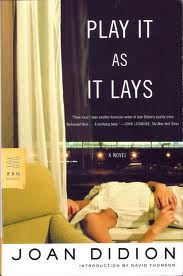
Play it as it lays Didion reviewAlbert Camus goes to Hollywood in Joan Didion’s celebrated 1970 novel, Play It As It Lays.

The story concerns Maria Wyeth, a 31-year-old movie actress of small distinction, as she suffers a vaguely defined emotional / moral / existential disintegration.

Nothing is going well in Maria’s life. Her marriage to a film director is falling apart. Her young daughter is institutionalized because of a severe psychiatric disorder. Maria is not working because – at least it seems to me – she is suffering from a debilitating combination of depression and anxiety. She terminates a pregnancy that results from an adulterous affair and is then haunted by the choice.  And through it all, Maria becomes more distant and indifferent, until she can no longer find any meaning in her life or the lives of the people around her.

Play I As It Lays is composed of 87 fragment chapters written in a elliptical style that largely focus on its characters’ external actions. Didion names Hemingway as one of her influences, and it shows.

Play It As It Lays and Camus’ The Stranger

One of my strongest reactions to Didion’s novel was how much it reminded me of The Stranger. (Spoiler alert, by the by.)

Both novels concern a character that sees life as essentially meaningless. Both characters commit a crime. In the case of Camus’ Meursault, it is the famous murder of an Arab man he encounters on the beach. In Maria’s, it is abetting the suicide of a friend  who shares her bleak view of life.

Meursault is imprisoned for his crime. Maria is confined to a neuropsychiatric hospital for hers, although whether this is the result of legal action or medical judgment or her own choice is not defined. Both are, overall, reasonably happy locked up.

Both Meursault and Maria Wyeth can be seen as monsters or truth-tellers. Both are viewed by other characters in their novels as selfish, self-absorbed, or evil (Maria addresses the question of evil directly in the opening sentence of Didion’s novel) although I don’t think Meursault and Maria are selfish as much as they are as indifferent to their own lives as they are to the lives of others.

Both seem to have one single authentic human connection: Meursault tenuously to his mother, Maria to her daughter Kate. Both novels have a desert setting (Play It As It Lays takes place as much in Nevada as Los Angeles). Both books are written in a clear, brief, terse, and unadorned style.

Both Play It As It Lays and The Stranger also possess a serious flaw, to my mind.

In Camus’ novel, it’s my nagging sense that Meursault commits the murder less from psychology or situation than from Camus’ need for him to commit the murder in order to advance the story. It’s a senseless crime, but it’s motivated neither by an irrational burst of emotion, or carelessness, or anything else I can see.

In Didion’s book, the flaw I see it that Maria Wyeth seems to suffer constant, intolerable emotional pain while at the same time acting with utterly indifference to her life.  These are mutually exclusive states of being. And while the exclusion doesn’t have to be absolute, I’m not sure Didion resolves the contradiction.

What is the nature of Maria Wyeth?

This is one of the more interesting questions a novel can ask about its main character and the best ones often answer it in unsettling ways.

Emma Bovary, for example, is a puzzling and off-putting and challengingly shallow literary character. Can we really take her as a successful simulacrum of a potential actual person? Because a profound occupation with the nature of humans and human life is the essential foundation of the novel, despite what theory geeks and academics might insist otherwise.

On first reading, I thought Maria Wyeth was a successful simulacrum because the novel is written retrospectively.

Play As It Lays opens with Maria in the neuropsychiatric hospital with all the book’s action already in the past. So the coldness and distance with which the book narrates Maria’s descent make sense: she’s simply withdrawn from pain that would otherwise have destroyed her.

The novel’s quick shift from the first person in the first chapter to third person – “a third very close to the mind of the character” as Didion described it in a Paris Review interview – also makes sense because it makes the distance between Maria and her experience greater.

But on the other hand, Didion makes a very big deal out of Maria and “nothing” in Play It As It Lays. Maria asserts in the beginning of the novel that “NOTHING APPLIES”. She explains that  her doctors, about her, “will extrapolate reasons where none exist.”

Maria tells her ex-husband she wants “nothing” and feels “nothing’.  Maria says, in a return to the first person toward the end of Play It As It Lays, “I used to ask questions, and I got the answer: nothing. The answer is ‘nothing.’”

On the last page of the book, Maria declares “I know something Carter never knew, or Helene, or maybe you. I know what ‘nothing’ means, and keep on playing.”

I read all this and I said to myself, “The lady doth protest too much, methinks.” Or is it brags?

Now it is possible that Maria Wyeth, the self-proclaimed Queen of Nothing, at the same time, and with equal sincerity, desperately wants to get out of the hospital, save her daughter, and live with her.  Quite possibly she wants nothing and feels nothing, except when she doesn’t. Holding mutually exclusive convictions is a human trait. In fact, it may be THE human trait.

It also human for a person to regard her experience, insight, and suffering as well as her resilience in the face of these, as unique and remarkable. Arrogance is another common human trait.

But I don’t see where Maria gets her arrogance. She is barely able to hold herself together in the novel from one moment to the next; and yet at the end of Play It As It Lays, we are supposed to believe that Maria has faced and transcended the devastating truth of life nobody else has the capacity to see much less the strength to withstand?

I don’t buy it. I’m not convinced. And because I’m not convinced, that makes Maria, not a simulacrum, but a conceit. Simulacrums speak for themselves, but conceits speak for their authors. And Maria Wyeth does not speak well for Didion.

Let’s wrap up with a little subjective opinion

Part of my reaction to Play It As It Lays is informed by my response to A Year of Magical Thinking, which I thought was a fine book, and made me feel sympathy for what Didion suffered, but which also set my teeth on edge because Didion wrote about the deaths of her husband and daughter in a way that seemed to imply her observations and feelings were unique. (My father said to me spontaneously about the book, “Does Didion think no one else has ever lost someone they loved?”) We could ask a similar question about Maria.

Then also, I’m sensitive to the unspoken conviction among writers and readers that a habit of introspection and a (sometimes) talent for expression gives them a finer soul than normal people. These qualities don’t, although they are often the parents of a particularly offensive and repugnant form of vanity. In its negative form, this vanity will suggest that if you are happy, you aren’t paying attention.

Finally, there are few things I enjoy less than reading a book about rich white people who are self-importantly miserable. My reaction to these characters goes something like this. “If you have an untreated or under-treated or resistant-to-treatment mental health disorder, that’s one thing. If not, then please make some modest effort to unf*** up your life. It might work.”

Now that intemperate outburst may lead you to conclude I didn’t like Play It As It Lays. But I did. It was well written and challenging and gave me a good workout. I had an interesting conversation / argument with Didion as I read it. Can’t ask for too much more than that.

Read Full Post »

Your Kindle is watching you like the StasiIn addition to attacking the traditional publishing model and starting fierce arguments over whether the rise in eBooks is (paradoxically) causing a decline in literacy, eReaders like the Amazon Kindle and the Barnes & Noble Nook are collecting data on how fast readers read an eBook, the parts they skip, and more according to NPR this week.

Leaving aside the question of whether this is another privacy invasion on the part of Big Data, the article focuses on the question of whether this data can help authors or hurt them.

Scott Turow takes the position that Big Data helps writers by letting them know where, if not why, they lose readers during a story. The novelist Jonathan Evison wonders what would have happened to Moby Dick if Melville had Big Data from readers and listened to it.

All of this reminded me of what I think of as the “continuum of the writer-reader collaboration”.

The act of reading is a collaboration between the writer and reader, an act which the writer begins and the reader finishes. The terms of this collaboration are initially set by the writer. The reader then accepts these terms, or not, but once she does – look out – because the experience and meanings of the book become hers.

Sometimes, the writer sets terms which are friendly to that great and aggregate abstraction known as “the reader”.

In fiction, these terms tend to include a plot featuring a conflict or conflicts, rising action, and a satisfying conclusion; central characters with whom we can identify or empathize; and writing that is clear and straightforward if not elegant, harmonious, or beautiful.

The “reality” of the book roughly conforms to the world reported in newspapers or portrayed in mass media or experienced by another great abstraction, the “average person”.

If the book’s reality doesn’t conform to this world, then it exists in a souped-up one, in which everyone is attractive, rich, witty, and powerful, and has more and better sex than generally experienced.

If the characters have problems in this world, they are exciting and important problems — like saving the world from a rogue nuke or loving a sparkly vampire — instead of boring ones like scraping up money to pay your bills or hemorrhoids.

Books with reader-unfriendly terms tend to be the opposite of all these things or, let us agree for the sake of brevity, Finnegans Wake.

Now there is no necessary causal relationship between reader-friendly terms, reader- unfriendly terms, entertainment, and art. In fact, all these elements, in all proportions, can be found in literature. Shakespeare’s invincible position at the pinnacle of literature in English is based on precisely the fact that he delivers enormous quantities of all four in roughly equal measures.

However, it also seems to me profoundly true that all real innovation in literature is founded on being reader-unfriendly, which is another way of saying “new and confusing”.

I’m not worried about Big Data stifling innovation. Big artists have big egos, and typically think everyone else in the world is an idiot who needs to catch up. They’ve been ignoring expert opinion for centuries. They can ignore Big Data just as easily.

If the next generation Kindle has a camera, however, I am going to stop reading naked.

Read Full Post »

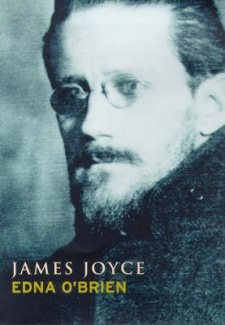
"James Joyce" by Edna O'Brien | Review  BiographyHypothesis: A genius is a person whose books we want to read and whose ass we want to kick.

That certain describes the James Joyce presented in Edna O’Brien’s brief, readable biography of the great Irish writer. O’Brien’s tone in James Joyce is more novelist than academic and that combined with the occasional Joycean flourish, the lack of footnotes, and the appalling bad behavior made me wonder, “Is this all true?”

In O’Brien’s biography, we see Joyce treating his family with contempt and his friends as servants and ATMs. Joyce’s marriage to Nora Barnacle seems to have been based primarily on erotic passion (their sex letters are monuments to skeezy) although they remained together for life and O’Brien does not tell of infidelities by either James or Nora.

O’Brien reports no evidence of Joyce having a relationship with his son Giorgio. Joyce is distraught over his daughter Lucia’s madness, although his insistence that her behavior was a sign of genius rather than insanity smacks of self-aggrandizement as much as denial. Joyce is devastated by the death of the father he ignored while the man was living. As far as we can tell from O’Brien, Joyce cared for no one else.

Through it all, Joyce carousels. And works himself to exhaustion and blindness creating the most significant works of English literature written in the 20th century. The books are worth the price of all this misery. But I’m glad I didn’t have to pay it.

Read Full Post »

My Antonia by Willa Cather Willa Cather’s My Antonia is one of those novels I saw as having faded into a genteel but deserved obscurity. Anything that struck readers in 1918 as innovative or shocking had long since become quaint, I believed, leaving little to command the attention of modern men and women.

So I was delighted by how good I found My Antonia. Much of my delight came from Cather’s quietly exquisite prose. Her descriptions of the natural world are masterful, although she does a pretty good job of making her characters and situations feel real and convincing, too.

Here is a sample from the narrator’s first impression of the prairie:

As I looked about me I felt that the grass was the country, as the water is the sea. The red of the grass made all the great prairie the colour of wine-stains, or of certain seaweeds when they are first washed up. And there was so much motion in it; the whole country seemed, somehow, to be running.

My Antonia’s episodic structure – the novel is a collage of stories – has a pleasantly proto-modernist flavor (without the tricky syntax). The novel made me wonder about its relationship to Cather’s own life. And in the end, it delivered a grand thematic and emotional wallop.

I warmly recommend it. Here are some details.

My Antonia – The Obligatory Plot Summary

Cather’s novel takes the form of a memoir written by James Quayle Burden, a childhood friend of Antonia’s four years her junior, who arrives in the Nebraska town of Black Hawk on the same day she does. Jim is an orphan from Virginia who has traveled west to be raised by his grandparents. Antonia has immigrated with her family to America from Bohemia (the present day Czech Republic).

For many years, their lives run parallel to each other. First, they are neighbors on country farms situated near each other on a prairie just beginning to be brought under cultivation. Later, they are neighbors in Black Hawk where Jim has moved with his grandparents and Antonia has been hired as a cook and housekeeper. They are separated when Jim leaves Black Hawk to attend university and then settles down to a job and a marriage in New York City. Twenty years later, at the end of the novel, Jim finally returns to Nebraska and seeks out Antonia.

Despite the title, My Antonia is primarily Jim’s story and Antonia and her family can disappear for pages and even chapters at a stretch. The novel finds the time to tell the stories of the hired men who work for Jim’s grandparents; to talk about other immigrant families besides Antonia’s, especially other young farm girls who are hired to work for households in Black Hawk; to describe the residents and observe the culture of the town; and to relate the details of Jim’s love affair with one of Antonia’s friends, Lena Lingard.

Is Jim Burden Willa Cather?

In general, I think it is a bad idea to make inferences about a writer’s life from her novels.

One of the great advantages of fiction is that it allows you to tell readers everything and nothing about yourself – to be wholly candid and entirely private at the same time. And Willa Cather seems to have valued her privacy, considering how many of her private letters and papers she destroyed before her death.

Nevertheless, Willa does make it hard to resist the temptation to equate her with Jim Burden in My Antonia, even though Cather almost certainly intended us to see her as the “I” that appears in the introduction.

Both Burden and Cather moved from Virginia to Nebraska when they were ten years old. Both attended the University of Nebraska (although Jim ultimately earns his degrees from Harvard). Both settled in New York City although their lives are possessed my memories of the prairie. Both write their books, the same book as it happens, in their forties.

Both also admire the same women: the strong, self-supporting, and independent immigrant hired girls who – with the exception of Antonia – never marry or have children.

This brings up the inevitable question of whether Cather was a lesbian and transposed herself into Jim’s character in order to write inconspicuously.

I’m an agnostic on the “Was Willa Cather a lesbian?” question (if that is actually the right question). That she sometimes dressed as a man and used the nickname “William” at university, and that she lived for nearly 40 years with the editor Edith Lewis, are generally known and rather indicative facts.

Whether Cather had sex with Edith or other women is, to the best of my knowledge, unknown and I believe it is equally unknown what Cather considered herself to be, sex or no sex. Cather’s opinion is the only valid one in the matter, of course, and she is beyond the means of telling.

Which leaves the questions of what My Antonia meant to Cather a tantalizing mystery which gives the novel, to me, some extra shimmers of meaning.

My Antonia – The Great America Novel?

This is the crown that Fitzgerald’s The Great Gatsby has worn for decades but I wonder if he didn’t steal it from Cather.

For all their differences, both The Great Gatsby and My Antonia are books profoundly occupied with the past and how happiness resides there rather than the present. They both locate the past in the Midwest and the present in New York City. They are both occupied with a woman from the past, Daisy Buchanan in The Great Gatsby and Antonia in Cather’s novel. And they both derive their greatest emotional power by evoking the natural world of the new continent before it came to be corrupted by men and society.

In Gatsby, it is Nick Carraway dreaming on the last page of the novel of the “fresh, green breast of the new world” the Dutch sailors first saw when they arrived in America, and concluding, “So we beat on, boats against the current, borne back ceaselessly into the past.”

In My Antonia, this fresh world still exists during Jim and Antonia’s childhood, although it slowly disappears as they age.

Indeed, the great thematic arch of My Antonia is the parallel motion of Jim growing from child to adult, and moving from the natural world to the city. Jim spends his childhood on farms in Virginia and then the great unsettled prairie. As an adolescent, he moves into a small country town. As a young man, he goes the University of Nebraska in Lincoln and then Harvard in Boston. As an adult, he settles, marries, and works in New York City.

There Jim finds a world of money and machines, work and relationships as unsatisfactory as Fitzgerald’s characters found it. The difference is that for Jim his old life isn’t utterly irretrievable.

In the last line of the novel he tells us, speaking of himself and Antonia, “Whatever we have missed, we possessed together the precious, the incommunicable past.”

Read Full Post »

There was no sex in Western literature until 1857.

This is an exaggeration and a simplification of course. (You are reading this on the internet after all.) But not by as much as you might think. Sex does play a role in literature before 1857, but it is very seldom a straight-forward one. Between…

Beowulf (ca 800 to 1,100 CE) and Leaves of Grass (1856)

… there is very little direct examination of sexual desire. Sex is there, of course, but it is always contained within a related topic. Passion is one such topic, giving desire nobility and a certain amount of respectability with its parallels to spiritual ecstasy and religious transcendence.

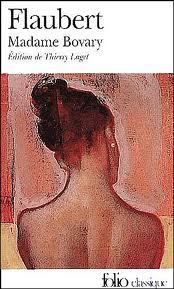
Madame Bovary - History of Sex in Western LiteratureTo conceive a great passion was certainly admirable. To give in to it was less so – although somewhat understandable – unless you happened to passionately repent afterwards, in which case you were back in the clear, and also had something new to do with all that animal energy.

Love was another one of these topics, a step down from passion in terms of intensity, but a step up in terms of stability, and was perfectly respectable.

This is not to say that passion and love are not valuable human experiences, or that they can’t exist along with desire, or all the literature dealing with either is false.

But the language of passion and love are also a means of not talking about sexual desire, or a means of excusing it, or most importantly a means of dismissing physical desire’s power, whether it’s tales of courtly love, or the story of Emma and Mr. Knightley, or Walt Whitman who with his great moving exuberance unites the body and soul together.

When sex does appear in Western literature before 1857, it is played for comedy through lower-class characters, such as Chaucer’s Wife of Bath or Henry Fielding’s Tom Jones or, much more explicitly, Cleland’s Fanny Hill.

There are more troublesome outliers to muddy the picture. (Did I mentioned you were reading this on the internet? Okay good.)

The Decameron comes to mind and the work of the Marquis de Sade. But let’s agree for the sake of my personal convenience that these are exceptions that prove the rule

Madame Bovary (1857)

Flaubert’s novel caused a scandal and it’s not hard to see why. In Madame Bovary, he both plainly describes sexual desire and attacks the language in which it had previously been discussed.

Flaubert’s language seems quite tame by today’s standards, but he left no doubt about what he meant. For example, during a meeting with a lover, Flaubert writes that “[Emma] tiptoed over on bare feet to check once again that the door was locked, and in one motion she shed all her clothes; — pale and silent and serious, she fell upon him, shivering.”

Flaubert is just as direct when comes to the romantic language of “passion”. Emma’s first lover, Rodolphe, deliberately and cynically uses that language, and plays the role of the passionate lover, to seduce Emma, and Emma willingly embraces the role, out of a desire for something other than the stifling, self-satisfied, and clueless adoration of her husband Charles.

She again embraces the role with her second lover, Leon, and embraces it more desperately the more she senses the intensity of their relationship fading, and the more she feels the consequences of her deceptions bearing down on her.

Flaubert may have been the first voice to speak plainly about sex and to decouple the physical act from the language of passion and love, but he was followed by a long silence. It seems that Western literature needed the massive social disruption caused by the First World War to make books like …

Ulysses (1922) and Lady Chatterley’s Lover (1928)

… possible. Joyce’s Ulysses is quite explicit about sex, but it wasn’t the perfect book to break the taboo, largely because it was so difficult for many readers to understand.

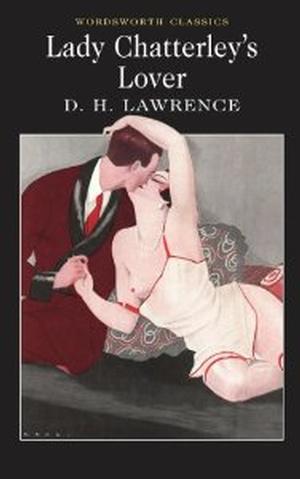
Lady Chatterley - History Sex Western LiteratureLady Chatterley’s Lover did a better job with its plain speaking, and caused a scandal. But instead of silence, these books were soon followed by others, such as Miller’s Tropic of Cancer (1934). Lady Chatterley and Tropic of Cancer were involved in obscenity trials as late as 1960, but these failed, and the subject of sex became ubiquitous in books by the end of the decade.

I don’t see this change as an unqualified success. A great deal of sex in books these days ranges from the merely gratuitous to the frankly pornographic, and is rendered with such an appalling, puzzling, frequently hilarious lack of skill that it can chase you right back to Jane Austen.

On the other hand, the fact of sexual desire, and the fact that desire demands satisfaction, are different matters. These need to be addressed in literature because, like in life, they don’t go away just because they’re ignored. And when desire and love are denied, between consenting adults not restrained by other promises, this denial blights the soul. We can put up with the occasional internet sensation trilogy to gain that.

Massey Content Related to A Brief History of Sex in Western Literature

My 100 word parody of 50 Shades of Grey

My 7 rules for writing sex scenes

My 100 word review of Madame Bovary

Read Full Post »

Gilead Marilynne Robinson What is the purpose of fiction? If it is to imaginatively engage its characters – and by so doing strengthen the reader’s ability to empathize with real people – then Marilynne Robinson’s 2005 Pulitzer Prize winning novel Gilead succeeds brilliantly.

The novel takes the form of a long letter written by John Ames, a Congregationalist minister living in a small Iowa town during the 1950s, to his young son.

Ames, who is in his mid-seventies and suffering from a fatal heart condition, wants to leave his child a record of his life and a way for the boy to remember him after he dies.

Gilead is filled with the aching beauty that the jacket copy of every other novel promises, but few in my experience actually deliver. Robinson voices Ames’ great and genuine love for his son, and his sorrow at leaving him so soon, with a simplicity and directness founded on total conviction. Robinson doesn’t seem to have created John Ames. She seems to have been angelically possessed by him.

Robinson brings equal beauty and conviction to Ames’ expressions of his love for the Iowa prairie and his life in Gilead, even during the long decades of loneliness between the death of his first wife and child in his youth, and the second family he begins as an old man.

For those who think that a little bit of aching beauty goes a long way, Gilead also serves up a heaping portion of plot like a hearty Midwestern meat loaf.

This plot includes the story of his second marriage to Lila, a woman half his age who appears one Sunday in Ames’ church for the service.

She returns every week and Ames falls ridiculously and helplessly in love with her – ridiculously (he thinks) because he is an old man and helplessly because he can see of no way to approach her consistent with his moral convictions. So his relief and gratitude are immense when Lila tells him one day, “You ought to marry me.” What the town and his church think of this marriage is an interesting silence in Gilead.

Another plotline in the novel are the stories of John Ames’ grandfather and father. Ames’ grandfather was a fiery preacher and abolitionist who believed slavery was so great an evil that it justified violent opposition, and who fought with John Brown and with the Union Army. Ames’ father was an ardent pacifist, and the conflict between the two men extends into John Ames own lifetime and forms part of his story.

Most prominently, however, is the story of John Ames (Jack) Boughton, John Ames’ god-son and a child of his best friend. Jack is a charming ne’er-do-well who returns to Gilead after a many years absence.

Jack torments Ames by reminding the preacher of his inability to love the man who carries his name, by making Ames’ fear that his wife and child will fall victim to Jack Boughton after his death, and by provoking his jealousy.

All these storylines are presented episodically by Robinson. So readers who enjoy novels which present conflicts, development them through rising action, and bring them to resolution – the “I can’t wait to find out what happens next” model – may find Gilead slow. I found it enthralling from beginning to end.

Some readers may also find John Ames’ sometimes lengthy discussions of Christian theology dull. These discussions are perfectly consistent with a bookish minister educated in the early 20th century who has a great deal of lonely time on his hands. I liked them but I have a semi-professional interest in theology.

Related Content to Gilead.

I think those readers who enjoyed Gilead for its “aching beauty” will like Annie Dillard’s Pilgrim at Tinker Creek. I also think they will enjoy Colette’s My Mother’s House, which I wrote about here. Finally, you might read my collection of poems about faith.

Read Full Post »

James Joyce' A Portrait of the Artist as a Young ManIs selfishness an obligation of genius? If so then Stephen Dedalus, the focus of James Joyce’s brilliant semi-autobiographical novel A Portrait of the Artist as a Young Man meets his responsibilities in full.

The book follows Stephen as he grows from a young child to a sin-and-salvation obsessed teenager to an ambitious university student preparing to leave his home, country, and religion, and forge his own soul as a free artist.

Portrait deserves its acclaim as one of the founding works of modernism. Joyce uses his famous stream of consciousness technique to convincingly render Stephen’s inner voice, which he interweaves with dialogue, descriptions, sermons, and diary entries. The story is built on thematically linked episodes, rather than conventional plot and conflict, and rewards the attention required from readers to follow it.

Joyce regards Stephen Dedalus as the model of what a writer should be (an early draft of the novel was called “Stephen Hero”) but it is his character’s spectacular self-concern that stands out as much as the spectacular potential of his talent.

Stephen Dedalus thinks about no one but himself. He is indifferent to the poverty of his parents and younger siblings, while carelessly neglecting the university classes they struggle to afford. He values his friends largely as sounding boards for his ideas. And he refuses his pious mother the comfort of attending a service for a religion in which he no longer believes, holding his fine scruples higher than her single request.

Perhaps great artists need to ruthlessly commit themselves solely to the creation of their art. Perhaps this is an obligation of genius. But it is not a pretty one.

Related Content on James Joyce

You’ll find my review of Finnegan’s Wake (actually totaling 100 words) as part of this post.

Here is an interesting article on Finnegan’s Wake by Michael Chabon. Aside from trying a little too hard to out-Joyce Joyce, I like Michael’s thoughts quite a bit.

Read Full Post »

Moby Dick by Herman MelvilleFew American novels put off the general reader like Herman Melville’s Moby Dick. And the general reader isn’t entirely wrong to be put off.

Moby Dick is a genuinely strange work of art. For a book published in 1851, it’s more modernist text than 19th-century story, and might actually qualify as the first existentialist novel, if you take the White Whale to be the embodiment of a meaningless and hostile universe. Moby Dick is dense and it is difficult.

But it’s not as dense or as difficult as its reputation. It’s a pretty good sea-faring yarn. And it is a FUNNY book, at least until Ahab stomps onto the deck of the Pequod and sucks all the humor out of Ishmael and Queequeg, and the voyage in general, with his doomed, megalomaniac pursuit of revenge.

Now, there is some heavy going in this Melville novel and the first-time reader trying to decide how to read Moby Dick might choose to conserve his or her resources by “skimming” selected chapters. Father Mapple is a famous character, but Chapter 8 (“The Pulpit”) and Chapter 9 (“The Sermon”) could deter anyone from reading further for fear of discovering much much more of the same.

The many expository chapters, in which Melville discourses at length on every possible topic related to whales and whaling, also pose a problem for those picking up the novel for the first time.

To skip these chapters entirely would be to abstain from many of Moby Dick’s pleasures, particularly since Ishmael’s jaunty comic voice adds an agreeable tone of parody to these chapters.

At the same, there are a lot of them, and Melville is not always brief. So new readers would do well to pick and choose among chapters as they make their way through the book. For example, Chapter 32 (“Cetology”) and Chapter 42 (“The Whiteness of the Whale”) in their concentration and length are prime candidates for reading at a later date.

Which is not to say you should never read them. One of the great advantages of Moby Dick is that first-timers will do little violence to their understanding of the book’s story if they don’t read it straight through. Many of the chapters can stand on their own, inviting you to dip into the book where and as the mood possesses you. It also allows you to assemble your understanding of Moby Dick piece by piece, as if it were a 500-page jigsaw puzzle, rather than make a grimly determined march from the first page through to the last.

Finally, a copy of Moby Dick that includes reference materials is a big help. The Norton Critical Edition of Moby Dick includes maps, a glossary of nautical terms, and explanations of whaling and whalecraft with illustrations, all of which make Herman Melville’s book easier and more enjoyable to read.

Read Full Post »

Crime and Punishment by Fyodor DostoyevskyWhen I picked up Crime and Punishment by Fyodor Dostoyevsky, I was expecting it to be dense, dull, and depressing – especially since the background materials I read stated that Dostoyevsky wrote Crime and Punishment as an explicit critic of certain radical theories that were current in 1860s Russia, including utilitarianism and rationalism.

It’s not a good sign when a novel has a thesis. This is usually an indication you are about to be treated to a bunch of cardboard characters clomping around mouthing platitudes, engaging in fake debates, and delivering essay-length monologues while sitting in a café smoking, humping each other, or bravely defying some oppressive bureaucrat or petty despot.

So I was pleased when I found Crime and Punishment to be a wilder, stranger, more flawed, more chaotic, more puzzling, and ultimately more engaging book than I expected.

Dostoyevsky, by all accounts, meant to deliver a lecture pretending to be a novel. He ended up creating a work of art. Here’s how (with a truck-load of spoilers in the discussion).

Crime and Punishment: A Black Comedy?

The first indication that I was following Dostoyevsky down his own particular rabbit hole, rather than sitting in his classroom dutifully taking notes, was that long passages of Crime and Punishment were both horrible and funny.

An early example is what happens after Raskolnikov, the handsome and arrogant law school drop-out who is the novel’s central character, famously murders an old pawnbroker and her sister. Raskolnikov falls into a fever that seems physical, emotional, and spiritual all at once.

But instead of taking us into Raskolnikov’s apparently tortured mind, Dostoyevsky focuses on his friends, who cheerfully encourage him to get better while chatting about mutual acquaintances or who view him as a fascinating case of morbid psychology or some undefined nervous complaint.

Another example is the character of Porfiry Petrovich, the detective assigned to solve the murders. Porfiry is short and stout, with a soft round face and a figure Dostoyevsky describes as “somewhat womanish” who laughs and titters through nearly every conversation he has.

Yet this comic-figure of a man is also Dostoyevsky’s figure of vengeance. Porfiry is convinced of Raskolnikov’s guilt early in the book, pursues him with relentless guile, and attempts to drive Raskolnikov to confess either to the police or in a suicide note when he concludes there isn’t enough evidence to arrest him.

My final example. After 500 pages of anguish and self-examination, Raskolnikov goes to the police station to confess. Here is the high dramatic moment. Here is the finale of the novel. What happens?

Raskolnikov encounters a pompous, idiot lieutenant who babbles on about nonsense so incessantly that Raskolnikov actually gives up and leaves. A few minutes later, Raskolnikov returns, tries again, and this time manages to get the lieutenant to shut up long enough to confess.

These are odd, distracting, irrelevant choices if you want to advance a narrow moral argument. But they are excellent ones if you want to explore the strangeness, complexity, unpredictability, and absurdity of life. Which is what artists do. And that is what Dostoyevsky did, I think, despite his intentions to the contrary.

Iago, Raskolnikov, Meursault: The Reasons for the Crime Are … What?

For a thesis book to examine whether it is moral to commit murder, it is important for the author to clearly establish the reasons the character committed murder before he can show why those reasons are wrong.

But here’s the problem. Dostoyevsky doesn’t. Instead, he gives us a Chinese menu of possible motives, none of which are particularly convincing even to Raskolnikov himself.

The best example of this is in Chapter IV of Part V when Raskolnikov confesses he murdered the two women to Sonya , the virtuous naïve Christian girl who loves Raskolnikov unconditionally and who also happens to be a prostitute. (I’m not making that up.)

Anyhow, first, Raskolnikov tells Sonya that he murdered the women because he wanted to be like Napoleon, who pursued his grand ambitions without regard for conventional morality. Then he tells Sonya he murdered for money, so he could finish his education and support his family. Then he tells Sonya he murdered the old woman because she was a “louse … a useless, loathsome, harmful creature.” Then he says the reasons he committed the murders are that he is “vain, envious, malicious, base, vindictive and … well, perhaps with a tendency to insanity.” Then he blames the murders on “sulkiness”. Then he serves up a Will to Power argument. Then he agrees with Sonya that the devil made him do it. Then he says he did it for himself. Then he goes over all these reasons all over again and concludes, I’m so unhappy!

As the basis for a thesis, this is a hot mess. As a portrait of humanity it is – well, some of you might think it a hot mess too – but I think it is brilliant. And a century ahead of its time.

It has become fashionable, based on the latest cognitive and behavioral science, to conclude human beings are deeply irrational creatures who use reason not to guide their actions, but too justify them after the fact. It is also an established principal, at least among the modernist writers, that the more closely you examine the human character, the more ambiguous and ungrounded in some final essence the human character seems to become.

I tend to think of this vision of humanity in terms of classic (or Newtonian) mechanics and quantum mechanics. In classical mechanics, matter at a certain size … typically visible to the unaided human eye … behaves in logical, predictable, and consistent fashions. But at the atomic and subatomic level, all hell breaks loose with matter doing seemingly impossible things, like being in two places at once, or being both “up” and “down”, or other weird stuff that gives the average person a headache just contemplating. And yet, the visible logical world is founded on the invisible chaotic one.

This seems to me to be a good description of Raskolnikov. He is a quantum character trying to exist in a classical world. And not succeeding particularly well. And upsetting Dostoyevsky’s program in the process.

Also, all this suggests to me that Raskolnikov committed the murders for nothing or because there was an emptiness at his center that made him so indifferent that no action he took, good or bad, finally had meaning. Which I think is the case with Shakespeare’s Iago and Camus’ Meursault, and so I’ve added Raskolnikov to that group.

Crime, Punishment. No Crime, Punishment. Crime, No Punishment. No Crime, No Punishment.

The final reason for thinking Crime and Punishment isn’t a thesis book focused on Raskolnikov’s murders, despite Dostoyevsky’s stated intentions, is the amount of extraneous, irrelevant, contradictory, and confounding characters and plots he includes.

This sounds like a criticism, but what it really means is that Dostoyevsky did not let his school-teacher impulses get in the way of his inspiration, which seems to want to explore the whole spectrum of crimes and punishments, with or without a causal relation between the two.

It starts with Raskolnikov himself, who despite having committed a pre-meditated murder and a impulsive one (Raskolnikov kills the old woman’s sister when she surprises him during the crime), gets all of 8 years in prison.

Now I am not familiar with standards of punishment in 19th century Russia, but this sounds a little light to my American but none the less opposed to the death penalty ears, and was a bit surprising to Raskolnikov himself.

There are also unpunished criminals in Crime and Punishment. For example, the character of Svidrigaïlov, a depraved landowner who is suspected of several murders and sexual assaults, gets away free from the law (although he does commit suicide in one of the novels most persuasive and harrowing chapters). There is also Luzhin, a sadistic bully who likes to prey on women he perceives to be helpless.

We also find punished innocents. Sonya becomes a prostitute in a desperate attempt to keep her family, especially her younger step-siblings, from starvation. These step-siblings themselves suffer from the drunkenness of their father and the angry despair, then madness, then death by consumption of their mother.

Finally, there are unpunished innocents such as Raskolnikov’s cheerful and loyal friend Razumikhin, who happily marries Raskolnikov’s sister, and the detective Porfiry, who succeeds in helping to drive Raskolnikov’s confession and serving the ends of justice.

Dostoyevsky renders many of these characters with a grotesque, Gogol-esque exuberance that also undermines the thesis aspects of the book. The fact of their existence, rather than what the characters mean or what “morals of the story” Dostoyevsky wants us to take away with us, seem the real point of the novel.

Which perhaps makes Dostoyevsky like Milton in Blake’s “Marriage of Heaven and Hell” when Blake says

The reason Milton wrote in fetters when he wrote of Angels & God, and at liberty when of Devils & Hell, is because he was a true Poet and of the Devils party without knowing it

But I think Dostoyevsky is more like the Oracle of The Matrix movies when she talks about a character called the Architect. She says the Architect’s role in the movie is to “balance the equation”. She tells Keanu Reeves her role is to “unbalance it”.

Fyodor set out to be the Architect. He winds up being the Oracle.

Read Full Post »
« Newer Posts - Older Posts »