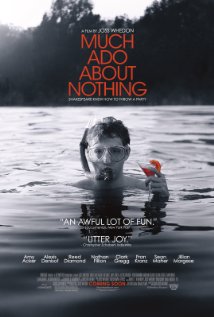
In his new film adaptation of Shakespeare’s Much Ado About Nothing, director Joss Whedon has made a movie which is both funny and affecting – but funnily enough, more affecting than funny.
A great deal of Whedon’s success comes from solid performances by most of the cast and his choice to have his actors read their lines “naturalistically” – i.e. as normal conversation rather than as the impossibly articulate prose or the poetry it actually is.
The result is that the dramatic elements in Much Ado About Nothing, which I usually find thin and forced, work pretty well in this movie.
Hero and Claudio, the young lovers who can easily come across as pretty blanks, are brought to moderately complex life and real pain by Jillian Morgese and Fran Kranz, enough that I was wiping away a tear or two during Act V and hoping my wife in the next seat didn’t notice.
Clark Gregg as Leonato and especially Reed Diamond as Don Pedro both express the easy humor and hard anger of men used to power. Sean Maher finds a convincing seam of quiet malevolence in the two-dimensional villain Don John. And let me give an enthusiastic shout out to the comic constable Dogberry, who is underplayed by Nathan Fillion to a perfection of sublime silliness.
The major problem in this Much Ado About Nothing comes exactly where the play is – and where I expected Whedon to be – strongest: the brilliant and beloved sparring between Beatrice and Benedick in the first two acts.
This is a result, in part, of the naturalistic line readings that I thought served the weaker elements of the text well. The difficulty is that these passages are performances by Beatrice and Benedict, for the people around them, for each other, and for themselves. Turn them into conversation and you leave the audience crying, “Where’s the sparkle? Where’s the snap?”
Some of the fault lies with the actors, however. Neither Amy Acker as Beatrice or Alexis Denisof as Benedick seem to have clicked with their roles in the early parts of Much Ado About Nothing. The good news is that Acker plays Beatrice transformed by love very well, and is strong during the rest of the film.
On the other hand, Denisof never does much better than muddle through. The idea behind his Benedick appears to be that the character has been made awkward and embarrassed by love. But I could never suppress the impression that it was Denisof playing Benedick awkwardly rather than playing Benedick as awkward.
Don’t let this dissuade you from seeing the movie, however. Overall, I think you’ll be pleased. Whedon filmed this Much Ado About Nothing in a luminous black and white that pleases the eyes. His smooth jazz soundtrack is somewhere between innocuous and fine. And the de rigueur celebration scene and kiss right before the credits will leave you smiling as you exit the theater.
C.S. Lewis’ The Screwtape Letters – which consists of epistolary advice from the senior demon Screwtape to a junior demon Wormwood on the damnation of a human soul – is frequently described as a satire. But I don’t see any satire at all in The Screwtape Letters.
What I do see is a brilliant and generous exploration of human nature, a miniature portrait of Britain as the Phoney War comes to an end, and some of the most perfect prose you are going to find in English.
Satire uses exaggeration and intensification to criticize a person, idea, institution, or social convention that has power by making it look ridiculous. Satirizing demons is difficult because if you don’t believe in them as metaphysical beings (ie, you don’t believe they exist), then there is nothing to criticize.
If you do believe in devils, then you are likely to regard Lewis’ Screwtape as utterly convincing rather than ridiculous. Metaphysical evil is self-exaggerating and self-intensifying after all. And Screwtape’s bureaucracy and banality, twenty years before Arendt’s Eichmann in Jerusalem, offers readers who reached the age reason before the close of the twentieth century, a highly plausible picture of hell.
But The Screwtape Letters offers much more than an original demonic voice, satirized or not. Its greatest achievement – and I think, real purpose – is its comprehensive depiction of the human character in all aspects.
Screwtape is, of course, interested in exploiting human vice, vanity, and pettiness to achieve his goals, so these get full treatment. But he is also interested in neutralizing human virtues because these are weapons that counter the work of demons.
The emphasis is on religion and the work of religious devotion throughout, but Lewis’ insights are so universal they are likely to please readers of any religion or no religion at all – except for those diehards who are dissatisfied with any book that does not exactly confirm their particular convictions; and for such folks I recommend reading very few books or none at all. At best, you’ll be wasting ninety-five percent of your time. Why bother?
Screwtape considers the sources of domestic harmony and disharmony; sexuality, love, and married life; the foibles of social interactions in all its forms; the hybrid animal and spiritual nature of humans (under the theory of “undulation”); the character of Christianity and other trends of thought; the temptations of the world; and more.
Perhaps my favorite letter is on the nature of human laughter and joy because many good things in life, many pleasures, are gifts Lewis believes God wants us to embrace. In a few pages, Lewis explores, “Joy, Fun, the Joke Proper, and Flippancy” with an economy and incisiveness that should provoke jealousy in any writer except that admiration overwhelms envy.
Lewis’ Screwtape associates Joy with Music and says “something like it occurs in Heaven – a meaningless acceleration in the rhythm of celestial experience” which he as a demon detests. Joy and laughter are “a direct insult to the realism, dignity, and austerity of Hell” according to Screwtape.
Toward the end of the book, World War II, which has always been hovering at the edges of The Screwtape Letters, comes to the forefront as the German bombing campaign of Britain begins and the unnamed young man who is the focus of Wormwood’s intentions joins the war effort. Here it was impossible for me to think Lewis’ wasn’t speaking from his own experiences fighting in the First World War, and he does a masterful job making us feel the quality of that time in England.
Finally, there is Lewis’ writing. I could praise it, but I will simply give you an example of Screwtape at his most caustic, and let you decide. Screwtape discovers that Wormwood has allowed his young man to fall in love with a Christian girl, and this is Screwtape’s reaction:
I have looked up this girl’s dossier and am horrified at what I find. Not only a Christian but such a Christian – a vile, sneaking, simpering, demure, monosyllabic, mouse-like, watery, insignificant, virginal, bread-and-butter miss. The little brute. She makes me vomit. She stinks and scalds through the very pages of the dossier. It drives me mad, the way the world has worsened. We’d have had her to the arena in the old days. That’s what her sort is made for. Not that she’d do much good there, either. A two-faced little cheat (I know the sort) who looks as if she’d faint at the sight of blood and then dies with a smile. A cheat every way. Looks as if butter wouldn’t melt in her mouth and yet has a satirical wit. The sort of creature who’d find ME funny!
Which are Nabokov’s best books? And which should you consider reading? Any ranking is subjective but the reasons behind a “best of” rank can help you decide. So here is my personal list of the eight “best” Nabokov books, which include six novels, one memoir, and one collection of interviews. Also see the Nabokov FAQs below these reviews.
1. Lolita (1955)
Lolita is Nabokov’s best novel because it is the book that best synthesizes all his major characteristics as a writer:
(1) A love of language
(2) Delight in word play, patterns, puzzles, and games
(3) A highly intelligent, narcissistic-sociopath narrator
(4) A resilient victim who is the center of Nabokov’s sympathy
(5) A preoccupation with perception, consciousness, time, and memory
(6) A belief in fate and the existence of a great design behind what seem to be the random and irrelevant facts of ordinary life
(7) The conviction that art is a refuge from the assault of death
In addition, Lolita is the disturbing story of a successful child rapist. It features brilliant miniature portraits of postwar America – almost Vermeer-like in their lucidity – as well as a phantasmagorical climax that takes place in a fairytale nightmare land. Lolita is funny, harrowing, heartbreaking, and transcendent. It caused a scandal, was a critical and then a popular success, and made Nabokov a mint of money. As art and cultural phenomenon, Lolita excels
2. Speak, Memory (1966)
Not a novel, but a memoir of Nabokov’s life from childhood to the moment he escapes France weeks before the 1940 German invasion – Speak, Memory is a classic of autobiography that leaves most of Nabokov’s story untold.
Instead, it focuses on Nabokov’s most cherished memories of his family and friends; his youth in Russia and his young adulthood in Western European exile; on the natural world and butterfly hunting; on a recital of the Nabokov family’s august history and their liberal politics; on stories of Vladimir’s education and tutors and governesses, including the famous “Mademoiselle O”; on poetry; and more.
Through it all permeates the great Nabokovian pre-occupation and conviction that there is more than darkness before the beginning and after the end of life; that our living persists and this persistence is wonderful; and that the people we love won’t disappear into nothingness after death. You find this theme frequently in Nabokov, but its purest distillation is here in this great book.
3. Pnin (1957)
Professor Timofey Pnin is Nabokov’s most deeply comic and deeply human character, and his response to the incessant comic cruelty Cervantes inflicts on Don Quixote. The structure of the novel is slight and episodic (Pnin began life as serial pieces published in The New Yorker) and lacks the dazzling pyrotechnics of books like Lolita, Pale Fire, and Ada. What Pnin offers instead is hilarity, enormous tenderness for the agonies of an ordinary life, and the danger of laughing at rather than laughing with Timofey; which is complicated by the fact that the arrogant narrator of this novel is not a Humbert Humbert or a Charles Kinbote, but Vladimir Nabokov himself.
4. Pale Fire (1962)
In terms of structure, technique, and pure virtuosity – and as a landmark of post-modern fiction – Pale Fire is Nabokov’s masterpiece. But it is a cold masterpiece.
The novel is constructed from a 999-line poem in rhyming couplets composed by one of the book’s characters (the Robert-Frost-like John Shade), with a forward, commentary, and index written by another (the extravagantly delusional Charles Kinbote).
The major conceit of Pale Fire is that Kinbote’s commentary has nothing to do with Shade’s poem, which creates a WTF experience for the unwarned first-time reader rivaled in English-language novels of the 20th century only by the “Benny” section of Faulkner’s The Sound and The Fury.
Nabokov’s prose in Pale Fire is brilliant; there is no better example of “the novel as chess problem” in his work; and Charles Kinbote is the craziest if not the most dangerous of Nabokov’s narrators (although it is difficult to tell what is “real” and what is imagination in his novels).
However, the human tenderness in Pale Fire – frequently buried in Nabokov’s major works – is particularly difficult to find here. It exists in Shade’s poem, which tells the story of his unhappy daughter’s suicide, and the long grief of Shade and his wife over their loss. But this is overwhelmed by Kinbote’s monumental self-absorption and the intricate innovation of Nabokov’s design. Nabokov’s supreme novel for the mind.
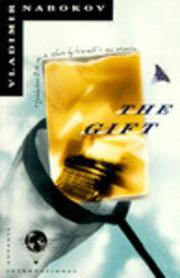
5. The Gift (1937)
The last and best of the novels Nabokov wrote in Russian, The Gift is a portrait of a young Russian writer, Fyodor Konstantinovich Godunov-Cherdyntsev, finding his way as an artist and falling in love with the woman who would become his wife.
Nabokov transforms this commonplace premise into a novel which is dense with detail, filled with examples of Godunov-Cherdyntsev’s writing, and convinced that fate is working secretly to assure the young writer’s happiness.
Nabokov’s powers of observation and description come to the forefront in The Gift, particularly since the novel, like many lives, is short on plot. This will please fans of modernism but there are metafictional touches as well.
The novel features a 90-page chapter entirely devoted to a book by Fyodor called The Life of Chernyshevski as well as a generous sample of hostile reviews of it. Most especially, at the end, you see Fyodor coming up with the idea to write a book that will become The Gift itself.
6. Ada (1969)
Ada is Nabokov’s Finnegan’s Wake. Meaning that you can see Ada as either the summation of Nabokov’s artistic vision which pushes to their limits his genius as an author, the form of the novel, and the abilities of the audience. Or you can see Ada as a deeply self-indulgent, over-intricate and deliberately obscure, reader-hostile mess.
I’m inclined to the former view, although I think Ada is a good example of the axiom that more is not always better, and even Nabokov fans will need to endure a fair amount of confusion, re-read the novel several times, or rely on expert help (such as Brian Boyd’s Nabokov’s Ada or the chapters in his biography of Vladimir).
Ada is occupied with the 80+ year love affair between Van and Ada Veen who are, as it turns out, brother and sister and which takes place on a parallel / alternative Earth sometimes called Anti Terra and sometimes Demonia. All seven of the Nabokov qualities are in evidence, plus a fair amount of literary parody as well as a few science fiction touches and other assorted material that will keep readers so inclined to puzzle out Ada happily at work. Matthew Hodgart’s 1969 review of “Ada” gets it right and is a hoot to read too.
7. Bend Sinister (1947)
Nabokov always insisted he was indifferent to politics, but Bend Sinister suggests he wasn’t indifferent to the cruelty governments inflict on individuals.
The novel takes place in the nightmare city of Padukgrad, run by the dictator Paduk and his “Party of the Average Man”. Paduk wants Adam Krug, a renowned philosopher, to give a speech in support of his government. When Krug refuses, Paduk threatens his son, and the bungling brutality of Paduk’s thugs leads to tragedy.
In Bend Sinister, Nabokov focuses on Adam Krug’s love for his son and his cheerful contempt for the dictator Paduk, a childhood acquaintance. Although the novel takes place in a fictitious country, and feels like other Nabokovian worlds, Bend Sinister is an accurate portrait of the dynamics of the total state. What is fantasy, and what gives the novel its final punch, is when Nabokov reaches into the novel and mercifully saves a character from the suffering that state inflicts. (For a longer discussion of Nabokov and totalitarianism, see my post Tyrants Destroyed: Politics in the Novels of Vladimir Nabokov.)
8. Strong Opinions (1973)
Readers of this collection of interviews, edited to the last comma by Nabokov himself, could be forgiven for concluding Vladimir was even more arrogant and imperious than his reputation.
Nabokov does spank the hell out of just about everyone in Strong Opinions: Freud; a long list of “second rate” writers including Balzac, Dostoevski, Lawrence, Camus, Sartre, and Faulkner; consumers of “poshlost” or cheap, vulgar sometimes popular and sometimes exalted culture; Westerners duped by Soviet propaganda; members of any literary, social, or political group; fans of “general ideas” and “everyday reality” and “social interest” and “moral messages” in novels; Edmund Wilson and his grasp of Russian. The spanking goes on.
Nabokov does condemn cruelty and brutality in all its forms. He expresses a great sunny and personal happiness. And he provides useful facts, such as the pronunciation of his last name (see my note below). As complete a portrait of the public Nabokov as Speak Memory is a portrait of the private.
Frequently Asked Questions about Vladimir Nabokov
What kinds of books did Nabokov write?
Nabokov wrote novels, poems, short stories, plays, and works of literary criticism in English and Russian. His novels in Russian include Mary (1926). King, Queen, Knave (1928). The Luzhin Defense or The Defense (1930). The Eye (1930). Glory (1932). Camera Obscura (1933). Laughter in the Dark (1938). Despair (1934). Invitation to a Beheading (1936). The Gift (1938). His novels in English include The Real Life of Sebastian Knight (1941). Bend Sinister (1947). Lolita (1955) Pnin (1957) Pale Fire (1962) Ada or Ardor: A Family Chronicle (1969) Transparent Things (1972) Look at the Harlequins! (1974) The Original of Laura (fragment, 2009).
Nabokov’s wife Véra was his inspiration, first reader, business manager, and much more. All his novels were dedicated to her. Nabokov’s and Véra’s only child, Dmitri Vladimirovich Nabokov, helped translate many of his father’s books and oversaw his literary estate after his mother died in 1991. Dmitri had a career as a professional opera singer. For a few years in the 1960s, he raced cars professionally as well.
Did Nabokov study butterflies?
Nabokov was also famous for both his love of butterflies and his scientific study of them. Since Nabokov was a self-taught zoologist, most of the scientific community considered him a dilettante. As it turns out, one of Nabokov’s biggest theories about butterflies was correct.
Was Nabokov a Russian author or an American author?
This question is a perennial source of disagreement. Those who wish to go spelunking in Plato’s cave and come up with elaborate theories, aesthetic or otherwise, about the essence of the words “Russian” and “American” are free to do so. And doubtless you will too. For my part, I think the right way to answer the question is to ask Nabokov. And his answer goes like this. Nabokov is an American author because Nabokov chose to become an American citizen.
Nabokov was born in Russia, fled the revolution in 1917, and never returned. He went to university in England but did not become an English citizen. He lived in Germany but fled to France when Hitler rose to power. (Véra was a Jewish.) He fled France ahead of the German invasion in 1940. Nabokov lived in America for twenty years and became a citizen. In the early 1960s, he and Véra moved to Switzerland to be near Dmitri. Yet Nabokov always maintained his US citizenship, paying a great deal of American taxes for the privilege as he liked to point out. The Paris Review asked Nabokov in 1967 “Do you consider yourself an American?” This is how he answered:
Yes, I do. I am as American as April in Arizona…. I feel a suffusion of warm, lighthearted pride when I show my green USA passport at European frontiers. Crude criticism of American affairs offends and distresses me. In home politics, I am strongly anti-segregationist. In foreign affairs, I am definitely on the government’s side. And when in doubt, I always follow the simple method of choosing that line of conduct which may be the most displeasing to the Reds and the Russells.
I might also say there is something quintessentially American about Pnin and Lolita and Ada and Van Veen, but saying that I realize I’ve fallen back into Plato’s cave.
Those inclined toward reasoned compromise might gently suggest Nabokov is a “Russian-American” author but neither reason nor compromise exists these days so y’all gonna have to pick a tribe.
How do you pronounce Vladimir Nabokov’s name?
How to pronounce Nabokov’s name is another source of perennial disagreement. This is what Nabokov himself said in a 1965 interview with TV-13 in New York and even he doesn’t firmly answer the question:
As to pronunciation, Frenchmen of course say Nabokoff, with the accent on the last syllable. Englishmen say Nabokov, accent on the first, and Italians say Nabokov, accent in the middle, as Russians also do. Na-bo-kov. A heavy open “o” as in “Knickerbocker”. My New England ear is not offended by the long elegant middle “o” of Nabokov as delivered in American academies. The awful “Na-bah-kov” is a despicable gutterism. Well, you can make your choice now. Incidentally, the first name is pronounced Vladeemer — rhyming with “redeemer.”
Have movies been made of Lolita?
The most famous Nabokov movies are the two Lolita films: the 1962 version directed by Stanley Kubrick (Nabokov wrote the screenplay) and the 1997 version directed by Adrian Lyne. Lyne’s film is not a success aside from the opening credit sequence, featuring music by Ennio Morricone, which achieves a beauty and heartbreak the rest of the film conspicuously lacks.
Was Humbert Humbert a rapist?
Humbert Humbert is a serial rapist who monstrously abuses Lolita. (The beauty of the story is all on Humbert’s side. The real heartbreak belongs to Lolita alone even if you believe Humbert’s remorse over his treatment of Lolita is genuine.)
You could argue that Nabokov also fails to deal with Humbert as a serial rapist and monstrous abuser and to the extent that Lolita’s experience is all but obliterated from the novel, you are right. I can only say that the novel emphasizes those qualities which made it possible for Humbert to succeed as a rapist. His good looks and good manners and good education. His charm and most of all his dazzling narcissism and his titanic self-absorption. That Humbert abused Lolita because he failed to see her, and failed to see her because he could only see himself, is precisely the point in my reading.
Now, Nabokov himself is having none of this and Lionel Trilling is having much worse. At least in the filmed interview below.
Interview Videos: Here are the two parts of an interview with Nabokov about Lolita.
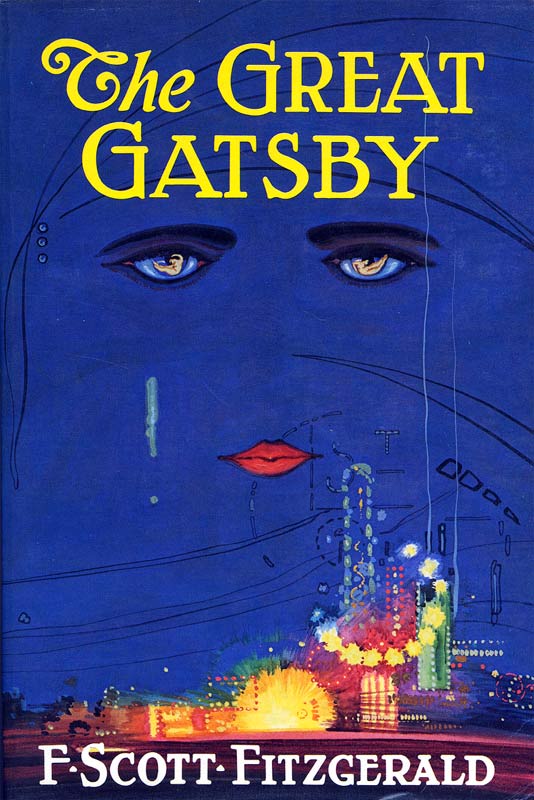
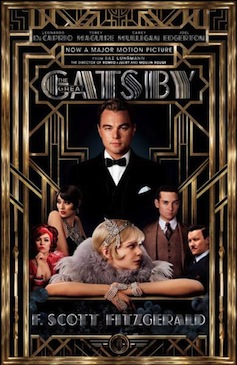
Julie Bosman published an interesting article on the front page of the The New York Times yesterday about competing cover designs for two paperback editions of The Great Gatsby. (The article is here.) The first is a re-issue of the classic Gatsby cover familiar to readers old enough to have read Fitzgerald’s masterpiece in high school or college. The second is the tie-in edition for the movie starring Leonardo DiCaprio and directed by that genius of brilliant excess — or hawker of wretched excess, take your pick — Baz Luhrmann.
Much of the article describes the different markets at which the two cover designs are targeted, and different sales strategies behind each. Readers already familiar with the novel are likely to choose the classic design, while readers just discovering the book are more likely to be attracted by the movie version.
Behind one of these strategies, however, are certain attitudes toward literature which I find — well, let me be gentle in my expressions here — contemptible. Allow me to explain:
How does the cover design of The Great Gatsby change the novel? (Hint: It doesn’t.)
Assuming that texts in today’s competing versions of The Great Gatsby are identical, how do the differing cover designs affect the experience of reading the novel?
The answer is they don’t. Just like reading Gatsby on a tablet rather than on paper doesn’t change the experience, as long as you think what is essential about a novel is reading the text. Is engaging the words on the page. Is entering into a conversation with the author as you read the book.
Now, the cover design can influence your expectations of a novel you haven’t read. And if those expectations are different than your reading experience, you may come to a different conclusion about the book than you might have otherwise. But all sorts of things influence our expectations of a book. Its status in the canon. The opinions of reviewers and friends. Advertising. Our mood and experiences. Our age.
But once you’ve read a book, how does anything other than having read it affect your expectations on re-reading it? Especially a novel like The Great Gatsby, which a lot of people have read. Or put another way…
If the cover design of The Great Gatsby doesn’t matter, why does anyone care?
Because people do care. Or at least we know for certain that one SoHo bookseller quoted in the article cares, because he says so. “It’s just God-awful,” he says, referring to the movie tie-in version. (I agree, by the way. It is pretty bad.)
But it doesn’t sound like this bookseller objects to the fact the cover design is ugly. Allow me to quote the article.
As to whether the new, DiCaprio-ed edition of “Gatsby” would be socially acceptable to carry around in public, [I’ve withheld the name, you can find it in the article] offered a firm no. “I think it would bring shame,” he said, “to anyone trying to read that book on the subway.”
Shame. Really. Why? Is it because the important thing about The Great Gatsby is not reading The Great Gatsby but being seen reading The Great Gatsby — especially being seen reading an edition of The Great Gatsby which signifies that you aren’t some hick coming late to the art party?
I realize I’m speculating aggressively here, with a certain amount of snark, but it’s hard to think what else our bookseller friend might have meant.
Also, while I’m at it, why the hell would you care what strangers in a city of 8.3 million people think of you? Are you likely to ever see them again? What’s the point of trying to impress people you don’t know?
Also, while I’m at it, shouldn’t we be happy if a person decides to read The Great Gatsby because the movie-cover persuaded him to pick it up? Shouldn’t we hope more people will read the books we like? I would think the answer to these questions is “yes”.
Unless of course the point of great novels is not to read them or share them, but to use these books to create an exclusive club that allows us to feel special and look down on everyone else.
Allow me to be blunt. If I haven’t been already. People who use art to bolster their social status or personal vanity are philistines. They don’t care about art. For them, it’s just another accessory to flash, like a fancy watch or a cocktail made with a certain brand of liquor.
And people who use art to exclude or denigrate others are the mortal enemies of art; enemies because the purpose of art is to connect and communicate, to inspire and delight, to comfort and challenge, to upset and exhaust, but always to leave us with a deeper experience of the life and consciousness and creation we share.
There is no connecting in an exclusive club, just arrogance and self-congratulation and rigid insularity and pettiness. These are pretty contemptible qualities.
I think I’ll pass on the opportunity to join and go get the new ugly Gatsby instead. I hear it’s available at Walmart.
Somewhat Related Content
Here’s a post on the aura of art that got started by a discussion in the comment section below.
In The New York Times this week, Scott Turow published an op-ed on publishing and eBooks titled “The Slow Death of the American Author”.
Following my habit, I won’t summarize the piece (since you can read Turow’s thoughts here). But I will throw out a few more-or-less random notes. Here we go.
Publishers Put the Screws to Authors on eBook Royalties
Turow says in the piece that publishers limit “e-book royalties to 25 percent of net receipts. That is roughly half of a traditional hardcover royalty.”
My first reaction to this is “huh?” because it sounds like Turow is saying that authors often get royalties of 50 percent of net receipts on hard covers. Unless publishers subtract their costs from this net before calculating the royalty, or unless Turow means the actual dollars paid are roughly double, this sounds very high and totally sweet.
Now, I have to admit I haven’t seen many book contracts in a while, and none of them for general fiction. So I’d be happy for information from someone with current experience in the industry. Also, if any publisher would like to provide a sample contract – perhaps with my name on it? – that would be okay-dokay too.
Anyhow, as for the complaint that publishers put the screws to authors, all I can say is, “What else is new? It’s a business. The point is to buy low, sell high, and sleep on a pile of money.” At least publishers are willing to pay authors something, even if the word “pittance” is germane. As opposed to these folks.
Pirating of E-Books Are a Threat to E-Books
This is a different problem and one about which I can’t be as flip. Many eBooks authors are finding the best way to combat getting screwed (or ignored) by publishers is to sell directly to the reader.
As you may know from my other posts, I am quite keen on this model, although I don’t think it is the utopian revolution described by some of its more enthusiastic boosters.
However, if e-Book piracy becomes as endemic as other forms of media piracy, then the model breaks down. And leads to this question: What reason will writers have to create good work?
Writers Should Write for the Love of Writing
Yeah, that sounds nice, and to a large – but not absolute – degree, it’s true. All good writing starts with enthusiasm and love, I agree.
But that doesn’t mean the only reward for writers should be personal satisfaction; and the folks who claim otherwise are either individuals eager to read books for free or companies that have business models which substantially depend on the enormous amount of free content on the web. (A big piece of the value electronic device manufacturers and internet service providers offer to their customers is access to free content. Pirate sites monetize their piracy by selling advertising, much of it through our giant friend on the internet, Google.)
Also, to paraphrase Turow, and to borrow from King Lear’s advice to Cordelia, writers who get nothing for their writing will eventually write … nothing. Or more accurately, writers will write less, and the quality of their writing will decline, if they can’t get paid for their work.
Those at most risk are the mid-list, middle-brow authors. Successful genre writers are likely to always make enough money to keep writing about vampires or serial killers, particularly it they can sell rights to movie or television producers. Writers with real artistic talent will find a perch in a college or university that is happy to pay them hard cash for the prestige of their name and a light teaching load.
Everyone else? I hope they make a beautiful corpse.
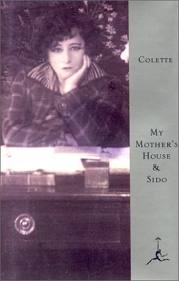
In My Mother’s House, the French author Colette has pulled off one of the most difficult tricks in literature: she’s written a compelling memoir without having a compelling story to tell.
Colette offers readers no major events in My Mother’s House – no plot, no drama, and very little conflict. Instead, she presents a kaleidoscope of memories about her family, pets, neighbors, and the French village in which they lived.
Occasionally, she will relate an important family story. For example, Colette tells how her older sister abandons their family after her marriage and leaves their mother to stand in helpless agony outside of the house in which her estranged daughter has gone into labor with her first child.
But for the most part, Colette fills the book with incidental events and small details, such as how her father offered to teach a neighborhood woman the meaning of love for “six pence and a packet of tobacco” and how her mother intentionally distracted the local priest during his sermon “by swing[ing] her watch ostentatiously at the end of its chain”.
What makes the book more than a collection of brilliantly realized sketches, however, is its organization around the themes of love and death. My Mother’s House is infused with the knowledge that everything Colette loved from her childhood – her mother, her father, her brother, the beauty of her mother’s garden – have passed away.
In the chapter titled “Laughter,” Colette’s mother warns her husband not to try to die before her. Instead, Colette writes…
He did try, and succeeded at the first attempt. He died in his seventy-fourth year, holding the hands of his beloved, and fixing on her weeping eyes a gaze that gradually lost its colour, turned milky blue, and faded like a sky veiled in mist.
Colette’s mother follows her husband into death and Colette experiences other losses as well. She tells how the beauty of nature has ceased to move her the way it moved her as a child, and Colette describes how her own daughter, at the age of nine, will soon lose her sense of childhood wonder.
My Mother’s House gains much of its power from the force, clarity, and simplicity of Colette’s writing, which reads like the work of a master of English prose even though its translated from the French. Colette’s book also gains power from the passion that lies beneath her descriptions. Literature can be a furious bulwark against death, in which the writer refuses to accept that all she loves best in life – her mother, her family, the richness of her consciousness – will disappear.
In My Mother’s House, Colette has ensured they won’t. They remain vibrantly alive in its pages, which is perhaps the greatest accomplishment any writer can hope to achieve.
Notes on the Author. Sidonie Gabrielle Colette, one of France’s most respected writers, was born in Burgundy in 1873 and died in Paris in 1954. She wrote dozens of books, including the novels Cheri and Gigi; was elected to the Academie Goncourt; and was the second woman to become a Grand Officer of the Legion of Honor.
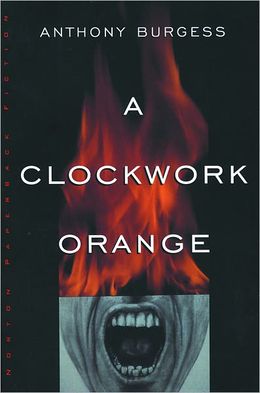
Anthony Burgess’ A Clockwork Orange succeeds purely on the strength of its narrator’s voice – but what a voice!
The novel’s story is told by 15-year-old Alex who lives in a vaguely dystopian, vaguely futuristic country that seems to be Britain. Alex can check off every item under the DSM definition of sociopath. He bullies his parents and friends. He brutally assaults people at random. He gang-rapes a woman, rapes two young girls, and kills an old woman while trying to burglar her house. Alex regards this as all good youthful fun. When confronted by authorities, he knows how to pantomime innocence or remorse. When punished, he laments that no one cares or feels sorry for poor Alex.
All this promises to make Alex pretty ugly company, but sociopaths are often noted for their charm and wit, and Alex has these in aplenty – not to mention exuberance, intelligence, formidable powers of observation, and a passionate love of classic music.
He also has the advantage of “nadsat,” the famous Russian-influence English slang Burgess invented for Alex, which puts the violence Alex commits at a remove from the reader and lends it a fantastical, almost fairy-tale quality.
Burgess described A Clockwork Orange as a “jeu d’esprit” that he wrote in three weeks, and it certainly feels like a book created in a burst of white-hot inspiration and imagination.
And it is a good thing, too. Because the “philosophical” parts of the novel, for which A Clockwork Orange is often complimented, strike me as (at best) heavy-handed and (at worst) laughably obvious.
So the philosophical meditation part of A Clockwork Orange goes like this.
First, Alex runs around assaulting, raping, and murdering. Then he is sent to prison where he is subjected to behavior modification that physically incapacitates him any time he thinks about committing violence. Then he un-behavior modifies himself by jumping out a window. Then he decides it’s time to grow up, find a nice wife, and have a cute baby.
Get it?
In case you don’t, Burgess sprinkles handy hints throughout the novel. So there is a book within a book, also titled “A Clockwork Orange,” from which Alex helpfully reads a summary passage on how you shouldn’t turn men into mindless machines. There is also the prison chaplain, just before Alex goes for his behavior modification therapy, worrying out loud to the young man:
Does God want goodness or the choice of goodness? Is a man who chooses the bad perhaps in some way better than a man who has the good imposed upon him?
Burgess leaves us in no doubt of the answer to this question, and since he has created the world in which the question is asked, he gets to arrange his “facts” and “reality” to support his talking points. (Ayn Rand was a great one for doing that too.)
A Clockwork Orange is also noted for its satirical elements, and these were better than the philosophy, but not exactly revelatory. The police, politicians, Christianity, and what look like Communist intellectuals all get a good bracing spank and that was fine.
For me, one of the interesting things about reading A Clockwork Orange was how it compared and contrasted to Graham Greene’s Brighton Rock.
Greene’s novel features Pinkie, another murderous teenage British sociopath at the center of another “novel as meditation” – this time on the nature of sin and morality. Greene’s novel doesn’t deliver the same jolt of pure linguistic bliss as A Clockwork Orange, but it doesn’t bludgeon you with its themes either. It’s a close call, but I like Greene’s book a little better. I would fully recommend reading both, however.
Many of Shakespeare’s plays are baggy loose monsters — but Hamlet may be the baggiest and loosest of them all.
It’s hard to stage the full text in less than four hours unless you take it at a dead run; and considering there are scenes and even characters which could seemingly be cut and make the play better, why wouldn’t you?
But here’s the thing. Hamlet can look a mess on stage. But it has a near perfect harmony among its thematic elements. And once you seem them, it is difficult to consider (well, at least for me) anything but judicious line edits.
Here are my arguments against making the most common cuts:
Fortinbras
When directors are looking to save time, Fortinbras is usually the first to go. The problem is that Fortinbras is the play’s essential frame.
It is clear that Shakespeare intended Fortinbras to play this role. Like Hamlet, Fortinbras is the son of a king who shares his father’s name and who is seeking to avenge his father’s death and recover his kingdom from a usurper.
Fortinbras is also uniquely tied to Hamlet. As we learn from the gravedigger in Act V, Hamlet was born on the day his father slew Fortinbras’ father. Fortinbras achieves his revenge barely five minutes after Hamlet’s death. The correspondences between the two characters are so exact they must be deliberate.
Fortinbras offers two important contrasts to Hamlet. The first is that Hamlet is only interested in personal revenge. He acts with indifference to his responsibilities as a powerful prince and there is not much evidence that Hamlet actually cares he isn’t king.
Fortinbras also wants his revenge, in his case by attacking Denmark, but he won’t do it in defiance of his Uncle Norway. Despite his personal motivations, Fortinbras acts like a politic prince.
The second contrast is that Fortinbras is patient, resolute, calculating, bold, and opportunistic. Fortinbras manages events in his life while accepting they are often beyond his control and keeping his eyes on his goal.
By comparison, Hamlet cycles between paralysis and recklessness. He tends to either over-manage or under-manage events, and his Act V fatalism leads him to walk into a contest that both he and Horatio sense is a trap.
The result? Hamlet is complicit in the destruction of the entire Danish royal family. Fortinbras seizes the crown of Denmark without striking a blow.
Ophelia & Laertes
This sister and brother are too central to the plot of Hamlet to disappear, but they often get trimmed. And these cuts reduce Ophelia and Laertes’ role as a double for Hamlet.
Like Hamlet, Ophelia and Laertes also have a murdered father, and between them they reflect Hamlet’s reactions to his murdered father – except Ophelia and Laertes follow their reactions through to conclusion.
Hamlet is believed to have gone mad either because of grief for his father’s death or despair over Ophelia’s rejection of his love. He also contemplates suicide. Ophelia actually goes mad with grief from her father’s death and actually does commit suicide.
I also believe she feels despair over Hamlet’s rejected love, sharpened by his murder of her father. There is a great deal of evidence that Hamlet and Ophelia’s relationship was serious (Hamlet’s behavior in the graveyard makes little sense if it wasn’t) and more than enough circumstantial evidence to convince me it was sexual.
Both Laertes and Polonius worry about Ophelia losing her virginity to Hamlet. Hamlet taunts Polonius and Ophelia in explicitly sexual terms after Ophelia obeys her father and rejects him. Ophelia’s madness is full of talk of sex and unfaithful lovers. None of this makes much sense if Hamlet and Ophelia shared a mere chaste flirtation.
Laertes is, of course, the wronged son who actually does “with wings as swift as mediation … sweep to [his] revenge”. He acts with the kind of blinkered recklessness with which Hamlet believes he should also act.
Like Hamlet, Laertes is focused only on his personal revenge, not the political implications of conspiring with the king to murder the heir to the throne. And he dies the same death as Hamlet, from the same weapon and same poison.
One detail of Laertes story also reveals the politics that are largely invisible in the play. Even though he is not a member of the royal family, Laertes shows up in Denmark and instantly becomes the leader of a rabble ready to make him king.
Why couldn’t Hamlet have organized the same men to depose Claudius? He was, by Claudius’ report “loved of the distracted multitude”. Fortinbras would have seized the opportunity in one red hot minute. Hamlet, apparently, never saw his chance or gave it a thought.
The Player King & Queen
I get why a director would cut these speeches. The dumb show that proceeds the Player King and Queen does everything needed to advance the plot. Other scenes and speeches emphasize the point that practically every character in Hamlet is playing a role (you could go as far to say that Hamlet’s tragedy was he was forced to play roles to which he was not suited). The Player King’s speech is hard to follow. And the topic of the scene is not particularly relevant to the major themes of the play.
But I will say this. It is interesting that the most honest and authentic conversation in the whole play (excepting those between Hamlet and Horatio) occurs between two actors playing actors in a play within a play.
I also think it is interesting that Hamlet chose this text for the actors to play. The scene suggests how Hamlet might have viewed his parents’ relationship, regardless of the actual and unknown truth of the matter.
Polonius & Reynaldo
Honestly, you could whack this entire scene and not do Hamlet any harm at all. Other than hinting that Polonius might not have been a complete idiot for his entire life, and providing some additional comedy – if you want that – I don’t see the point. I’m always surprised when this scene appears in a production.
Let’s Whack “the morn, in russet mantle clad” Etc.
All of which is not to say (Reynaldo withstanding) that with a sharp pencil, and a little work, a director couldn’t easily save her audience 30 or 40 minutes of sitting. There’s not too much pure purple junk in the play, although those lines of Horatio’s at the end of Act I qualify.
I find almost every word Hamlet says entertaining, but I’m also aware other people might reasonably conclude that the man never shuts up; and if these people trim some of his words, particularly if they are making a Hamlet movie, I may not like it, but I don’t blame them.
Polonius also talks on and on, which is the point and also the joke, but generally the point is gotten and the joke exhausted well before Polonius finishes up. You can excise lesser lines of lesser characters and some of the duller clowning of the gravediggers. That would all be fine.
But please leave Fortinbras alone. We really need him!
Based on its reputation, I was expecting to like the 2009 Royal Shakespeare Company production of Hamlet, directed by Gregory Doran and starring David Tennant, much better than I did.
Every Hamlet rises or falls on the performance of the title-role actor, and Tennant had both strengths and problems. He has the perfect look for the part, and he nailed the Danish prince’s anxiety and snark. But when it came to exploring Hamlet’s anguish and rage, he fell back on acting BIGGER and LOUDER. As I result, I don’t think Tennant connected with full emotion to the part, so I didn’t feel much emotion watching him.
Another problematic performance was Patrick Stewart’s Claudius. I liked his wise and even-tempered reading; however, Stewart’s usurper was so amiable that he failed to convince me he could kick a dog much less kill his brother, seduce his brother’s wife, and plot the treacherous murder of their son.
On the plus side, the women of the play were pretty good. Mariah Gale’s Ophelia was strong and self-possessed, even in madness where she was more angry than wounded. (Jean Simmons’ guppy out of water reading of Ophelia in Olivier’s movie version was a low point of Hamlet on film.) Penny Downie’s Gertrude was quite good, too, except for the Act IV bedroom scene with Tennant, when she seem to fight his big and loud with her own big and loud.
Also on the plus side, Doran’s Hamlet is funny. He seizes every opportunity the play allows to read lines as comic. This means Polonius really takes it on the chin, although I also enjoyed the utter bafflement Tom Davey’s Guildenstern projected whenever the dialogue didn’t require him to reveal a faint glimmer of understanding. (He gave Osric a run for his money. ) Good fun too were the expressions of impatience, disbelief, credulity, and exasperation the actors wore whenever anyone, not just Polonius, made a long speech. All the joking diminished the tragic punch of the staging, however.
Now, my quibbles. I have no idea in what time period this Hamlet was meant to be set. Tennant was the complete modern hipster. Horatio dressed like a middle-aged academic circa 1982. Claudius and Gertrude had the air of a rich mid-20th century power couple. Polonius resembled an Elizabethan courtier on dress-down day. Different soldiers carried weapons from vastly different centuries. If there was a point to all this variety, I missed it.
Finally, Doran cut roughly seven lines from “To be, or not to be”. God knows there are vast tracks of Shakespeare – particularly in the history plays – which can be given the boot to everyone’s benefit, but editing Hamlet’s most famous speech accomplishes nothing beyond gratuitous shock value.
On my Hamlet list, I’d put the Tennant version right above Ethan Hawke’s. See my list of best Hamlet movies.
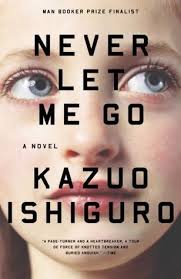
Can you appreciate a book without particularly liking it? That was my reaction to Kazuo Ishiguro’s 2005 speculative or experimental or science-fiction novel (read the review then pick your adjective), Never Let Me Go.
Never Let Me Go focuses on three characters – Tommy, Ruth, and the novel’s narrator Kathy H. – who are students at what seems to be an upscale private school called Hailsham in what seems to be England in the 1980s. But something isn’t quite right.
The disquiet begins with the first chapter in which an adult Kathy talks about her work as a “carer” for “donors”. The story quickly returns to Kathy’s childhood at Hailsham where the students are only taught art, where the teachers are called “guardians”, and where not only are parents and the outside world never mentioned, but where they seem to barely exist.
As it turns out, there is a good reason for all these strange facts. The students of Hailsham are clones who are being raised to adulthood for the singular purpose of providing organ donations to “normal” men and women. The last donation is fatal.
And with that realization, we follow Ishiguro down his rabbit hole, and pop up in the world of Kafka or Beckett (as other reviewers have well noted before me); but unlike the fantastical worlds of Gregor Samsa’s middle-class family apartment, or Vladimir and Estragon’s desolate country road, the world of Never Let Me Go never quite achieves a coherent internal logic. Which means I don’t think the novel is an entirely successful experiment.
But before I get to these objections, let me talk about what I think Ishiguro did right.
The Flat Affect of Kathy H. Is Pitch Perfect. And Hard to Take
Kathy H.’s narrative voice in Never Let Me Go is cool – even cold – dispassionate, and elusive. She leaves an enormous amount unsaid about the feelings and experiences of clone donors. They all seem to embrace their fate with a combination of resignation and acceptance. The four stages of donations are not described. Post-operative pain or complications are vaguely acknowledged, at best. Every donor dies off the page. No one knows where the bodies are buried. If they are buried.
Kathy H. describes strong emotions, even in herself, with a matter-of-fact tone that prevents us from feeling them. She doesn’t seem to want our sympathy, and her coolness makes our empathy harder.
But all this seems exactly right. Asking someone to remain alive in feeling who has been bred and raised like cattle; who has helped the people she loves die in the service of a society that treats them as spare parts; and who herself is now facing the same death – all that is too much.
Kathy H. should be shut down as person. And if that makes our empathy harder, then it should be harder, because it is a catastrophic lack of empathy in Never Let Me Go that makes the genocidal slavery of the clones possible.
And I would go further and say since any injustice committed by one human against another has as its foundation a failure of empathy, then the novel pushes us to strengthen the quality which is the solution to its (fantastical) horrors.
Never Let Me Go: An Inadequate Portrait of Human Life
You might think after that statement I don’t have any serious criticisms of Never Let Me Go. But I do.
My first criticism is based on the indications that Ishiguro wants us to understand the experience of Kathy H. and Tommy and Ruth as universal. We know this explicitly from the February 2005 interview Ishiguro gave to The Guardian in which he said:
There are things I am more interested in than the clone thing. How are they trying to find their place in the world and make sense of their lives? To what extent can they transcend their fate? … Most of the things that concern them concern us all.
We also know it implicitly because it is not just Kathy H. who responds to her fate with resignation and acceptance. Every clone responds with resignation and acceptance. If there are variations from these two emotions in the world of Never Let Me Go, we have no report of them.
This is a barren and withered portrait of human life; and while it is an accurate description of some human lives, it is entirely inadequate representation of the human race I know.
That race, too, strives with might and contends with blood. That race, too, loves with a fierceness that will break before it quits. That race, too, rejoices and despairs. That race, too, knows beauty as well as horror. That race, too, seethes for justice in the face of injustice. That race, too, believes beyond all reason, beyond the heavy evidence of experience. That race, too, endures and endures.
Where are these lives too in Never Let Me Go?
Clone Organ Donors: Extraneous and Finally, a Distraction
My other problem with Never Let Me Go is that I think it was a mistake for Ishiguro to situate his science-fiction nightmare in what otherwise appears to be England in the middle-late 20th century.
It would have been fine if Ishiguro had transformed the premise into something more familiar: say a children’s cancer ward in which Kathy H. could have been an orphan and ward of the state, the other characters had dysfunctional families, and so on. Then Ishiguro could still have explored the things in which he says he was most interested without all the fussing with clones.
Or he could have set Never Let Me Go in some dystopian alternate Earth-like world sometime in the past or future, in which it would be easy to accept the clones because that’s what happened in this world. (Think of Panem in The Hunger Games.) That would also have been fine and easy to do.
But as it is in Never Let Me Go, I kept stopping and saying to myself: “Wait, exactly how does this clone-donor society thing work again?”
How did England, barely ten years after the defeat of Nazi Germany, the exposure of the death camps, and the end of the Nurenberg Trials, transform itself from a reasonable progressive Western society – as these things go – into a moral monster? Did the rest of the Allied powers acquiesce or participate? How did England get the entire medical profession to ignore the Hippocratic Oath? Where there no objections from the religious communities? Did anyone object? Who was making money from this? Was there an underground railroad for clones? What was the system of control? As young adults, the clones seem to be able to roam at will. What stopped them from disappearing into society, where they would be indistinguishable from other human beings? Why didn’t the clones go all Rambo on the murderous bastards running the system? As an American, I can name entire states – hello, Texas – that would rise up in violent defense of themselves. How did science perfect cloning months after the discovery of the DNA double helix, but still need another 30 years to invent the Walkman?
Also, I’m not a big fan of the novel of social comment, but the premise clearly suggests that our societies are capable of such actions, but doesn’t go any further with the suggestion. This combination of provocative and perfunctory doesn’t sit well.
Should You Read Never Let Me Go?
Never Let Me Go is two books in many ways. As the story of three people dealing with horrors not at all dissimilar from real ones in the world today, I thought it was pretty good. As a speculative science-fiction novel, it would have needed to speculate much harder and much more thoroughly to be a success
 In his new film adaptation of Shakespeare’s Much Ado About Nothing, director Joss Whedon has made a movie which is both funny and affecting – but funnily enough, more affecting than funny.





 Peter Galen Massey