Posts Tagged ‘books’

sookie stackhouse novels harrisIf the perfect beach book (1) offers a likeable heroine (2) tells stories about problems you don’t have, (3) is smart but not taxing, and (4) contains enough sex to make up for the fact you can’t have any since you a sharing a motel room with your kids – then Charlaine Harris’ vampire novels, including the recently published Dead Ever After, are pretty good choices.

Certainly, Ms. Harris has earned her success with the character of Sookie Stackhouse, a telepathic barmaid living among vampires, werewolves, witches, fairies, and just-folks humans in the small Northern Louisiana town of Bon Temps.

Much of Sookie’s appeal comes from the fact that she is a normal person. Every day, she gets up and works an unglamorous job. She shops for food, buys gas, cleans her house, and watches TV. At night, she says her prayers. On Sunday mornings, she goes to the local Methodist church. Sookie tries to look after her hard-working but sexually reckless brother. Most of the time, she wonders if she’s done right or not.

Sookie is also appealing because her strength comes from her character, not her paranormal abilities. In almost every fight with a supernatural being – and with many normal humans – Sookie is overmatched, but she will fight all the same if forced, rather than surrender. Sookie also has great courage. She will put herself in danger to help a friend or a person to whom she feels obligated. She will act on principle when it’s against her own self-interest. And she can make hard decisions when her good sense tells her she has to make them.

Another quality of Charlaine Harris’ vampire novels is their social commentary. The books are occupied with how society treats people who are different, and you don’t have to look hard to see the parallels between the vampires in Harris’ novel and homosexuals (and others outside sexual, gender, and lifestyle norms) in our own.

The supernatural can also be seen as the outward manifestation of interior psychology in the novels. Sookie dates vampires and werewolves, which is another way of saying she goes out with no-good men who are blood-suckers and animals, while ignoring the romantic possibilities with her dependable boss Sam, a shape shifter who likes to take the form of a collie.

Sookie’s mind-reading power functions in a similar way. Her telepathy is really the magical extension of her natural intelligence and perceptiveness, qualities that can make a woman living in a small town “different” or “odd” to many of the people around her.

None of these parallels should be taken too far. Harris does not invest every character or story with a deeper meaning. Or put another way, with a nod toward Freud’s famous observation, sometimes a vampire is just a vampire in the Sookie Stackhouse books.

Charlaine Harris is not a great prose stylist, but her writing demonstrates craft, and Harris conveys the sound of Sookie’s voice – and particularly her sense of humor – very effectively.

Her plot architecture is another matter, however. Many of the books are constructed around a series of loosely related incidents, rather than a unified story that has an arc and momentum. The mystery elements of her stories are often thin and feel perfunctory. Her plots seldom twist. And as the series has stretched on, it has become more and more of a soap opera.

This is not such a bad thing for beach books, however, and it means that you can read the series in any order. So try a couple if you discover you just can’t read Woolf’s The Waves while the ocean crashes and the seagulls cry and your neighbors the next umbrella over are blasting Bon Jovi. I couldn’t.
Read Full Post »

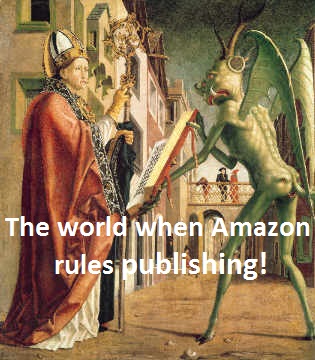
amazon is the devil?When a federal judge ruled that Apple was guilty of conspiring to fix the price of eBooks last week, the lamentations began.

Commentators declared this would lead to the destruction of the traditional publishers and the ascendance of Amazon as a monopolistic hegemon, which would use its vast market powers to homogenize and commoditize our reading culture. Also, frogs would rain down from the sky.

But I don’t think any such thing will happen. (Well, the frogs might.) Here’s why.

The Traditional Publishing Model Is Not Essential to Reading Culture

The traditional publishers think they are essential to reading culture because they were essential in the past and because (I’m quite sure) they are sincerely devoted to their craft.

But the only two actors who are essential to reading culture are writers and readers.  Publishers are … or were … a necessary intermediary between the writer and reader, back when printing books and getting them into the hands of readers were complicated, expensive operations.

Now these tasks aren’t necessarily complicated or expensive. There are plenty of new ways, many more than before, for writers and readers to connect. And as long as you have writers and readers, you’ll have a reading culture. Before I discuss why, however, let me make a semi-related point.

Good Books Have Always Been Bad Business

This is not to say you can’t make money from serious books or serious literature. You can. The problem is you can’t make enough money consistently to turn the proposition into a sustainable business.

This leaves publishers with two choices. The first is you have a huge company in which the blockbusters in popular genres subsidize the “serious” books. For publically traded companies, this is the only option because they will be punished by the markets if they lose money.

The second is you have a small company, privately held, in which the owners see themselves as patrons of and missionaries for writers as much as they see themselves as business people, and their financial goals don’t extend too much beyond avoiding bankruptcy.

The recent obituary for Arthur Rosenthal of Basic Books described this dynamic nicely when it said he “let his taste in nonfiction and his quasi indifference to profit margins guide him as a publisher”.

Now Amazon is making the lives of people who work within the huge company model a living hell. But it is making the small company model so easy that anyone with a computer and internet access can become a publisher.

Writers of Serious Books Are Adapting. Amazon Is Helping Them Do It

One of the assumptions in much of the recent wailing over Amazon’s victory is that only serious books are real books and only serious publishers are real publishers.

No one was fretting that the Dan Browns of the world would disappear because they knew they wouldn’t.  A hegemon Amazon would still publish Dan Brown because he makes a lot of money.

The commentators did worry that a hegemon Amazon would ignore the serious, unprofitable books. Well, maybe. But maybe not.  Amazon has demonstrated an almost pathological indifference to earning a profit over the years.  This would make them a perfect publisher for the Virginia Woolfs of the world. And perhaps they would like the prestige of a having such writers under their imprint?

But if not, Amazon has given writers the tools to directly publish and promote their own books. Amazon’s print-on-demand model allows small publishing companies to produce print books with very low overhead costs. Kindle Direct allows people to publish eBooks at basically no cost.

Everyone has a chance. Including the serious writers and important voices who are getting overlooked right now by those old gatekeepers of the reading culture, the traditional publishers.

The Government Doesn’t Just Punish Price Fixing. It Also Punishes Monopolies

Finally, remember that it is not only illegal to fix prices. It’s also illegal — not to become a monopoly, as it turns out talking to my FTC lawyer friend — but to use monopoly power to stifle competition. And the government departments that are aiding Amazon by ruling against Apple, so some people claim, are the same departments that would force Amazon to change its business practices or break up if it did.

We can’t risk that harm, you say? Well, under the legal system of the United States, you generally can’t punish companies because you think they will break the law. You have to wait until they actually do.

In the meantime, I encourage everyone to seize the new opportunities. They’re good fun. And you might make some art, or some cash, too.

Related Massey Posts

A few comments on “Book Publishers Scramble to Rewrite Their Future” by Evan Hughes

The NPR Interview with Mark Coker of Smashwords | Self-Publishing on eBook

Read Full Post »

What’s the difference between an innovation and a gimmick in literature? An innovation expands the author’s vision while a gimmick tries to hide his lack of one. You’ll find excellent examples of both in George Saunders’ recent short story collection, Tenth of December.

When Saunders is good in this volume, he is very good indeed, and the elements he uses frequently throughout Tenth of December work well together to create resonant stories. These elements include …

  • language that is faulty or inadequate, usually because the narrative voice belongs to a person with whom Saunders has not shared his gifts as a writer.
  • characters who are teetering on the edge of economic / social / psychological / personal failure confronting other characters who enjoy extraordinary success (no one seems to occupy the middle ground).
  • the motif of fictional pharmaceuticals that can regulate every human characteristic.
  • strong satiric impulses balanced by great empathy for his characters.

tenth of december george saundersOne of the best stories in Tenth of December is “Escape from Spiderhead” in which Saunders slowly reveals to us that the narrator is being used as an unwilling test subject for powerful drugs because he has been convicted of murder. Here words are deformed by bureaucrats and scientists, who use technical language to obscure the horror of their actions, and Saunders deploys his innovative premise to deliver a knock-out meditation on free will, regret, and redemption.

Another excellent story is “Victory Lap” which tells the anxiety-provoking tale of a high school girl, the middle-aged man who attempts to kidnap her, and a high school boy who intervenes.  Saunders nails the voices of all three characters. The kidnapper narrates the pathetic execution of his pathetic fantasy to perfection, but it is the teenagers who really shine. Their words grasp at ideas and emotions without quite seizing hold of them, and you get the sense in the end that Saunders intends the triteness of their language to be a deliberate defense against the fear they experienced.

In these examples, the innovations – the science-fiction premise of “Spiderhead”, the conspicuously stylized narration of “Victory Lap” – work with the other elements to create stories that capture your mind, your heart, and your gut. But that’s not the case for every story in Tenth of December.

For example, “Exhortation” is a staff memo composed of inept motivational business-speak wrapped around the message that the department will all be fired unless performance measures improve. “My Chivalric Fiasco” is mostly about what happens when a worker at a Renaissance-Fair business takes a drug that makes him a highly articulate speaker of ersatz medieval dialect.

Other than admiring Saunders prose, or nodding in automatic agreement at the obvious lessons (offices are insane places in “Exhortation” and sexual harassment is bad in “Fiasco”), there is little for the reader to do. The gimmick of the style doesn’t hide the thinness of the story.

The longest piece in this collection, and I think the weakest, is “The Semplica Girl Diaries”. The story is told through the diary of a man who plunges his family from serious money problems to desperate money problems by making an expensive, impulsive, and useless purchase.

This purchase happens to be (as is eventually revealed to us) four young girls from poor countries who hire themselves out as living lawn ornaments.

As a big honking obvious metaphor for the exploitation of third-world labor by Americans, you would be hard pressed to find a metaphor bigger or more honking or more obvious. Once Saunders shows the metaphor to you, however, there is not much left. You can enjoy the gyrations of the story. I didn’t. You can admire his prose style. I did. But virtuosity alone is never enough to satisfy me. It has to be in the service of something other than itself.

Don’t let this stop you from reading Tenth of December. The rewards outweigh the frustrations, and your effort will be entirely redeemed by its best and shortest story, “Sticks,” in which a man tries to connect with his family by decorating a metal pole in their yard with clothes and words. Here Saunders does more in two pages than many writers can do in one hundred. And that’s neither innovation or gimmick. That’s  talent.

Read Full Post »

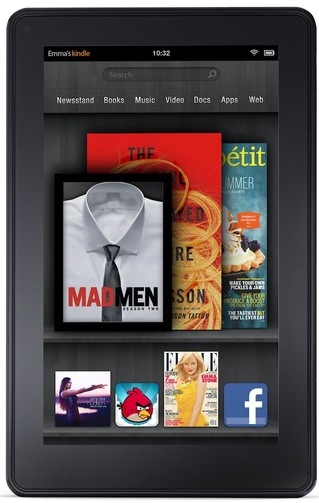
Kindle Fire

I am not a myth!

I don’t have a dog in the fight between Amazon and big publishers over eBooks – I’m just an irrelevant bystander — but I do think I can tell when someone is trying to sell me a bill of goods.

At least that’s how I felt about parts of “The Seven Deadly Myths of Digital Publishing” by Bill McCoy, which appeared on the Publishers Weekly website today. However, I agreed with other points in Bill’s argument and overall found the article well worth reading. Here are my notes:

Tablets and Large Screen Smartphones Are Transforming Digital Publishing

McCoy says that new devices along with new universal coding standards will allow electronic publishing to offer “highly-designed illustrated and enhanced digital books” as well as greater reader interaction and social engagement. He also believes that the differences between reading content on an eReader, a mobile phone app, or a website will be reduced, where as currently they are distinct formats. All of this will allow the eBook’s success to expand beyond their current domains in “novels and linear non-fiction”.

All this is interesting and cool and thanks to Bill for sharing. My problem is that his article implies that Amazon (the monster elephant in the room he doesn’t name) is vulnerable because they are reliant on a proprietary and outdated E Ink platform: that is the Kindle.

Which would be true if Amazon hadn’t launched the Kindle Fire in September of 2011, and wasn’t continuing to roll out enhanced versions at a fraction of the cost of an iPad ever since.

Plus, considering Amazon has a pretty decent on-demand video streaming service already live, I’d say they are thinking about how to deliver content through their own website.

Now this doesn’t mean that Amazon will be more successful seizing the opportunities of the future than big publishers; but I do think it shows that Amazon sees those opportunities as clearly as Bill does. And Amazon sure doesn’t look like it’s behind the curve.

Authors Still Need Publishers

On this one, I’d say Bill is on thin ice. If not swimming in open water. Anyhow, he makes several points. That writers will need publishers for their expertise in editing, cover design, typography, and marketing. That publishers can evolve into new roles as multi-media / multi-platform “producers” of content in collaboration with writers. And that publishers can find a role organizing communities around authors and readers interested in the same topics.

Well. Expertise is editing, cover design, typography, and marketing is not limited to publishers and there are an enormous number of experienced freelancers out there (many of whom used to work for the publishers’ until they were outsourced).  Literary agents have marketing skills and are at least as well positioned, maybe better positioned, to be creative collaborators with writers, not mention their business managers. And none of these folks are going to demand 90% of a book’s net revenue as compensation.

As for community creation, is a publisher going to want create a community around a topic in which they aren’t the dominant publisher? And if they are the dominant publisher, are people going to believe that community ISN’T a form of advertising run by a big company for which they are working as unpaid copywriters?

I ain’t sure.

Now Bill is right that authors still need publishers. But the authors who need publishers most are the unknown ones – ie, the ones least likely to make them money. Will Stephen King still need a major imprint in five years? Maybe not.

And Let’s Not Forget About Amazon’s Huge Sales Pipe

Last summer, Forrester research stated that 30% of all online shoppers begin with Amazon to research products. Not Google. Not Bing-Yahoo. Amazon. Yikes.

Why? Well, people know they can find a lot of stuff they want to buy, at reasonable prices, with convenient shipping on Amazon. Getting them to change their habits and say, buy eBooks direct from a publisher platform, is going to take some major heavy lifting – most especially, offering some new product or service of such compelling value the people have a good selfish reason to switch.

Otherwise, publishers can innovate eBooks all they want. But they are still going to need to sell a lot of them through Amazon, because that’s where readers want to buy them right now.

And Let’s Not Forget About 70% Royalties and the Power of Social Media to Bypass All the Old Gatekeepers

And while I’m walloping away at Bill – who is doubtless a nice man and doesn’t deserve it – let’s not forget about 70% net royalties from eBooks published through Amazon versus 10% give or take from publishers for print books. With those numbers, authors could sell fewer total units of just eBooks at a lower cost through Amazon and still make more money. Ouch.

Plus, social media can be a highly effective way to market books, but publishers really can’t do it for authors. Who would you rather follow on Twitter? Dan Brown or the marketing assistant assigned to tweet about Dan Brown books at Doubleday?

So Pete, You’d Never Sign a Contract with a Traditional Publisher Then, Right?

Are you kidding? In a second. I am one of the unknowns in desperate need of their help. I love you, Doubleday, you big beautiful handsome company you. Call me!

Read Full Post »

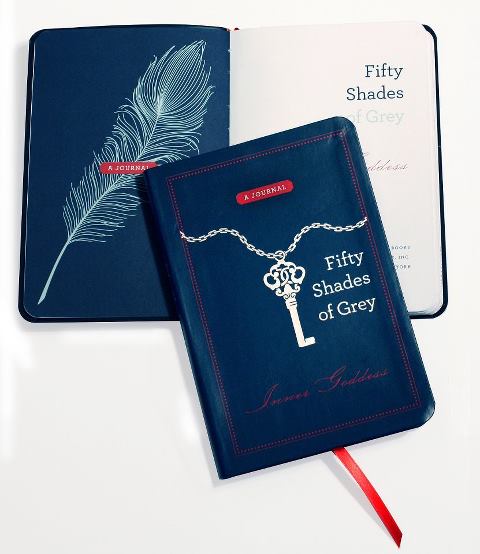
fifty shades of grey inner goddess journalFor a guy who writes mediocre poetry and has read one volume of Proust, I’ve always been pretty okay with capitalism. But the Fifty Shades of Grey Inner Goddess Journal (list price $16.99) is making me change my mind.

Before I saw the ad for this excellent product in The New York Times Book Review this morning, I regarded capitalism as not necessarily a good system, but the system which in practice has created the most wealth for the largest number of people so far.

Its dynamic of winners and losers was necessary to reward hard work, innovation, and risk-taking as well as to discourage free-riders (although I’m no free marketeer and I think the United States’ level of social protections is inadequate to ensure we get the most from all our people, not just those of privilege).

Capitalism certainly generates a large number of crappy products, but I’ve never been able to side with the critics who makes this point because (1) their definition of “crappy product” is “crap I don’t buy” and (2) they tend to talk as if they are the only ones who see through capitalism, while everyone else is its slave-drone-fool or an active participant in its malevolence.

But you know what. I was wrong.

It’s not just the breathtakingly cynical whoring after profit the Inner Goddess Journal represents that’s changed my mind because, honestly, you see whoring after profit going on all the time all over the place.

It’s that the Inner Goddess Journal includes “tips for writers” and plenty of blank pages for “aspiring writers” to “express their own Inner Goddess” according to the product description.

E.L. James offering tips for writers is like Genghis Khan handing out advice on how to live in peace with your neighbors.

Okay James wrote the books, and people liked them, and she made money, and everyone was happy. Fine. I’m okay with that. I read the first one. I thought it was hilariously awful. I moved on. It’s a free country. I’ll read the books I like. You read the books you like. God bless American. Amen.

But this. James wants to metastasize herself and Vintage Books is her enabler. Ladies, gentlemen, please. Write all the erotica you want. But don’t follow her advice. Because if you do, I’m going to have to move to a commune or see if the Pennsylvania Amish will take me in. And my wife won’t be very happy about that. I think.

Read Full Post »

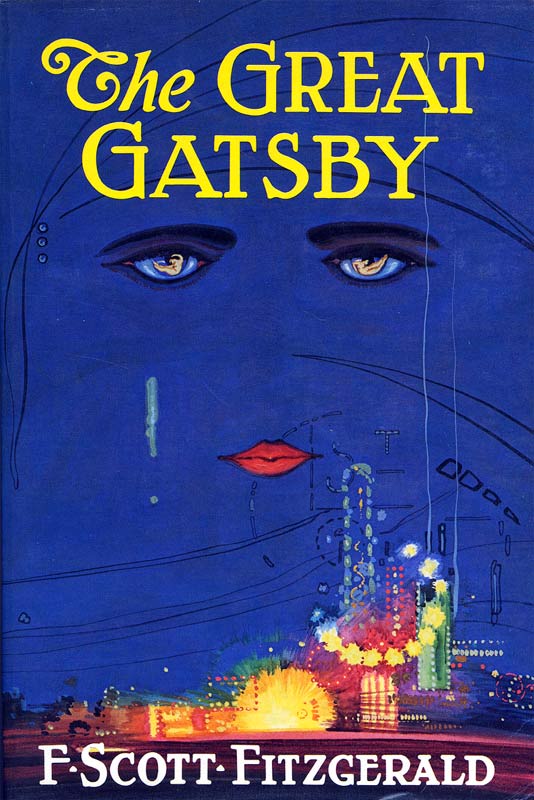
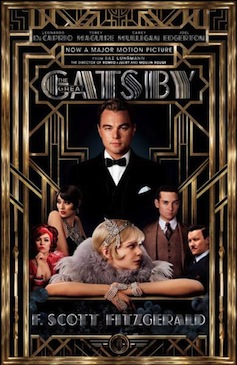
The Great Gatsby, classic cover designJulie Bosman published an interesting article on the front page of the The New York Times yesterday about competing cover designs for two paperback editions of The Great Gatsby. (The article is here.)  The first is a re-issue of the classic Gatsby cover familiar to readers old enough to have read Fitzgerald’s masterpiece in high school or college. The second is the tie-in edition for the movie starring Leonardo DiCaprio and directed by that genius of brilliant excess — or hawker of wretched excess, take your pick — Baz Luhrmann.

Much of the article describes the different markets at which the two cover designs are targeted, and different sales strategies behind each. Readers already familiar with the novel are likely to choose the classic design, while readers just discovering the book are more likely to be attracted by the movie version.

Behind one of these strategies, however, are certain attitudes toward literature which I find — well, let me be gentle in my expressions here — contemptible. Allow me to explain:

How does the cover design of The Great Gatsby change the novel? (Hint: It doesn’t.)

The Great Gatsby, movie designAssuming that texts in today’s competing versions of The Great Gatsby are identical, how do the differing cover designs affect the experience of reading the novel?

The answer is they don’t. Just like reading Gatsby on a tablet rather than on paper doesn’t change the experience, as long as you think what is essential about a novel is reading the text. Is engaging the words on the page. Is entering into a conversation with the author as you read the book.

Now, the cover design can influence your expectations of a novel you haven’t read. And if those expectations are different than your reading experience, you may come to a different conclusion about the book than you might have otherwise. But all sorts of things influence our expectations of a book. Its status in the canon. The opinions of reviewers and friends. Advertising. Our mood and experiences. Our age.

But once you’ve read a book, how does anything other than having read it affect your expectations on re-reading it? Especially a novel like The Great Gatsby, which a lot of people have read. Or put another way…

If the cover design of The Great Gatsby doesn’t matter, why does anyone care?

Because people do care. Or at least we know for certain that one SoHo bookseller quoted in the article cares, because he says so. “It’s just God-awful,” he says, referring to the movie tie-in version. (I agree, by the way. It is pretty bad.)

But it doesn’t sound like this bookseller objects to the fact the cover design is ugly. Allow me to quote the article.

As to whether the new, DiCaprio-ed edition of “Gatsby” would be socially acceptable to carry around in public, [I’ve withheld  the name, you can find it in the article] offered a firm no. “I think it would bring shame,” he said, “to anyone trying to read that book on the subway.”

Shame. Really. Why?  Is it because the important thing about The Great Gatsby is not reading The Great Gatsby but being seen reading The Great Gatsbyespecially being seen reading an edition of The Great Gatsby which signifies that you aren’t some hick coming late to the art party?

I realize I’m speculating aggressively here, with a certain amount of snark, but it’s hard to think what else our bookseller friend might have meant.

Also, while I’m at it, why the hell would you care what strangers in a city of 8.3 million people think of you? Are you likely to ever see them again? What’s the point of trying to impress people you don’t know?

Also, while I’m at it, shouldn’t we be happy if a person decides to read The Great Gatsby because the movie-cover persuaded him to pick it up? Shouldn’t we hope more people will read the books we like? I would think the answer to these questions is “yes”.

Unless of course the point of great novels is not to read them or share them, but to use these books to create an exclusive club that allows us to feel special and look down on everyone else.

Allow me to be blunt. If I haven’t been already. People who use art to bolster their social status or personal vanity are philistines. They don’t care about art. For them, it’s just another accessory to flash, like a fancy watch or a cocktail  made with a certain brand of liquor.

And people who use art to exclude or denigrate others are the mortal enemies of art; enemies because the purpose of art is to connect and communicate, to inspire and delight, to comfort and challenge, to upset and exhaust, but always to leave us with a deeper experience of the life and consciousness and creation we share.

There is no connecting in an exclusive club, just arrogance and self-congratulation and rigid insularity and pettiness. These are pretty contemptible qualities.

I think I’ll pass on the opportunity to join and go get the new ugly Gatsby instead. I hear it’s available at Walmart.

Somewhat Related Content

Here’s a post on the aura of art that got started by a discussion in the comment section below.

Read Full Post »

This American author is deadIn The New York Times this week, Scott Turow published an op-ed on publishing and eBooks titled “The Slow Death of the American Author”.

Following my habit, I won’t summarize the piece (since you can read Turow’s thoughts here). But I will throw out a few more-or-less random notes. Here we go.

Publishers Put the Screws to Authors on eBook Royalties

Turow says in the piece that publishers limit “e-book royalties to 25 percent of net receipts. That is roughly half of a traditional hardcover royalty.”

My first reaction to this is “huh?” because it sounds like Turow is saying that authors often get royalties of 50 percent of net receipts on hard covers. Unless publishers subtract their costs from this net before calculating the royalty, or unless Turow means the actual dollars paid are roughly double, this sounds very high and totally sweet.

Now, I have to admit I haven’t seen many book contracts in a while, and none of them for general fiction. So I’d be happy for information from someone with current experience in the industry. Also, if any publisher would like to provide a sample contract – perhaps with my name on it? – that would be okay-dokay too.

Anyhow, as for the complaint that publishers put the screws to authors, all I can say is, “What else is new? It’s a business. The point is to buy low, sell high, and sleep on a pile of money.” At least publishers are willing to pay authors something, even if the word “pittance” is germane. As opposed to these folks.

Pirating of E-Books Are a Threat to E-Books

This is a different problem and one about which I can’t be as flip. Many eBooks authors are finding the best way to combat getting screwed (or ignored) by publishers is to sell directly to the reader.

As you may know from my other posts, I am quite keen on this model, although I don’t think it is the utopian revolution described by some of its more enthusiastic boosters.

However, if e-Book piracy becomes as endemic as other forms of media piracy, then the model breaks down. And leads to this question: What reason will writers have to create good work?

Writers Should Write for the Love of Writing

Yeah, that sounds nice, and to a large – but not absolute – degree, it’s true. All good writing starts with enthusiasm and love, I agree.

But that doesn’t mean the only reward for writers should be personal satisfaction; and the folks who claim otherwise are either individuals eager to read books for free or companies that have business models which substantially depend on the enormous amount of free content on the web. (A big piece of the value electronic device manufacturers and internet service providers offer to their customers is access to free content. Pirate sites monetize their piracy by selling advertising, much of it through our giant friend on the internet, Google.)

Also, to paraphrase Turow, and to borrow from King Lear’s advice to Cordelia, writers who get nothing for their writing will eventually write … nothing. Or more accurately, writers will write less, and the quality of their writing will decline, if they can’t get paid for their work.

Those at most risk are the mid-list, middle-brow  authors. Successful genre writers are likely to always make enough money to keep writing about vampires or serial killers, particularly it they can sell rights to movie or television producers. Writers with real artistic talent will find a perch in a college or university that is happy to pay them hard cash for the prestige of their name and a light teaching load.

Everyone else? I hope they make a beautiful corpse.

Related Articles:

“Scott Turow and his Sinking Ship” (criticalmargins.com)

Read Full Post »

Evan Hughes has written an interesting piece on eBooks, the publishing industry, self-publishing, and the future of writers and readers for wired.com

I won’t summarize the article (since you can read it here) which nicely describes many trends reported elsewhere in the recent past; but I will make a few observations about points that particularly struck me. Here they are:

Successful Self-Published eBooks Are Serials Written in Pulp Genres

The writers who’ve had success self-publishing eBooks seem to work largely in traditional pulp genres like science fiction, crime, horror, romance, and erotica. These writers produce books in series, each of which creates an intense desire to read the next, just like one tasty potato chip makes you desperate to eat another. The digital format lets you satisfy that desire instantaneously and buy the next volume, from any place at any time.

As a bonus, you don’t have to figure out how to get rid of the damn thing once you’ve finished it. The pleasure in pulps is all about reading the next one, not re-reading the ones you already own, which tend to lie around the house and glare at you reproachfully for having paid $30.00 for the hard cover. Passionate fans are excepted from this problem.

All of which makes me feel better about my own lack of self-publishing success with Queen of the Nude since my mistake was not following this model. (I’m rationalizing because I’m feeling vulnerable today.)

I seem to have written erotica. Good! But I’ve actually written a commercial fiction / literary fiction hybrid. Bad! And it is not the first in a series. Bad! And I pretty much wrap everything up on the last page. Bad! I’m doomed. Okay, enough whining.

Only Writers Who Aren’t Yet Successful Need Publishers

Traditional publishers offer writers only two services of any real value today: some modest – but highly unreliable – assurance of quality and marketing muscle which they may or may not flex. (Big guaranteed advances also count as a service, if you can get one.)

These services are useful primarily to writers who might deserve an audience but don’t have one. Successful authors, self-published or otherwise, don’t need help building an audience, and these audiences generally don’t need an assurance of quality because they have already have a decent idea of what they will get.

This means, right now, traditional publishers only offer compelling value to those writers least likely to make them money. And these companies have got to be sweating blood at the thought of the moment when eBooks capture a great enough percentage of all book sales that writers like Stephen King decide they can make more coin without them.

Because when this happens – and I don’t usually pretend I can predict the future, but I think it is a when – the traditional publishing industry will need to find new ways to offer writers and readers value. Or cease to exist.

Books Still Need Paper Copies to Sell Books?

This is an intriguing assertion. According to Hughes, lots of data suggests that while people like to buy books online, they still like to discover these books in stores. So books published on paper and sold in bricks-and-mortar stores will always be essential to publishing.

I’m not sure this is true, however. People discover books many ways, particularly from friends, reviews, and social media as well as advertising.

I enjoy browsing in bookstores and buying books from them (one of the few forms of shopping I actually like), but I’m hard pressed to think of an occasion when I have ever bought a book I had wholly discovered in a store.

Like traditional publishers, bookstores are going to need more new ideas to survive. I don’t believe either is fated to go extinct. But I don’t see a solution to their problems, either.

Read Full Post »

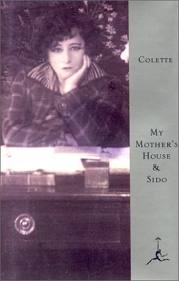
Cover of Colette's "My Mother's House"In My Mother’s House, the French author Colette has pulled off one of the most difficult tricks in literature: she’s written a compelling memoir without having a compelling story to tell.

Colette offers readers no major events in My Mother’s House – no plot, no drama, and very little conflict. Instead, she presents a kaleidoscope of memories about her family, pets, neighbors, and the French village in which they lived.

Occasionally, she will relate an important family story. For example, Colette tells how her older sister abandons their family after her marriage and leaves their mother to stand in helpless agony outside of the house in which her estranged daughter has gone into labor with her first child.

But for the most part, Colette fills the book with incidental events and small details, such as how her father offered to teach a neighborhood woman the meaning of love for “six pence and a packet of tobacco” and how her mother intentionally distracted the local priest during his sermon “by swing[ing] her watch ostentatiously at the end of its chain”.

What makes the book more than a collection of brilliantly realized sketches, however, is its organization around the themes of love and death. My Mother’s House is infused with the knowledge that everything Colette loved from her childhood – her mother, her father, her brother, the beauty of her mother’s garden – have passed away.

In the chapter titled “Laughter,” Colette’s mother warns her husband not to try to die before her. Instead, Colette writes…

He did try, and succeeded at the first attempt. He died in his seventy-fourth year, holding the hands of his beloved, and fixing on her weeping eyes a gaze that gradually lost its colour, turned milky blue, and faded like a sky veiled in mist.

Colette’s mother follows her husband into death and Colette experiences other losses as well. She tells how the beauty of nature has ceased to move her the way it moved her as a child, and Colette describes how her own daughter, at the age of nine, will soon lose her sense of childhood wonder.

My Mother’s House gains much of its power from the force, clarity, and simplicity of Colette’s writing, which reads like the work of a master of English prose even though its translated from the French. Colette’s book also gains power from the passion that lies beneath her descriptions. Literature can be a furious bulwark against death, in which the writer refuses to accept that all she loves best in life – her mother, her family, the richness of her consciousness – will disappear.

In My Mother’s House, Colette has ensured they won’t. They remain vibrantly alive in its pages, which is perhaps the greatest accomplishment any writer can hope to achieve.

Notes on the Author. Sidonie Gabrielle Colette, one of France’s most respected writers, was born in Burgundy in 1873 and died in Paris in 1954. She wrote dozens of books, including the novels Cheri and Gigi; was elected to the Academie Goncourt; and was the second woman to become a Grand Officer of the Legion of Honor.

Read Full Post »

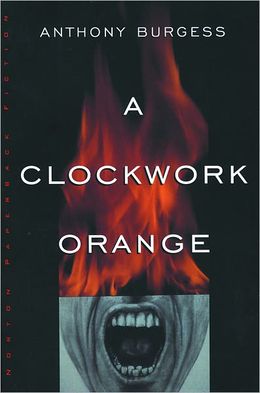
a clockwork orange anthony burgess reviewAnthony Burgess’ A Clockwork Orange succeeds purely on the strength of its narrator’s voice – but what a voice!

The novel’s story is told by 15-year-old Alex who lives in a vaguely dystopian, vaguely futuristic country that seems to be Britain.  Alex can check off every item under the DSM definition of sociopath. He bullies his parents and friends. He brutally assaults people at random. He gang-rapes a woman, rapes two young girls, and kills an old woman while trying to burglar her house. Alex regards this as all good youthful fun. When confronted by authorities, he knows how to pantomime innocence or remorse. When punished, he laments that no one cares or feels sorry for poor Alex.

All this promises to make Alex pretty ugly company, but sociopaths are often noted for their charm and wit, and Alex  has these in aplenty – not to mention exuberance, intelligence, formidable powers of observation, and a passionate love of classic music.

He also has the advantage of “nadsat,” the famous Russian-influence English slang Burgess invented for Alex, which puts the violence Alex commits at a remove from the reader and lends it a fantastical, almost fairy-tale quality.

Burgess described A Clockwork Orange as a “jeu d’esprit” that he wrote in three weeks, and it certainly feels like a book created in a burst of white-hot inspiration and imagination.

And it is a good thing, too. Because the “philosophical” parts of the novel, for which A Clockwork Orange is often complimented, strike me as (at best) heavy-handed and (at worst) laughably obvious.

So the philosophical meditation part of A Clockwork Orange goes like this.

First, Alex runs around assaulting, raping, and murdering. Then he is sent to prison where he is subjected to  behavior modification that physically incapacitates him any time he thinks about committing violence.  Then he un-behavior modifies himself by jumping out a window. Then he decides it’s time to grow up,  find a nice wife, and have a cute baby.

Get it?

In case you don’t,  Burgess sprinkles handy hints throughout the novel. So there is a book within a book, also titled “A Clockwork Orange,” from which Alex helpfully reads a summary passage on how you shouldn’t turn men into mindless machines. There is also the prison chaplain, just before Alex goes for his behavior modification therapy,  worrying out loud to the young man:

Does God want goodness or the choice of goodness? Is a man who chooses the bad perhaps in some way better than a man who has the good imposed upon him?

Burgess leaves us in no doubt of the answer to this question, and since he has created the world in which the question is asked, he gets to arrange his “facts” and “reality” to support his talking points. (Ayn Rand was a great one for doing that too.)

A Clockwork Orange is also noted for its satirical elements, and these were better than the philosophy, but not exactly revelatory. The police, politicians, Christianity, and what look like Communist intellectuals all get a good bracing spank and that was fine.

For me, one of the interesting things about reading A Clockwork Orange was how it compared and contrasted to Graham Greene’s Brighton Rock.

Greene’s novel features Pinkie, another murderous teenage British sociopath at the center of another “novel as meditation” – this time on the nature of sin and morality. Greene’s novel doesn’t deliver the same jolt of pure linguistic bliss as A Clockwork Orange, but it doesn’t bludgeon you with its themes either. It’s a close call, but I like Greene’s book a little better. I would fully recommend reading both, however.

Read Full Post »

« Newer Posts - Older Posts »