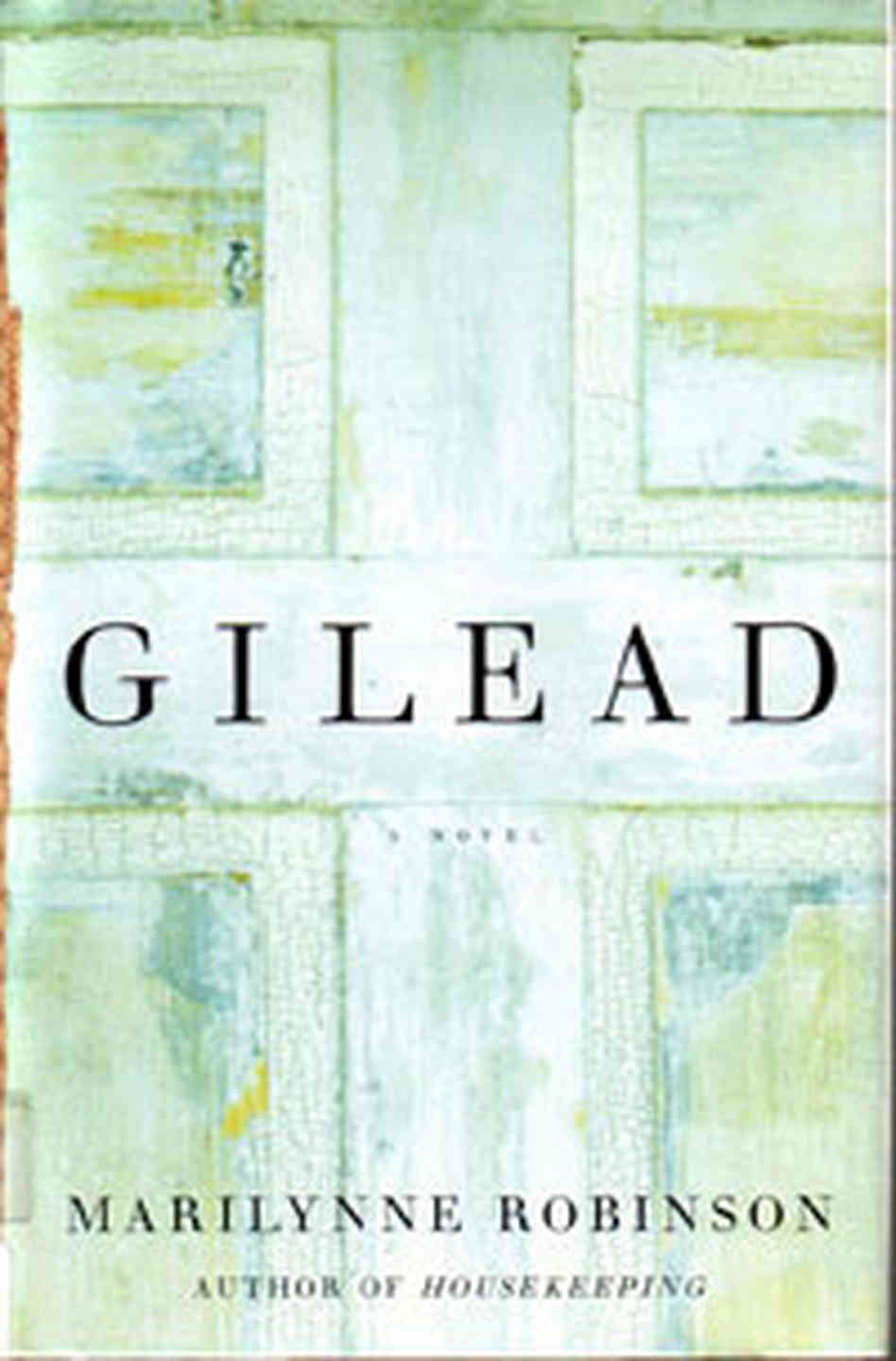
Gilead Marilynne Robinson What is the purpose of fiction? If it is to imaginatively engage its characters – and by so doing strengthen the reader’s ability to empathize with real people – then Marilynne Robinson’s 2005 Pulitzer Prize winning novel Gilead succeeds brilliantly.

The novel takes the form of a long letter written by John Ames, a Congregationalist minister living in a small Iowa town during the 1950s, to his young son.

Ames, who is in his mid-seventies and suffering from a fatal heart condition, wants to leave his child a record of his life and a way for the boy to remember him after he dies.

Gilead is filled with the aching beauty that the jacket copy of every other novel promises, but few in my experience actually deliver. Robinson voices Ames’ great and genuine love for his son, and his sorrow at leaving him so soon, with a simplicity and directness founded on total conviction. Robinson doesn’t seem to have created John Ames. She seems to have been angelically possessed by him.

Robinson brings equal beauty and conviction to Ames’ expressions of his love for the Iowa prairie and his life in Gilead, even during the long decades of loneliness between the death of his first wife and child in his youth, and the second family he begins as an old man.

For those who think that a little bit of aching beauty goes a long way, Gilead also serves up a heaping portion of plot like a hearty Midwestern meat loaf.

This plot includes the story of his second marriage to Lila, a woman half his age who appears one Sunday in Ames’ church for the service.

She returns every week and Ames falls ridiculously and helplessly in love with her – ridiculously (he thinks) because he is an old man and helplessly because he can see of no way to approach her consistent with his moral convictions. So his relief and gratitude are immense when Lila tells him one day, “You ought to marry me.” What the town and his church think of this marriage is an interesting silence in Gilead.

Another plotline in the novel are the stories of John Ames’ grandfather and father. Ames’ grandfather was a fiery preacher and abolitionist who believed slavery was so great an evil that it justified violent opposition, and who fought with John Brown and with the Union Army. Ames’ father was an ardent pacifist, and the conflict between the two men extends into John Ames own lifetime and forms part of his story.

Most prominently, however, is the story of John Ames (Jack) Boughton, John Ames’ god-son and a child of his best friend. Jack is a charming ne’er-do-well who returns to Gilead after a many years absence.

Jack torments Ames by reminding the preacher of his inability to love the man who carries his name, by making Ames’ fear that his wife and child will fall victim to Jack Boughton after his death, and by provoking his jealousy.

All these storylines are presented episodically by Robinson. So readers who enjoy novels which present conflicts, development them through rising action, and bring them to resolution – the “I can’t wait to find out what happens next” model – may find Gilead slow. I found it enthralling from beginning to end.

Some readers may also find John Ames’ sometimes lengthy discussions of Christian theology dull. These discussions are perfectly consistent with a bookish minister educated in the early 20th century who has a great deal of lonely time on his hands. I liked them but I have a semi-professional interest in theology.

Related Content to Gilead.

I think those readers who enjoyed Gilead for its “aching beauty” will like Annie Dillard’s Pilgrim at Tinker Creek. I also think they will enjoy Colette’s My Mother’s House, which I wrote about here. Finally, you might read my collection of poems about faith.

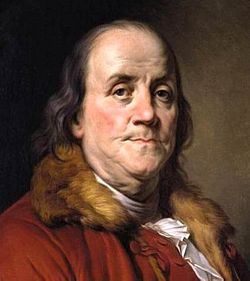
Benjamin Franklin author of The Drinker's DictionaryAmong his many achievements, Benjamin Franklin was the publisher and editor of The Pennsylvania Gazette, which offered news, opinion, and humor to its readers.

The humor includes “The Drinker’s Dictionary” brought out by Franklin in January 1736. The piece begins with a condemnation of drunkenness I don’t take with complete seriousness since Franklin is also famous for saying “Beer is proof God loves us and wants us to be happy”.

In any case, The Dictionary features more than 200 “round-about Phrases” or slang terms “to signify plainly that A MAN IS DRUNK.”

Some of this slang does not make much sense, having grown enigmatic over the past 270 years. However, I think that makes it funnier, the way some drunk men become more amusing as they make less sense. Here is a selection of my favorites:

B. He’s Biggy, Boozy, Bowz’d, Buskey, Buzzey, Bungey. He’s kiss’d black Betty.

C. He’s been too free with the Creature. Sir Richard has taken off his Considering Cap.

G. He’s Glad, Groatable, Gold-headed, Booz’d the Gage, As Dizzy as a Goose.

J. He’s Jolly, Jagg’d, Jambled, Going to Jerusalem, Jocular, Been to Jerico, Juicy.

P. He’s as good conditioned as a Puppy. He’s been among the Philippians. He’s contending with Pharaoh.

R. He’s Rocky, Raddled, Rich, Religious, Lost His Rudder, Ragged, Rais’d.

S. He’s Steady, Stiff, Stew’d, Stubb’d, Soak’d, Soft.

W. He’s Wise. He’s Wet.

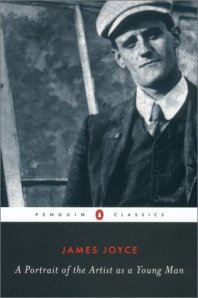
James Joyce' A Portrait of the Artist as a Young ManIs selfishness an obligation of genius? If so then Stephen Dedalus, the focus of James Joyce’s brilliant semi-autobiographical novel A Portrait of the Artist as a Young Man meets his responsibilities in full.

The book follows Stephen as he grows from a young child to a sin-and-salvation obsessed teenager to an ambitious university student preparing to leave his home, country, and religion, and forge his own soul as a free artist.

Portrait deserves its acclaim as one of the founding works of modernism. Joyce uses his famous stream of consciousness technique to convincingly render Stephen’s inner voice, which he interweaves with dialogue, descriptions, sermons, and diary entries. The story is built on thematically linked episodes, rather than conventional plot and conflict, and rewards the attention required from readers to follow it.

Joyce regards Stephen Dedalus as the model of what a writer should be (an early draft of the novel was called “Stephen Hero”) but it is his character’s spectacular self-concern that stands out as much as the spectacular potential of his talent.

Stephen Dedalus thinks about no one but himself. He is indifferent to the poverty of his parents and younger siblings, while carelessly neglecting the university classes they struggle to afford. He values his friends largely as sounding boards for his ideas. And he refuses his pious mother the comfort of attending a service for a religion in which he no longer believes, holding his fine scruples higher than her single request.

Perhaps great artists need to ruthlessly commit themselves solely to the creation of their art. Perhaps this is an obligation of genius. But it is not a pretty one.

Related Content on James Joyce

You’ll find my review of Finnegan’s Wake (actually totaling 100 words) as part of this post.

Here is an interesting article on Finnegan’s Wake by Michael Chabon. Aside from trying a little too hard to out-Joyce Joyce, I like Michael’s thoughts quite a bit.

Guns are patrioticThe recent tragic murders of young students and teachers in the Sandy Hook Elementary School move us to demand the US government take strong action to protect our children from gun violence.

The many responsible voices calling for armed officers to patrol schools, and for teachers and administrators to arm themselves, are important steps toward responding to the crisis.

However, these steps are not sufficient to protect our children. Gunmen who enter schools knowing there are police officers or armed teachers in the building will simply kill the adults with weapons first, then turn their guns on the unarmed children. More Sandy Hooks will be inevitable.

Therefore, we are calling on all people serious about protecting children from gun violence to create a national program to arm all school children.

Each child should be given an age-appropriate handgun as well as training similar to the instruction required to earn a concealed-carry permit in many American states.

Young children should be given a .22 pistol with no recoil and a trigger break pull pressure set at 1.25 pounds to ensure that small fingers can fire the weapon with relative ease.

Older pre-adolescents should be armed with .38 pistols and high-school age students with .45 handguns. Members of the ROTC and the football team should be armed with assault rifles, after they receive additional training and certifications. Twenty-round magazines should be standard for the handguns of all children regardless of age.

Guns should be integrated into school curriculums to increase the readiness of our children to use their weapons in self-defense. For example, word problems such as this one could be added to elementary school math programs:

Three men carrying assault rifles enter your classroom. You are armed with a pistol containing a twenty-round magazine. How many rounds can you fire at each gunman, assuming you fire an equal number of rounds at each? Are there any rounds left over? If so, how many? Show your work. Extra Credit. You should aim at the center mass of a man carrying an assault rifle to increase your chances of killing him before he kills you: True or False?

We estimate this program will require spending of $625.00 per child, with $475.00 going to pay for a reliable firearm and $150.00 to pay for training.

With 43 million school-age children in the United States, the total cost of our proposed program is 26.9 billion dollars.

We can assure those concerned about the size of the federal deficit that our proposal to arm children is revenue neutral and may even run a slight surplus.

This is because public health experts estimate that 7% of children in each generation – or just over 3,000,000 boys and girls – will die from accidental or intentional misuse of their weapons.

It costs $80,000 to provide each child in America with a public education. Therefore, the deaths of these 3 million children will save taxpayers 240 billion dollars per generation.

These savings will cover the cost of the program as well as the projected short-term and long-term costs of caring for the estimated 34% or 14.6 million children who will be injured by accidental or intentional misuse of their weapons.

While we recognize that these are not an insignificant number of deaths and injuries, we believe that the other 28 million children will be saved from gun death or injury as a result of our proposal. We also believe these deaths and injuries are a reasonable price to pay for the preservation and protection of the constitutional freedoms Americans enjoy.

As a result, we urge each of you to contact your representative and senators in Washington DC and demand they swiftly enact a comprehensive program to arm all children in the United States. Thank you for your support.

Moby Dick by Herman MelvilleFew American novels put off the general reader like Herman Melville’s Moby Dick. And the general reader isn’t entirely wrong to be put off.

Moby Dick is a genuinely strange work of art. For a book published in 1851, it’s more modernist text than 19th-century story, and might actually qualify as the first existentialist novel, if you take the White Whale to be the embodiment of a meaningless and hostile universe. Moby Dick is dense and it is difficult.

But it’s not as dense or as difficult as its reputation. It’s a pretty good sea-faring yarn. And it is a FUNNY book, at least until Ahab stomps onto the deck of the Pequod and sucks all the humor out of Ishmael and Queequeg, and the voyage in general, with his doomed, megalomaniac pursuit of revenge.

Now, there is some heavy going in this Melville novel and the first-time reader trying to decide how to read Moby Dick might choose to conserve his or her resources by “skimming” selected chapters. Father Mapple is a famous character, but Chapter 8 (“The Pulpit”) and Chapter 9 (“The Sermon”) could deter anyone from reading further for fear of discovering much much more of the same.

The many expository chapters, in which Melville discourses at length on every possible topic related to whales and whaling, also pose a problem for those picking up the novel for the first time.

To skip these chapters entirely would be to abstain from many of Moby Dick’s pleasures, particularly since Ishmael’s jaunty comic voice adds an agreeable tone of parody to these chapters.

At the same, there are a lot of them, and Melville is not always brief. So new readers would do well to pick and choose among chapters as they make their way through the book. For example, Chapter 32 (“Cetology”) and Chapter 42 (“The Whiteness of the Whale”) in their concentration and length are prime candidates for reading at a later date.

Which is not to say you should never read them. One of the great advantages of Moby Dick is that first-timers will do little violence to their understanding of the book’s story if they don’t read it straight through. Many of the chapters can stand on their own, inviting you to dip into the book where and as the mood possesses you. It also allows you to assemble your understanding of Moby Dick piece by piece, as if it were a 500-page jigsaw puzzle, rather than make a grimly determined march from the first page through to the last.

Finally, a copy of Moby Dick that includes reference materials is a big help. The Norton Critical Edition of Moby Dick includes maps, a glossary of nautical terms, and explanations of whaling and whalecraft with illustrations, all of which make Herman Melville’s book easier and more enjoyable to read.

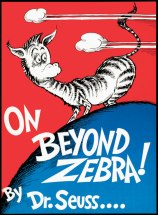
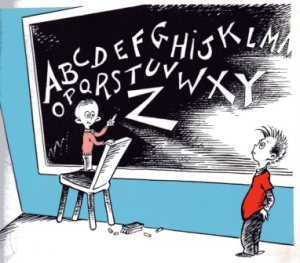
On Beyond Zebra cover by Dr. SeussThe children’s books of Theodor Seuss Geisel (better known as “Dr. Seuss”) are divided between the didactic and the anarchic.

Didactic books, often with a solidly liberal agenda, predominate. These include The Lorax (a warning against environmental destruction), The Sneetches (a satire of mindless consumerism and status-seeking), and The Butter Battle Book (a Cold War cautionary tale).

Some of Dr. Seuss’ most famous books combine the didactic and the anarchic. The Cat in the Hat is one of the great agents of anarchy in children’s literature, his inspired chaos opposed by Sally and her brother, and finally contained only by the re-appearance of their mother.

Dr. Seuss’ teaching books show the same dynamic. For example, Dr. Seuss’s ABC makes learning the alphabet fun through a wild collection of assonance- and alliteration-heavy nonsense rhymes (and one highly inappropriate image for children).

What I like about Geisel’s On Beyond Zebra (1955) is that it is the mirror-opposite of the ABC book and many others. On Beyond Zebra opens with this quote:

Said Conrad Cornelius o’Donald o’Dell,
My very young friend who is learning to spell:
‘The A is for Ape. And B is for Bear.
‘The C is for Camel. The H is for Hare
‘The M is for Mouse. And the R is for Rat.
‘I know all the twenty-six letters like that…
‘… Through to Z is for Zebra. I know them all well.’
Said Conrad Cornelius o’Donald o’Dell.
‘So now I know everything anyone knows.
‘From beginning to end. From the start to the close.
‘Because Z is as far as the alphabet goes.’

Conrad Cornelius o'Donald o'Dell from On Beyond ZebraConrad is a young boy with neatly parted hair wearing a sweater and tie. He is speaking to a wonderfully beatnik-looking boy. This boy picks up a piece chalk, draws a new letter, one which Conrad had “never dreamed of before,” and announces “…most people stop with the Z / “But not me!”

And with this, On Beyond Zebra is off to the races, devising fantastical creatures in fantastical lands based on fantastical letters.

Along the way, On Beyond Zebra argues for the supremacy, the freedom, the possibilities, the joy, and the exuberance of the world of imagination over the world of knowledge and fact. The anarchic soundly trounces the didactic, for once.

And yet, at the end, somehow the didactic gets the last word.

Conrad Cornelius is so impressed with what he’s seen that he exclaims,“This is really great stuff! / And I guess the old alphabet / ISN’T enough!”

Oh well, if Dr. Seuss had to deliver a lesson, at least it was, “Don’t be afraid of curiosity. Don’t be afraid of the new. The world is always bigger than you think!” Those are good points. I’m writing them down. Will they be on the test?

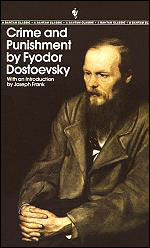
Crime and Punishment by Fyodor DostoyevskyWhen I picked up Crime and Punishment by Fyodor Dostoyevsky, I was expecting it to be dense, dull, and depressing – especially since the background materials I read stated that Dostoyevsky wrote Crime and Punishment as an explicit critic of certain radical theories that were current in 1860s Russia, including utilitarianism and rationalism.

It’s not a good sign when a novel has a thesis. This is usually an indication you are about to be treated to a bunch of cardboard characters clomping around mouthing platitudes, engaging in fake debates, and delivering essay-length monologues while sitting in a café smoking, humping each other, or bravely defying some oppressive bureaucrat or petty despot.

So I was pleased when I found Crime and Punishment to be a wilder, stranger, more flawed, more chaotic, more puzzling, and ultimately more engaging book than I expected.

Dostoyevsky, by all accounts, meant to deliver a lecture pretending to be a novel. He ended up creating a work of art. Here’s how (with a truck-load of spoilers in the discussion).

Crime and Punishment: A Black Comedy?

The first indication that I was following Dostoyevsky down his own particular rabbit hole, rather than sitting in his classroom dutifully taking notes, was that long passages of Crime and Punishment were both horrible and funny.

An early example is what happens after Raskolnikov, the handsome and arrogant law school drop-out who is the novel’s central character, famously murders an old pawnbroker and her sister. Raskolnikov falls into a fever that seems physical, emotional, and spiritual all at once.

But instead of taking us into Raskolnikov’s apparently tortured mind, Dostoyevsky focuses on his friends, who cheerfully encourage him to get better while chatting about mutual acquaintances or who view him as a fascinating case of morbid psychology or some undefined nervous complaint.

Another example is the character of Porfiry Petrovich, the detective assigned to solve the murders. Porfiry is short and stout, with a soft round face and a figure Dostoyevsky describes as “somewhat womanish” who laughs and titters through nearly every conversation he has.

Yet this comic-figure of a man is also Dostoyevsky’s figure of vengeance. Porfiry is convinced of Raskolnikov’s guilt early in the book, pursues him with relentless guile, and attempts to drive Raskolnikov to confess either to the police or in a suicide note when he concludes there isn’t enough evidence to arrest him.

My final example. After 500 pages of anguish and self-examination, Raskolnikov goes to the police station to confess. Here is the high dramatic moment. Here is the finale of the novel. What happens?

Raskolnikov encounters a pompous, idiot lieutenant who babbles on about nonsense so incessantly that Raskolnikov actually gives up and leaves. A few minutes later, Raskolnikov returns, tries again, and this time manages to get the lieutenant to shut up long enough to confess.

These are odd, distracting, irrelevant choices if you want to advance a narrow moral argument. But they are excellent ones if you want to explore the strangeness, complexity, unpredictability, and absurdity of life. Which is what artists do. And that is what Dostoyevsky did, I think, despite his intentions to the contrary.

Iago, Raskolnikov, Meursault: The Reasons for the Crime Are … What?

For a thesis book to examine whether it is moral to commit murder, it is important for the author to clearly establish the reasons the character committed murder before he can show why those reasons are wrong.

But here’s the problem. Dostoyevsky doesn’t. Instead, he gives us a Chinese menu of possible motives, none of which are particularly convincing even to Raskolnikov himself.

The best example of this is in Chapter IV of Part V when Raskolnikov confesses he murdered the two women to Sonya , the virtuous naïve Christian girl who loves Raskolnikov unconditionally and who also happens to be a prostitute. (I’m not making that up.)

Anyhow, first, Raskolnikov tells Sonya that he murdered the women because he wanted to be like Napoleon, who pursued his grand ambitions without regard for conventional morality. Then he tells Sonya he murdered for money, so he could finish his education and support his family. Then he tells Sonya he murdered the old woman because she was a “louse … a useless, loathsome, harmful creature.” Then he says the reasons he committed the murders are that he is “vain, envious, malicious, base, vindictive and … well, perhaps with a tendency to insanity.” Then he blames the murders on “sulkiness”. Then he serves up a Will to Power argument. Then he agrees with Sonya that the devil made him do it. Then he says he did it for himself. Then he goes over all these reasons all over again and concludes, I’m so unhappy!

As the basis for a thesis, this is a hot mess. As a portrait of humanity it is – well, some of you might think it a hot mess too – but I think it is brilliant. And a century ahead of its time.

It has become fashionable, based on the latest cognitive and behavioral science, to conclude human beings are deeply irrational creatures who use reason not to guide their actions, but too justify them after the fact. It is also an established principal, at least among the modernist writers, that the more closely you examine the human character, the more ambiguous and ungrounded in some final essence the human character seems to become.

I tend to think of this vision of humanity in terms of classic (or Newtonian) mechanics and quantum mechanics. In classical mechanics, matter at a certain size … typically visible to the unaided human eye … behaves in logical, predictable, and consistent fashions. But at the atomic and subatomic level, all hell breaks loose with matter doing seemingly impossible things, like being in two places at once, or being both “up” and “down”, or other weird stuff that gives the average person a headache just contemplating. And yet, the visible logical world is founded on the invisible chaotic one.

This seems to me to be a good description of Raskolnikov. He is a quantum character trying to exist in a classical world. And not succeeding particularly well. And upsetting Dostoyevsky’s program in the process.

Also, all this suggests to me that Raskolnikov committed the murders for nothing or because there was an emptiness at his center that made him so indifferent that no action he took, good or bad, finally had meaning. Which I think is the case with Shakespeare’s Iago and Camus’ Meursault, and so I’ve added Raskolnikov to that group.

Crime, Punishment. No Crime, Punishment. Crime, No Punishment. No Crime, No Punishment.

The final reason for thinking Crime and Punishment isn’t a thesis book focused on Raskolnikov’s murders, despite Dostoyevsky’s stated intentions, is the amount of extraneous, irrelevant, contradictory, and confounding characters and plots he includes.

This sounds like a criticism, but what it really means is that Dostoyevsky did not let his school-teacher impulses get in the way of his inspiration, which seems to want to explore the whole spectrum of crimes and punishments, with or without a causal relation between the two.

It starts with Raskolnikov himself, who despite having committed a pre-meditated murder and a impulsive one (Raskolnikov kills the old woman’s sister when she surprises him during the crime), gets all of 8 years in prison.

Now I am not familiar with standards of punishment in 19th century Russia, but this sounds a little light to my American but none the less opposed to the death penalty ears, and was a bit surprising to Raskolnikov himself.

There are also unpunished criminals in Crime and Punishment. For example, the character of Svidrigaïlov, a depraved landowner who is suspected of several murders and sexual assaults, gets away free from the law (although he does commit suicide in one of the novels most persuasive and harrowing chapters). There is also Luzhin, a sadistic bully who likes to prey on women he perceives to be helpless.

We also find punished innocents. Sonya becomes a prostitute in a desperate attempt to keep her family, especially her younger step-siblings, from starvation. These step-siblings themselves suffer from the drunkenness of their father and the angry despair, then madness, then death by consumption of their mother.

Finally, there are unpunished innocents such as Raskolnikov’s cheerful and loyal friend Razumikhin, who happily marries Raskolnikov’s sister, and the detective Porfiry, who succeeds in helping to drive Raskolnikov’s confession and serving the ends of justice.

Dostoyevsky renders many of these characters with a grotesque, Gogol-esque exuberance that also undermines the thesis aspects of the book. The fact of their existence, rather than what the characters mean or what “morals of the story” Dostoyevsky wants us to take away with us, seem the real point of the novel.

Which perhaps makes Dostoyevsky like Milton in Blake’s “Marriage of Heaven and Hell” when Blake says

The reason Milton wrote in fetters when he wrote of Angels & God, and at liberty when of Devils & Hell, is because he was a true Poet and of the Devils party without knowing it

But I think Dostoyevsky is more like the Oracle of The Matrix movies when she talks about a character called the Architect. She says the Architect’s role in the movie is to “balance the equation”. She tells Keanu Reeves her role is to “unbalance it”.

Fyodor set out to be the Architect. He winds up being the Oracle.
Fans of Patrick O’Brian’s Aubrey-Maturin novels value the scenes where Jack and Stephen are playing music in the great cabin of a ship or having particular conversations, like this one which considers the feathers of a paradise bird:

Stephen said, ‘Have you every contemplated upon sex, my dear?’

‘Never,’ Jack said. ‘Sex has never entered my mind, at any time.’

‘The burden of sex, I mean. This bird, for example, is very heavily burdened; almost weighed down. He can scarcely fly or pursue his common daily round with any pleasure to himself, encumbered by a yard of tail and all this top-hamper. All these extravagant plumes have but one function – to induce the hen to yield to his importunities. How the poor cock must glow and burn, if these are, as they must be, an index of his ardour.’

‘That is a solemn thought.’

H.M.S Surprise, pg.259, Norton paperback edition, 1991

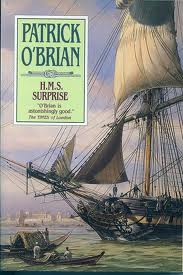
HMS Surprise by Patrick O'BrianIt seems strange, at first, that this should be so. The Aubrey-Maturin novels recount the adventures of Jack Aubrey, a British naval captain, and Stephen Maturin, an Irish-Catalan naval surgeon, naturalist, and intelligence agent, during the Napoleonic wars.

The series is full of battles, storms, shipwrecks, spycraft, political intrigue, the scientific discovery of new species, social manners, and problematic relationships between men and women.

And yet, both O’Brian and his fans always return to the quiet scenes between Jack and Stephen playing music or talking, as they are in the passage above. Why?

The reason has to do, I think, with the consolations literature offers us.

Good books have many uses. They are a pleasure and a comfort. They offer a hedge against loneliness. For centuries, readers have found their own thoughts and feelings in literature, and in finding these have been reassured that they are not alone and unknowable in this world.

And good books console us by offering a permanence to characters we love that we cannot find in the lives of the people we love outside of books.

Not all literature offers this consolation. It is no relief to know that Lear is always at the British camp near Dover, howling with the lifeless Cordelia in his arms, or that Antigone is always hanging in the cell to which Creon condemned her, dead by her own hand. Tragic works of literature offer us many things, but consolation is not one of them.

For consolation, a book must offer us characters who are convincingly human, not simply credible or familiar, and who engage our sympathies through both their virtues and their faults.

The book must also give these characters moments if not of happiness, then of peace and ease, because this is what we wish for ourselves. Among all our troubles and suffering, I think we all want – and believe we deserve – moments of at least modest contentment.

But we cannot stay in these moments or keep the people we love with us in them. Time moves. Circumstance and age separate us, further and further, until death makes the separation final and our only hope becomes reunion in another world; which many of us picture as being much like this one, except that hunger and violence and suffering and disease and death are banished.

Which makes heaven or the Summerlands or the after-life (or even reincarnation in the Indian religions) very much like the passages in the books we love.

Elizabeth Bennet will always be sparkling after dinner in the drawing-room at Netherfield, getting the best of and bettering Mr. Darcy, as alive today as the first moment she was written. Timofrey Pnin will always be playing croquet on the lawn at Al and Susan Cook’s summer house or discovering that Victor’s beautiful glass bowl is not broken after all. Jack Aubrey and Stephen Maturin will always be playing music while the wake of the Surprise stretches away behind them.

In this world, that is consolation indeed. Perhaps not enough. But I’ll take it.


Henry V by William ShakespeareIn Henry V, Shakespeare finds his “muse of fire” and she blinds us with her dazzling light.

Henry V is a play of almost ridiculous dramatic richness in which the scrappy, underdog Harry wins the battle of Agincourt, seizes his rightful French throne, and gets the King’s daughter. Hooray!

Except the war is justified by dubious arguments and provoked by the English clergy, who are eager to distract Henry from confiscating their wealth. Henry captures the French town of Harfleur after threatening genocide. He orders the slaughter of prisoners and leaves 10,000 French knights and soldiers dead on the field. Every friend of his youth, except one, is gone. They die in the battle, by execution after Henry’s judgment, or in the case of Falstaff, cold in bed with a wandering mind and a heart broken by the king.

In the end, it all comes to naught. The last lines of the play tell us Henry dies young, leaving England to be misruled by his infant son and a group of nobles who lose all that Henry won and spill more blood. But it was still worth it and Henry is still a hero. Right?

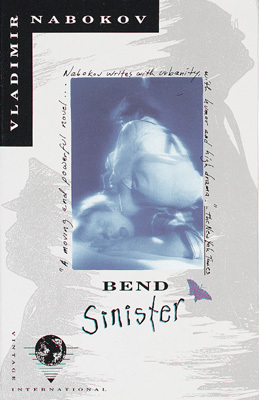
Bend Sinister Vladimir NabokovFor most of his life, Vladimir Nabokov declared himself indifferent to politics and expressed his satisfaction with never having joined any group or participated in any organized human activity.

Nabokov insisted that there were no “messages” in his work. He expressed contempt for literature that discussed general ideas, offered social commentary, dealt with everyday “reality” (a word Nabokov frequently put in quotes), or promised human interest.

Instead, Nabokov said he valued books that were grounded in the imagination and talent of the specific writer, and which offered aesthetic bliss which he recognized by a thrill in his spine.

Nabokov’s books seemingly confirm these principles. They are deeply idiosyncratic; full of dense word play, complex patterns, and recondite references; and deliver a great deal of what looks like misanthropy.

All of this argues you won’t find a trace of politics in Nabokov’s work just as he claimed. But here’s the thing. I don’t believe him. And neither should you.

The first reason you shouldn’t believe Nabokov is he knew from personal experience that indifference to politics does not stop politics from affecting you.

Nabokov and his family escaped the Russian Revolution in 1917. His liberal politician father was assassinated by Russian fascists in 1922. Nabokov fled Nazi Germany in 1933 and soon to be Nazi-conquered France in 1940 to protect his family and in particular his wife, Vera, who was Jewish. His brother Sergey died in a German concentration camp, where he was sent after speaking out against the Nazis.

The second reason you shouldn’t believe Nabokov is that while he may have bragged about never having joined any group, he also took great pride in his adopted country of the United States.

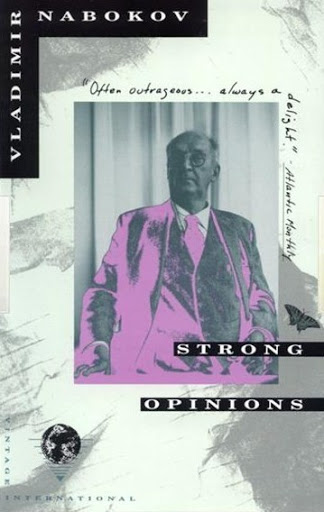
Strong Opinions Vladimir NabokovNabokov described himself as “American as April in Arizona” and said he felt a “suffusion of warm, light-hearted pride” when he showed his American passport at European borders (Strong Opinions, p. 98). He kept his US citizenship, and continued to pay American taxes, even after he and Vera moved to Switzerland.

By contrast, Nabokov was outspoken and unrelenting in his contempt for the leaders of the Soviet Union and the vast harm they had done to the Russian nation. Nabokov also had no problem arguing with the American liberals who continued to embraced Soviet propaganda long after they should have known better.

The third reason you shouldn’t believe Nabokov is that he consistently stated that the worst act a human being could commit was an act of cruelty. He believed that cruelty was the essence of all tyrants, and it is cruelty that he condemned in all his major novels.

This condemnation of cruelty can be hard to see because of Nabokov’s techniques as a writer, however.

Nabokov never wavered in his dislike of plainly written novels with obvious messages, and this dislike was reinforced by his observation that bad writers and bad leaders were much alike.

Nabokov saw bad writers and bad leaders as equally trite, vulgar, and stupid. They both thought and wrote and spoke in a debased language of general ideas, and both believed that human beings can be reduced to a few general “types” that are easily defined by commonplace characteristics.

Nabokov expresses this idea most succinctly in his short story, Tyrants Destroyed, when he wrote, “the real human being is a poet and [the tyrant] is the incarnate negation of a poet” (The Stories of Vladimir Nabokov, p. 446).

Nabokov also seems to have understood that the bad writer, especially the bad writer with a good reputation, actually legitimized the propaganda of a dictatorship’s officially sanctioned authors. If Balzac or Lawrence or Camus were first-rate artists, rather than second-rate scribblers, then the novels of approved Soviet writers could also be great works of art rather than tools of manipulation and misinformation.

So Nabokov responded by creating a highly personal – sometimes, stubbornly personal – body of work that emphasized the uniqueness of his characters and the originality of his imagination.

This approach, in itself, was an attack on authoritarian states like the Soviet Union, which insisted that the group was more important than the individual and which were threatened by any work that didn’t enthusiastically celebrate the state’s manifold virtues in a manner easily understood by the average person.

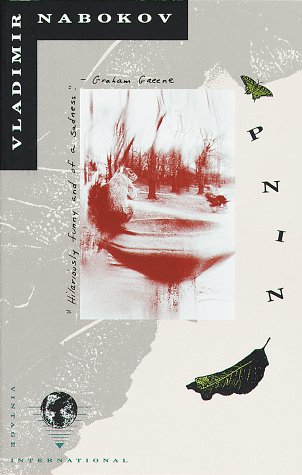
Pnin Vladimir NabokovNabokov’s work was also a relentless assault on cruelty. Nabokov didn’t usually link cruelty directly to a dictator, although the tyrant Paduk in the novel Bend Sinister is an exception. Instead, Nabokov created brilliant, charismatic monsters who blinded readers to their viciousness, monsters such as Humbert Humbert in Lolita, Kinbote in Pale Fire, and to a lesser degree Van Veen in Ada.

Nabokov could also take the side of those who suffered cruelty, most obviously in the characters of Professor Timofrey Pnin (a refuge from Soviet Russia like Nabokov) and  the philosophy professor Adam Krug from Bend Sinister who is helpless to stop the bungling thugs of that book’s tyrant from murdering his only child. I also believe he is quietly on the side of Lolita and Lucette Veen in Ada, and not the dazzling beasts who abuse them.

As usual, Nabokov expressed it best. In October 1971, when Nabokov was 72 and had finished writing all his major works, he said this to the interviewer Kurt Hoffman (Strong Opinions, p. 193):

“I believe that one day a reappraiser will come and declare that, far from having been a frivolous firebird, I was a rigid moralist kicking sin, cuffing stupidity, ridiculing the vulgar and the cruel – and assigning sovereign power to tenderness, talent, and pride.”