Turkey & Tofurkey, Freedom Fighters for ThanksgivingSteam rises off Turkey’s roasted-to-perfection skin as he rapidly surveys the dining room. It is empty.

“Get up, get up quick,” Turkey whispers to Tofurkey.

Tofurkey rolls to a standing position and rubs his superfluous wings against each other. “Is he gone? Oh where is he? Oh he looks so mean.”

“Never mind that,” Turkey says. “We have to make a break for it.”

“I can’t. I’m scared!”

“You’ve got to or you’ll be …”

Suddenly, a man holding a carving knife walks into the room. The birds freeze at the sight of the over-sized blade. The man looks at Turkey and Tofurkey with interest.

“Hey guys. You ready?”

“Ready for what?” Turkey asks. “Ready for the zombie apocalypse you call a celebration of family?”

“Well yes,” the man says. “It’s Thanksgiving. You don’t seem very cheerful about it.”

“If someone chopped off your head, shoved bread up your ass, and stuck you in an oven – would you be cheerful?”

“I’d like people to acknowledge that I suffer too,” Tofurkey says.

“You don’t even have a nervous system.”

“That’s kingdomist.”

The man puts down the knife, pours a glass of wine, and takes a sip. “I do see your points. But you are, like, after all … food?”

“That’s just what I’d expect a sadistic member of your genocidal species to say,” Turkey tells him.

“What are you doing in there?” the man’s wife calls from the kitchen.

“Disputing with the entrees.”

“I wouldn’t be a bit surprised.”

The man takes another sip of wine and watches Tofurkey thoughtfully. “You know his people eat your people.”

Turkey stares straight ahead, deeply uncomfortable.

“We’re here to talk about your crimes, man with big knife!” Tofurkey says.

“Would you excuse me?” the man says. “I have to mash the potatoes.”

The man leaves. Tofurkey turns to Turkey. “How do we get out? There’s no way out!”

“Here’s how,” Turkey says, pulling a 38 automatic, slapping the magazine home, and releasing the safety. “Turducken next door will distract that guy with a human call. Then I’ll shoot him. Then we scram. There’s Turducken now.”

Turducken pops up outside the dining room window and waves what appears to be a large kazoo at Turkey.

Turkey nods. Turducken blows the human call.

“You are the most attractive middle-aged man we’ve ever seen. Come back with us to our bachelorette boudoir,” the call announces in a seductive female voice.

“Oh I just knew this had to happen someday,” the man says, rushing into the room with the potato masher. “Coming girls. Hello? Hello?”

BLAM-BLAM-BLAM. Turkey fires three shots and misses the man, although he does destroy several Christmas plates hanging on the wall.

“Oops,” Turkey says.

“Give me that!” the man says, taking the gun from Turkey and unloading it. “The sooner I eat you two, the better.”

He looks up. Tofurkey is holding an extra-large can of cranberry sauce. “Say there, what are you doing with that Ocean Spray?”

“Freedom or death!” Tofurkey yells, throwing the can with surprising force and striking the man in the forehead. He spins to the ground.

Turkey and Tofurkey jump down from the table and run out the back door, singing as they do, “Oh, life, life! Sweet life! Away to the waters and the wild! Away to the Summerlands! Oh freedom! Oh more life!”

The man rises slowly to his feet, rubbing his forehead, and watches them go. “Well, I can’t really blame them I guess.”

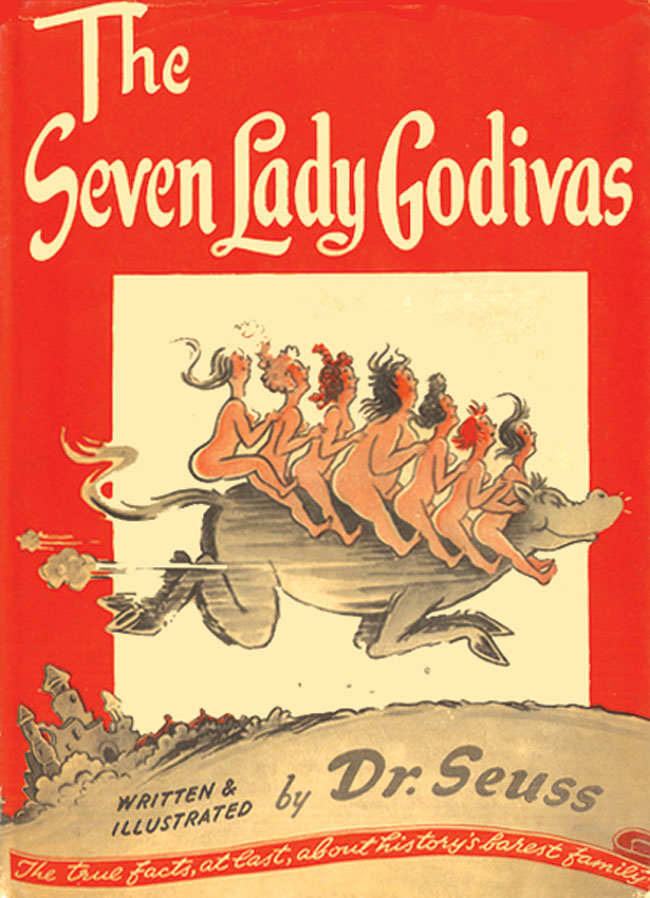
The Seven Lady Godivas by Dr. SeussWhile doing research for a future review of On Beyond ZebraI made this delightful discovery: Theodor Seuss Geisel (better known as “Dr. Seuss”) wrote and Bennett Cerf of Random House published The Seven Lady Godivas: The True Facts Concerning History’s Barest Family — a nudie novelty book aimed at adults.

Jack St. Rebor at Seussblog has done a good job describing the book, so I recommend you click the link and read the post.

Maria Popova of The Atlantic posted a nice collection of illustrations. My favorite Lady Godiva is “Dorcas”. You may not want to know that.

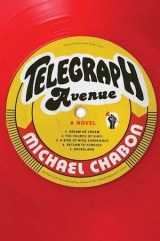
"Telegraph Avenue" a novel by Michael ChabonI’ve read a large number of pretty good novels by pretty good authors, and now I’ve read one more: Telegraph Avenue by Michael Chabon.

This is both praise and criticism, but not blame. It takes real talent and hard work to write a pretty good novel. Pretty good novels are less common than merely mediocre novels, or frankly bad novels, but they aren’t that uncommon either. In fact, with care and a little luck, you could spend your entire life reading pretty good novels.

If you want greatness, you won’t find it in Telegraph Avenue. If you want a pretty good novel, read on and see if Chabon’s latest matches your taste.

Telegraph Avenue: The Obligatory Summary

Telegraph Avenue is principally concerned with two couples, one African-American (Archy Stallings and Gwen Shanks) and one white (Nat Jaffe and Aviva Roth-Jaffe), and the two businesses they own in Oakland, California.

The men are the proprietors of Brokeland Records, a used vinyl record store specializing in jazz and funk, while the women are mid-wives and the owners of Berkeley Birth Partners. Both businesses are under threat, the record business from a proposed entertainment superstore, and the midwifery practice as a result of a complication that Gwen is perceived to have mishandled.

Gwen and Archy’s marriage is also in danger because Gwen, who is nine-months pregnant, no longer can tolerate Archy’s serial infidelity. In the mix are Archy’s father, Luther Stallings, a feckless former blaxploitation star looking to finance a new movie, and restart his career, using dubious means; the teenage sons of Archy and Nat, who are both friends and having sex; and an assortment of uniformly colorful secondary characters who round out the mise en scene.

I expect strong, well-drawn, complicated, but largely sympathetic characters from Michael Chabon, and he delivers these in Telegraph Avenue. I also expect a well constructed story, and on this quality Chabon is only middlingly – but I think deliberately – successful.

It’s clear Chabon intended to write a big, sprawling novel so I’m not going to ding the structure of Telegraph Avenue for being a bit of a mess.

But I will ding the novel for lacking a vision that might unify its multitude of elements. And I will knock Telegraph Avenue for its relentless, too-cool-for-school pop-culture fanboyism and for its prose style, in which some fine writing gets lost in Chabon’s inability to leave a sentence alone when he could adorned it with an excessive, frequently self-indulgent, and sometimes incoherent description, metaphor, reference, anecdote, or editorial aside.

Telegraph Avenue’s Message is … What?

The fastest way to lose me as a reader of novels is to hit me over the head with your talking points. But the lack of a vision, sitting behind the action, also weakens books. The best writers make you see the world in a new way. Telegraph Avenue doesn’t.

Chabon does feint a couple punches toward social comment, but without actually throwing one.

The first is toward soul-less big capitalism, embodied by the entertainment megastore and the healthcare industry. But this goes nowhere because the novel is firmly grounded in the bohemian middle class, who expect to enjoy the wealth of capitalism while rejecting its crass aesthetics (and pretending to themselves that this rejection is moral strength).

The second is toward race in America and here, Chabon either doesn’t throw a full punch or he throws a couple sly sucker ones.

One sucker punch is thrown at the white liberal middle class and upper middle class who are unable to distinguish their (I suppose I better say “our”) sense of personal injury and entitlement from our sense of social justice. Which leaves the people who actually need social justice out in the cold.

The utterly typical example of this is the opposition of Nat, and a few other neighborhood folks, to the entertainment megastore, which would bring new economic life to the community and provide steady work to a whole bunch of residents who don’t have it. If Chabon meant to criticize his most likely audience, he has. Sorta.

** Spoiler alert in the second example **

The second punch is a single scene which I would say was a knock-out blow if it weren’t one incident in a book that spends much more energy making comic book references than taking a clear-eyed look at America today.

The scene is when Gwen comes before three white male doctors at the local hospital who are addressing a complaint lodged against Gwen by a fourth white male doctor, who was the attending ob-gyn on the day Gwen and Aviva brought one of their home-birth patients to the ER because of a complication.

The attending ob-gyn had disparaged Gwen and Aviva’s work as dangerous and incompetent “voodoo” (among other phrases) and Gwen had gotten into his face. The stakes behind the complaint include Gwen and Aviva’s privileges at the hospital without which their practice would collapse.

Gwen goes on the offensive, accuses the attending doctor of racism, and threatening an EEOC complaint, which sends the doctor and the board into full retreat.

How much of a role did race play in this conflict? Clearly some. But how much of the attending doctor’s behavior was driven by the sometimes arrogance of physicians and their sometimes contempt for health providers without MD degrees? How much by underlying competition between two professional groups vying for the same group of patients? How much by personality, both the doctor’s in particular but also Gwen’s? How much by the circumstances of the moment of the argument, when both Gwen and the attending were stressed and exhausted?

If Chabon had done more of this, Telegraph Avenue would have been a novel with more power. Instead, we get a lot of Superman and Kung Fu.

Telegraph Avenue and Fanboy Sterility

Fanboys are enthusiastically followers of a particularly genre of art or culture. They use intellectual sophistication, encyclopedic knowledge, and painstaking analyses to compete with each other.

They also fiercely defend the purity of their fixed canon against subsequent changes, which they regard as corruptions. Because of this, fanboys are mostly born only after the energy, innovation, and creativity of a genre have been exhausted.

Telegraph Avenue is full of fanboys. Most prominently, there are Archy and Nat, who curate funk music on vinyl in their record shop and play funk music in their band. There are also Archy and Nat’s sons, who are enthusiastic fans of 1970s kung-fu movies. This enthusiasm spills over into Chabon’s plot, which embraces Luther Stallings and Quentin Tarantino, as well as Chabon’s narrative voice, which frequently makes references to comic books and pop culture.

The problem with all this fanboyism is that if you don’t share Chabon’s enthusiasms, large tracks of Telegraph Avenue cease to be interesting or compelling.

Worse, Chabon’s fanboyism seems to have diverted his attention from his real task. After all, it is the job of artists to bring energy, innovation and creativity to their work. It is the job of artists to corrupt fixed canons. It’s the job of artists to imagine the new, not protect the old. And it is the job of the artist to engage us, not talk to himself.

I think Chabon did these things well in The Amazing Adventures of Kavalier & Clay, where his enthusiasms became part of the blood of the book. In Telegraph Avenue, fanboy creative exhaustion seems to have infected the novel itself and Chabon’s enthusiasms just seem like distractions or self-centered obsessions. Or filler.

Telegraph Avenue and the Porn Star’s Testicle

You can open Telegraph Avenue at random and almost instantly find a sentence or a part of a sentence Chabon should have cut.

Take the one below from page 14, describing one of the security guards who is escorting Luther Stallings out of a memorabilia tradeshow because he doesn’t have a ticket.

The younger of the goons [had a] head shaved clean as a porn star’s testicle.

I have a number of problems with this. First, technically, male porn stars don’t shave their testicles. They shave their scrotums.

Second, the look of the skin on a shaved head is not the same as the look of the skin on a shaved scrotum. A shaved head is shiny and smooth. A shaved scrotum, no matter how tightly stretched, has wrinkles and dimples. When a sentence implicitly compares the appearance of thing A to thing B, then I believe thing A should actually resemble thing B.

Third, what is this testicle doing here? What purpose does it serve? How does it make the sentence better? What system of imagery does it extend or what resonances with other themes does it share?

Because the words “porn star” plus “testicle” are a real attention-getter, and if you are going to grab the reader’s attention like that, it should be for a good reason. Closer examination should produce an “Ah ha!” not a “Huh?”

I’ve read this passage many times. I don’t see a good reason. I just think Chabon’s well-earned success as a writer has made him sloppy.

Page after page of Telegraph Avenue is lousy with this stuff. If you enjoy writing of this type, you are in for a real treat because there is a lot of it. But if you don’t, then like me, you are going to need to adopt a friendly tolerance for the quirks of a writer you generally respect and do a whole bunch of skipping.

Which I recommend. Because the virtues of Telegraph Avenue are still greater than its faults.
The Hunger Games movie posterFor a carefully engineered pop-culture phenomenon and money-minting machine, the movie version of The Hunger Games ain’t half bad.

As you likely know, the film takes place in a post-apocalyptic future where the United States has become the totalitarian nation of Panem (a country that seems to be built from equal parts Walker Evans photography and Fritz Lang’s Metropolis).

Every year, the rulers of Panem hold the Hunger Games, a live televised gladiatorial spectacle for which 24 teenagers are chosen by lottery to participate. These children are required to fight and kill each other until a single boy or girl remains alive.

The movie follows 16-year-old Katniss Everdeen who volunteers for the games to save her younger sister, and who joins the boy chosen from her “district” to participate in the games – a boy we’ll discover soon enough has a crush on her.

What The Hunger Games Gets Right: Totalitarian Brutality, Katniss, and Haymitch

Gary Ross’ film adaptation of Suzanne Collins’ novel gets many things right. The bland, calculating ferocity of Panem’s leaders – who use the games to terrorize the half-starving masses and distract the luxury-addled ruling class – is persuasive as is the palpable fear and loneliness you can read on the children’s faces each time no one, except the audience, is watching.

Ross and the actress Jennifer Lawrence also get Katniss right. She is brave and resourceful, but she is not a preternatural self-confident and decisive Alpha girl. Katniss possesses an awkwardness and uncertainty that make her seem like a real teenager, too, although these qualities can also make Katniss a blank sometimes.

Woody Harrelson, as former Hunger Games’ winner Haymitch Abernathy and Katniss’ mentor, does more with a smaller role, suggesting both the damage the games have done to him and the caginess of a man who knows that the rulers of Panem still want to use him as a pawn.

Finally, and thankfully, the deaths of the Hunger Games participants’ are brief and discrete, rather than exploitive, although this discretion is much more about making the movie safe for mass consumption than it is about making a statement concerning the violence itself.

What The Hunger Games Gets Not-So-Right: Moral Quandaries and Teen Romance

Rendering The Hunger Games safe for mass consumption requires more than not lingering over the dramatization of children killing children, however.

It also requires contortions to prevent the moral depravity of the movie’s premise from tainting its heroine and our sympathetic identification with her (not to mention our willingness to pay $12.00 to watch fictional children slaughter each other).

To do this, the movie turns some of the Hunger Games’ victims into villains: specifically the kind of sadistic bullies that have populated movies for teenagers every since Hollywood started making movies for teenagers, except instead of insulting your clothes or hitting you in the nuts during dodge ball, they – you know – stab you in the heart with a sword.

This same requirement also demands that Katniss never have to make a morally compromised choice. She only directly kills one on the villain-victims as an instantaneous, defensive reflex. She is the indirect cause of the death of two other bullies, both of whom were threats to her. And she is the stalwart protector of the games’ youngest and most vulnerable participant as well as that boy with the crush on her, a doe-eyed but strapping young fellow by the name of Peeta.

Peeta is, of course, the other great concession the story makes to the imperative of mass consumption, in this instance to the ostensible requirement of young female audiences that a movie have a romance no matter how utterly out of place it is.

For example. When a girl is trapped in a high-tech colosseum run by dystopian dictators, what does she need more than food and shelter? More than medicine? More than better weapons or allies? More than a Deus-ex-machina revolution breaking out to save her?

She needs a boyfriend, apparently.

Anyhow, following the old formula, Peeta is sexually non-threatening, but following the newish formula (I’ll date it from the 1997 appearance of Buffy the Vampire Slayer on TV), he is less lethal than Katniss, but still able to throw a pretty kick-ass sack of flour in a pinch. I’m not making that up.

So The Hunger Games distorts itself around the creation and preservation of this relationship, to the extent that even the ruthless despots running the Hunger Games are helpless before it.

When Katniss and Peeta decide to go Romeo-and-Juliet on the murderous bastards, rather than decide who will die for the other, the bastards cry “Uncle!” and declare both can live.

Thus it appears the moral of The Hunger Games is that when Power Lust throws down against Puppy Love – Puppy Love wins. It sure sells more tickets, in any case.

Our luck may fail; our powers forsake us; our place on the boards be taken by better and younger mimes — the chance of life roll away and leave us shattered and stranded. Then men will walk across the road when they meet you — or, worse still, hold you out a couple of fingers and patronize you in a pitying way — then you will know, as soon as your back is turned, that your friend begins with a ‘Poor Devil, what imprudences he has committed, what chances that chap has thrown away!’ Well, well — a carriage and three thousand a year is not the summit of the reward nor the end of God’s judgment of men. If quacks prosper as often as they go to the wall — if zanies succeed and knaves arrive at fortune, and vice versa, sharing ill-luck and prosperity for all the world like the ablest and most honest amongst us — I say, brother, the gifts and pleasures of Vanity Fair cannot be held of any great account.

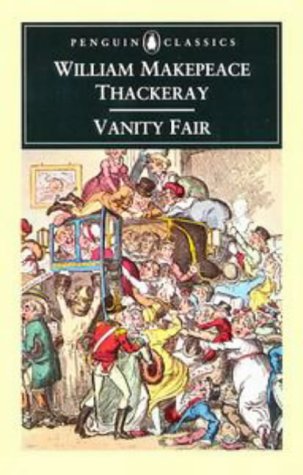
"Vanity Fair" by William Makepeace ThackerayThis quote has always seemed to me to be the heart of Vanity Fair, although it quivers with a sympathy — a sense of gentleness and mercy — that the sour Thackeray can’t quite summon for the characters he creates.

They are, for the most part, zanies and knaves or men and women of substance corrupted by their vanities. There is only one character Thackeray would likely describe as “ablest and most honest” — William Dobbin — and even Dobbin Thackeray mocks for pursuing and finally marrying a woman who Dobbin knows is not equal to and does not deserve his love.

The phrase “our place on the boards … taken by better and younger mimes” nods at one of Thackeray’s principal conceits in Vanity Fair: that his characters are “puppets” and he is the “Manager of the Performance”. But I also think the phrase gestures at something more profound, that Thackeray thinks we are all puppets, too, hack players in a foolish play.

“Well, well,” as Thackeray said. Maybe. But the vitality Thackeray invests in this nearly 800-page novel argues differently. And his opinion that “the gifts and pleasures of Vanity Fair cannot be held of any great account” perhaps suggests there are other gifts that are of “great account”. What these gifts might be, however, Thackeray doesn’t say.

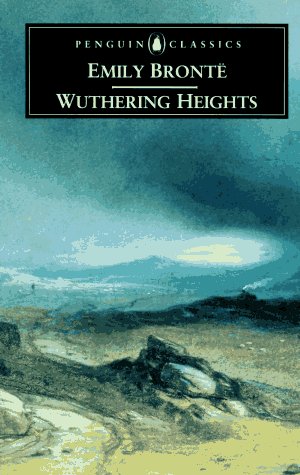
Bronte Wuthering HeightsHalloween is an excellent time to read a scary book, but you don’t have to read dreadful trash written by semi-literate hacks – although honestly, that can be pretty fun too.

So I’ve chosen my favorite works of “horror” from famous writers for this personal “best of” list, and treated each to my 100 Word Review format. Hope you find something in here you like!

Emily Bronte: Wuthering Heights (1847). Heathcliff and Cathy’s fierce love survives betrayal and lives on beyond death in this superb novel. Wuthering Heights tests the reader’s patience through its long middle section, but rewards this patience in the end, when Heathcliff either embraces an ecstatic vision or succumbs to insanity.

Cormac McCarthy: Blood Meridian (1985). Sam Peckinpah meets the Old Testament in this nightmare Western by the author of No Country for Old Men. Although the story follows a young boy through the Indian wars of the 1850s, its central figure is “the judge,” who seems to be neither man, demon, nor god, but the embodiment of the endless violence fixed deep in the human soul.

Henry James: The Turn of The Screw (1898). A country house, two small children, a young governess, and the appearance of menacing apparitions. You’ve seen this set-up before. But James is a master storyteller, and the ambiguity at the center of his tale – whether the children are haunted by the ghosts of former servants or by their governess’ furious delusions – make this work particularly effective and frightening.

Bram Stoker: Dracula (1897). Stoker’s novel makes the list because it’s a vampire novel actually worth reading. Dracula is a predator, not a seducer, and Stoker’s work surprises by resembling a detective novel as much as it does a horror story.

William Shakespeare: MacBeth (1606). An obvious choice, but it bears repeating that a play featuring regicide (among other murders), witches, ghosts, sleepwalking, suicide, a severed head, and blood everywhere and continuous, is a good choice for Halloween.

Nikolai Gogol: The Nose (1836). In this Russian short story, a minor civil servant wakes up one morning to discover his nose has been replaced by blank skin as flat as a “freshly cooked pancake”. The missing nose is an embarrassment, an inconvenience, an annoyance, a source of curiosity or indifference, but never the cause of wonder or fear. Similar in many ways to The Metamorphosis, Gogol wrote this story nearly 80 years before the appearance of Kafka’s famous beetle.

Shirley Jackson: The Lottery (1948). Jackson’s much-anthologized short story packs a wallop with its renowned gimmick ending. Whether it’s anything more than Children of the Corn for the Proust set is another matter.

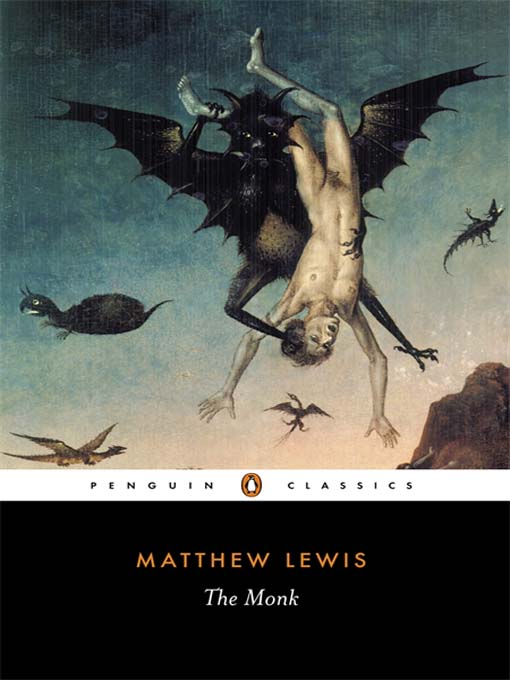
Matthew Lewis The MonkMatthew Gregory Lewis: The Monk (1796). For lurid trash with a pedigree, it’s hard to beat The Monk. The novel tells the story of a pious Capuchin who succumbs to lust and features black magic, rape, incest, torture, murder, and behind it all, the machinations of the Devil himself. The Monk is one of the key novels of the Gothic genre. It is also an urtext for the mass-market bestseller, in which a book that lacks coherent plot, internal logic, human insight, or a glimmer of writerly craft can become wildly popular by sheer force of sensationalism.

Bela Lugosi's DraculaFilmmakers generally take liberties with novels when they turn them into movies. And they should. What director wants to make a movie that is simply a faithful adaptation of someone else’s work?

At the same time, it comes as no surprise – for those with a nose for box-office profit – that the liberties directors like to take with novels often have to do with matters of sex.

This is certainly the case with two familiar versions of Bram Stoker’s vampire novel Dracula: the 1931 movie directed by Tod Browning and starring Bela Lugosi and the 1992 movie directed by Francis Ford Coppola, with Gary Oldman in the title role.

In Stoker’s novel, Dracula is a predatory monster who is indifferent to his victims. He is also a peripheral character. Dracula is largely absent from the pages of the book after the scene shifts from Transylvania to London.

In both 1931 and 1992 films, however, Dracula is a central character who develops a romantic relationship with the heroine of the story, Mina Harker.

Lugosi’s Dracula is a debonair aristocrat who tries to cart off Mina to be his demon bride against her will. Oldman’s Dracula, by contrast, turns up the dramatic volume. His vampire is a Romantic hero who finds in Mina the reincarnation of his much beloved, long-dead wife and who persuades Mina to fall in love with him and participate in her supernatural transformation.

The 1931 version is a classic, but the film is no longer interesting to watch except as a period piece. Its major problem is that it is just not scary anymore. The old-fashioned style of the acting, which mixes the naïve with the declamatory, doesn’t help. And the film is a victim of Bela Lugosi’s indelible performance, which is so familiar even to people who haven’t seen it that his original interpretation looks like a caricature.

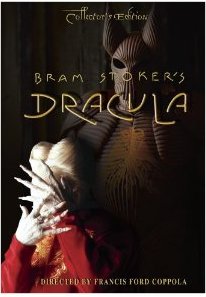
Gary Oldman's Dracula directed by CoppolaCoppola’s version is a middling success, not a classic, but it’s more fun despite its problems. Most of these are caused by the cast. Keanu Reeves and Winona Ryder are bloodless in their roles, which is a big problem in a vampire flick; and a post-Silence of the Lambs Anthony Hopkins as Dr. Van Helsing serves up a disappointing piece of lukewarm ham, instead of his savory fava beans and Chianti.

Luckily, there is an exquisite Gary Oldman as Dracula. Coppola’s film restores enough of the characters and story lines eliminated from the 1931 version to make the title’s claim to being “Bram Stoker’s” Dracula reasonable. Further, Coppola gives the film an interesting visual style. It doesn’t have the pedigree of German Expressionist films, from which Browning cribbed for his Dracula, but it is distinctive enough.

All in all, you could choose many worse films to get you ready for Halloween than these two movies.

But having rewatched both films and read Stoker’s novel recently, I have to admit the best vampire movie I’ve seen doesn’t feature Dracula and doesn’t come from Bram Stoker.

If you’re only going to watch one vampire movie this month, it’s hard to beat the superb combination of sex, style, horror, melodrama — and especially haute cheese — that Neil Jordan delivers in his film adaptation of Anne Rice’s Interview with the Vampire. Sorry, Bram.

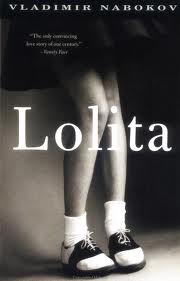
I am thinking of aurochs and angels, the secret of durable pigments, prophetic sonnets, the refuge of art. And this is the only immortality you and I may share, my Lolita.

Lolita by Vladimir Nabokov

Nabokov’s masterpiece is frightening story of abuse, a Gogolish road-trip through post-war America, a funhouse of unreliable mirrors, and a tale of selfish vice vanquished (but not excused) by love. After Humbert Humbert destroys his doppelgänger in the fairy-tale mansion on Grimm Road, he and Nabokov make a furious last dash to preserve Dolores Haze from time and death. They succeed.


The Unconsoled Kazuo IshiguroI can recommend The Unconsoled by Kazuo Ishiguro only to hard-core fans of Capital “L” Literature and even then, only to completists.

The Unconsoled follows Charles Ryder, a famous pianist, as he prepares to give a concert in an unnamed European city. Along the way, he is diverted from his preparation by a series of tedious conversations, meaningless tasks, and importunate personal requests from strangers who may or may not also be close family members or friends from his past. Both space and time seem to distort themselves around Ryder, and he has the ability to narrate events and conversations of which he can have no logical knowledge. In the end, as you might guess (I did by about page 23), Ryder never gives the concert.

The obvious major influence hanging over the book is Franz Kafka, although Lewis Carroll deprived of his whimsy and delight makes a strong argument for himself, too.

It’s also hard for me to think that Ishiguro has unknowingly given his character the same name as the hero of Evelyn Waugh’s Brideshead Revisited, another feckless and second-rate artist who is unhappy in his personal life.

But whatever the relationship of Ishiguro’s Charles Ryder to Waugh’s Charles Ryder may or may not be, and whatever relationship The Unconsoled may or may not have to Kafka or Carroll, and whatever significance all the complicated, ambiguous goings-on in this 500+ page novel may or may not possess – the truth is I don’t care because I don’t think the novel rewards the effort required to figure it out.

I have a couple loosely related reasons for thinking this. I’m going to toss them out and let you decide. Here they are.

The Unreliable Author or “Who is Charles Ryder?” Problem

“What’s up with Charles Ryder?” is probably the big question about The Unconsoled.

Does he suffer from a mental illness or some form of amnesia or dementia? Does Ryder have emotional problems that prevent him from connecting with other people? Is he just another hapless existential shadow wandering through a meaningless universe? Is Ryder a cubist construct of the conscious and unconscious mind intended to be part of a “realism taken to its extreme” project? Is his character a vehicle for expressing the instability and chaos that lie deep within seemingly stable human personalities?

All of these explanations seem plausible but none seem more plausible than the others. Which leads me to the suspicion that Ishiguro thinks it is the reader’s task to make sense of the book, not the author.

Some people like this. I don’t.

Life is a complicated, frustrating, ambiguous experience of which it is my task to make sense.

I’m on it. But I got my hands full just trying to make sense of my life. I don’t need Kazuo giving me duplicate homework.

The Exploring “Emptiness and Tedium” by Being Empty and Tedious Problem

I actually think this is what The Unconsoled is doing. The problem is that while exploring emptiness and tedium is interesting as an idea for a book, and might make a great short story, it is not interesting AS a book – especially one that is 500 pages.

And here’s a related problem.

Right now, I’m looking at a kitchen full of dirty dishes I need to clean up before I go to bed. If I want to explore the emptiness and tedium of life, I can think of no better method than washing those dishes. As a bonus, when I’m done, the dishes are washed.

At which point I could read a book that tells me something other than the fact that life can be empty and tedious, which – by the way – I already know because I just finished washing the d@mn dishes for somewhere between the 7,000th and 8,000th d@mn time in my life.

The Length for Length’s Sake and Difficulty for Difficulty’s Sake Problems

I don’t think Ishiguro wrote a long, difficult book just because he wanted the prestige of having written a long, difficult book.

First, Ishiguro doesn’t seem like that kind of guy looking at his body of work. Second, to say that would be to accuse Ishiguro of writing in bad faith, and I don’t know that to be true, and it may not be possible to know that about The Unconsoled.

But I wonder if Ishiguro was tempted or influenced by the desire for the prestige, considering the result. Writers, despite our often shy reputations, are just as vain as the next artist, after all.

Maybe Ishiguro’s ambition was greater than his inspiration or talent. It happens all the time in novels. If fact, it might happen every time. That would make The Unconsoled an honest effort. But it doesn’t necessarily make it one worth reading.

I love Dr. Seuss’s ABC and read it to my kids all the time. But after several years, I realized I had to skip “Letter R”.  It all seemed innocuous at first.

“Letter R” wasn’t my favorite rhyme but I kinda dug
Rosy Robin Ross’  jodhpurs and riding crop.

I wondered what Rosy found so interesting
about the red rhinoceros.  He seemed like
a nice fellow, but nothing special.

Then one day it struck me. I took a real close look
at that nose of his and thought, “Uh oh.”