Shakespeare's Hamlet

Go ahead. Cut my lines. I dare you.

Many of Shakespeare’s plays are baggy loose monsters — but Hamlet may be the baggiest and loosest of them all.

It’s hard to stage the full text in less than four hours unless you take it at a dead run; and considering there are scenes and even characters which could seemingly be cut and make the play better, why wouldn’t you?

But here’s the thing. Hamlet can look a mess on stage. But it has a near perfect harmony among its thematic elements. And once you seem them, it is difficult to consider (well, at least for me) anything but judicious line edits.

Here are my arguments against making the most common cuts:

Fortinbras

When directors are looking to save time, Fortinbras is usually the first to go. The problem is that Fortinbras is the play’s essential frame.

It is clear that Shakespeare intended Fortinbras to play this role. Like Hamlet, Fortinbras is the son of a king who shares his father’s name and who is seeking to avenge his father’s death and recover his kingdom from a usurper.

Fortinbras is also uniquely tied to Hamlet. As we learn from the gravedigger in Act V, Hamlet was born on the day his father slew Fortinbras’ father. Fortinbras achieves his revenge barely five minutes after Hamlet’s death. The correspondences between the two characters are so exact they must be deliberate.

Fortinbras offers two important contrasts to Hamlet. The first is that Hamlet is only interested in personal revenge. He acts with indifference to his responsibilities as a powerful prince and there is not much evidence that Hamlet actually cares he isn’t king.

Fortinbras also wants his revenge, in his case by attacking Denmark, but he won’t do it in defiance of his Uncle Norway.  Despite his personal motivations, Fortinbras acts like a politic prince.

The second contrast is that Fortinbras is patient, resolute, calculating, bold, and opportunistic.  Fortinbras manages events in his life while accepting they are often beyond his control and keeping his eyes on his goal.

By comparison, Hamlet cycles between paralysis and recklessness.  He tends to either over-manage or under-manage events, and his Act V fatalism leads him to walk into a contest that both he and Horatio sense is a trap.

The result? Hamlet is complicit in the destruction of the entire Danish royal family. Fortinbras seizes the crown of Denmark without striking a blow.

Ophelia & Laertes

This sister and brother are too central to the plot of Hamlet to disappear, but they often get trimmed.  And these cuts reduce Ophelia and Laertes’ role as a double for Hamlet.

Like Hamlet, Ophelia and Laertes also have a murdered father, and between them they reflect Hamlet’s reactions to his murdered father – except Ophelia and Laertes follow their reactions through to conclusion.

Hamlet is believed to have gone mad either because of grief for his father’s death or despair over Ophelia’s rejection of his love. He also contemplates suicide.  Ophelia actually goes mad with grief from her father’s death and actually does commit suicide.

I also believe she feels despair over Hamlet’s rejected love, sharpened by his murder of her father. There is a great deal of evidence that Hamlet and Ophelia’s relationship was serious (Hamlet’s behavior in the graveyard makes little sense if it wasn’t) and more than enough circumstantial evidence to convince me it was sexual.

Both Laertes and Polonius worry about Ophelia losing her virginity to Hamlet. Hamlet taunts Polonius and Ophelia in explicitly sexual terms after Ophelia obeys her father and rejects him. Ophelia’s madness is full of talk of sex and unfaithful lovers. None of this makes much sense if Hamlet and Ophelia shared a mere chaste flirtation.

Laertes is, of course, the wronged son who actually does “with wings as swift as mediation … sweep to [his] revenge”.  He acts with the kind of blinkered recklessness with which Hamlet believes he should also act.

Like Hamlet, Laertes is focused only on his personal revenge, not the political implications of conspiring with the king to murder the heir to the throne. And he dies the same death as Hamlet, from the same weapon and same poison.

One detail of Laertes story also reveals the politics that are largely invisible in the play. Even though he is not a member of the royal family, Laertes shows up in Denmark and instantly becomes the leader of a rabble ready to make him king.

Why couldn’t Hamlet have organized the same men to depose Claudius? He was, by Claudius’ report “loved of the distracted multitude”. Fortinbras would have seized the opportunity in one red hot minute. Hamlet, apparently, never saw his chance or gave it a thought.

The Player King & Queen

I get why a director would cut these speeches. The dumb show that proceeds the Player King and Queen does everything needed to advance the plot. Other scenes and speeches emphasize the point that practically every character in Hamlet is playing a role (you could go as far to say that Hamlet’s tragedy was he was forced to play roles to which he was not suited). The Player King’s speech is hard to follow. And the topic of the scene is not particularly relevant to the major themes of the play.

But I will say this. It is interesting that the most honest and authentic conversation in the whole play (excepting those between Hamlet and Horatio) occurs between two actors playing actors in a play within a play.

I also think it is interesting that Hamlet chose this text for the actors to play. The scene suggests how Hamlet might have viewed his parents’ relationship, regardless of the actual and unknown truth of the matter.

Polonius & Reynaldo

Honestly, you could whack this entire scene and not do Hamlet any harm at all. Other than hinting that Polonius might not have been a complete idiot for his entire life, and providing some additional comedy – if you want that – I don’t see the point. I’m always surprised when this scene appears in a production.

Let’s Whack “the morn, in russet mantle clad” Etc.

All of which is not to say (Reynaldo withstanding) that with a sharp pencil, and a little work, a director couldn’t easily save her audience 30 or 40 minutes of sitting. There’s not too much pure purple junk in the play, although those lines of Horatio’s at the end of Act I qualify.

I find almost every word Hamlet says entertaining, but I’m also aware other people might reasonably conclude that the man never shuts up; and if these people trim some of his words, particularly if they are making a Hamlet movie, I may not like it, but I don’t blame them.

Polonius also talks on and on, which is the point and also the joke, but generally the point is gotten and the joke exhausted well before Polonius finishes up. You can excise lesser lines of lesser characters and some of the duller clowning of the gravediggers. That would all be fine.

But please leave Fortinbras alone. We really need him!


Hamlet David TennantBased on its reputation, I was expecting to like the 2009 Royal Shakespeare Company production of Hamlet, directed by Gregory Doran and starring David Tennant, much better than I did.

Every Hamlet rises or falls on the performance of the title-role actor, and Tennant had both strengths and problems. He has the perfect look for the part, and he nailed the Danish prince’s anxiety and snark. But when it came to exploring Hamlet’s anguish and rage, he fell back on acting BIGGER and LOUDER. As I result, I don’t think Tennant connected with full emotion to the part, so I didn’t feel much emotion watching him.

Another problematic performance was Patrick Stewart’s Claudius.  I liked his wise and even-tempered reading; however, Stewart’s usurper was so amiable that he failed to convince me he could kick a dog much less kill his brother, seduce his brother’s wife, and plot the treacherous murder of their son.

On the plus side, the women of the play were pretty good. Mariah Gale’s Ophelia was strong and self-possessed, even in madness where she was more angry than wounded. (Jean Simmons’ guppy out of water reading of Ophelia in Olivier’s movie version was a low point of Hamlet on film.) Penny Downie’s Gertrude was quite good, too, except for the Act IV bedroom scene with Tennant, when she seem to fight his big and loud with her own big and loud.

Also on the plus side, Doran’s Hamlet is funny. He seizes every opportunity the play allows to read lines as comic. This means Polonius really takes it on the chin, although I also enjoyed the utter bafflement Tom Davey’s Guildenstern projected whenever the dialogue didn’t require him to reveal a faint glimmer of understanding. (He gave Osric a run for his money. ) Good fun too were the expressions of impatience, disbelief, credulity, and exasperation the actors wore whenever anyone, not just Polonius, made a long speech. All the joking diminished the tragic punch of the staging, however.

Now, my quibbles. I have no idea in what time period this Hamlet was meant to be set. Tennant was the complete modern hipster. Horatio dressed like a middle-aged academic circa 1982. Claudius and Gertrude had the air of a rich mid-20th century power couple. Polonius resembled an Elizabethan courtier on dress-down day. Different soldiers carried weapons from vastly different centuries. If there was a point to all this variety, I missed it.

Finally, Doran cut roughly seven lines from “To be, or not to be”.  God knows there are vast tracks of Shakespeare – particularly in the history plays – which can be given the boot to everyone’s benefit, but editing Hamlet’s most famous speech accomplishes nothing beyond gratuitous shock value.

On my Hamlet list, I’d put the Tennant version right above Ethan Hawke’s. See my list of best Hamlet movies.

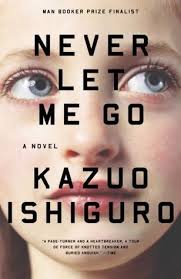
never let me go ishiguro rviewCan you appreciate a book without particularly liking it? That was my reaction to Kazuo Ishiguro’s 2005 speculative or experimental or science-fiction novel (read the review then pick your adjective), Never Let Me Go.

 Never Let Me Go focuses on three characters – Tommy, Ruth, and the novel’s narrator Kathy H. – who are students at what seems to be an upscale private school called Hailsham in what seems to be England in the 1980s.  But something isn’t quite right.

The disquiet begins with the first chapter in which an adult Kathy talks about her work as a “carer” for “donors”.  The story quickly returns to Kathy’s childhood at Hailsham where the students are only taught art, where the teachers are called “guardians”, and where not only are parents and the outside world never mentioned, but where they seem to barely exist.

As it turns out, there is a good reason for all these strange facts. The students of Hailsham are clones who are being raised to adulthood for the singular purpose of providing organ donations to “normal” men and women. The last donation is fatal.

And with that realization, we follow Ishiguro down his rabbit hole, and pop up in the world of Kafka or Beckett (as other reviewers have well noted before me); but unlike the fantastical worlds of Gregor Samsa’s middle-class family apartment, or Vladimir and Estragon’s desolate country road, the world of Never Let Me Go never quite achieves a coherent internal logic. Which means I don’t think the novel is an entirely successful experiment.

But before I get to these objections, let me talk about what I think Ishiguro did right.

The Flat Affect of Kathy H. Is Pitch Perfect. And Hard to Take

 Kathy H.’s narrative voice in Never Let Me Go is cool – even cold – dispassionate, and elusive. She leaves an enormous amount unsaid about the feelings and experiences of clone donors. They all seem to embrace their fate with a combination of resignation and acceptance. The four stages of donations are not described. Post-operative pain or complications are vaguely acknowledged, at best. Every donor dies off the page. No one knows where the bodies are buried. If they are buried.

Kathy H.  describes strong emotions, even in herself, with a matter-of-fact tone that prevents us from feeling them. She doesn’t seem to want our sympathy, and her coolness makes our empathy harder.

But all this seems exactly right. Asking someone to remain alive in feeling who has been bred and raised like cattle; who has helped the people she loves die in the service of a society that treats them as spare parts; and who herself is now facing the same death – all that is too much.

Kathy H. should be shut down as person. And if that makes our empathy harder, then it should be harder, because it is a catastrophic lack of empathy in Never Let Me Go that makes the genocidal slavery of the clones possible.

And I would go further and say since any injustice committed by one human against another has as its foundation a failure of empathy, then the novel pushes us to strengthen the quality which is the solution to its (fantastical) horrors.

Never Let Me Go: An Inadequate Portrait of Human Life

You might think after that statement I don’t have any serious criticisms of Never Let Me Go. But I do.

My first criticism is based on the indications that Ishiguro wants us to understand the experience of Kathy H. and Tommy and Ruth as universal. We know this explicitly from the February 2005 interview Ishiguro gave to The Guardian in which he said:

There are things I am more interested in than the clone thing. How are they trying to find their place in the world and make sense of their lives? To what extent can they transcend their fate? … Most of the things that concern them concern us all.

We also know it implicitly because it is not just Kathy H. who responds to her fate with resignation and acceptance. Every clone responds with resignation and acceptance. If there are variations from these two emotions in the world of Never Let Me Go, we have no report of them.

This is a barren and withered portrait of human life; and while it is an accurate description of some human lives, it is entirely inadequate representation of the human race I know.

That race, too, strives with might and contends with blood. That race, too, loves with a fierceness that will break before it quits. That race, too, rejoices and despairs. That race, too, knows beauty as well as horror. That race, too, seethes for justice in the face of injustice. That race, too, believes beyond all reason, beyond the heavy evidence of experience. That race, too, endures and endures.

Where are these lives too in Never Let Me Go?

Clone Organ Donors: Extraneous and Finally, a Distraction

My other problem with Never Let Me Go is that I think it was a mistake for Ishiguro to situate his science-fiction nightmare in what otherwise appears to be England in the middle-late 20th century.

It would have been fine if Ishiguro had transformed the premise into something more familiar: say a children’s cancer ward in which Kathy H. could have been an orphan and ward of the state, the other characters had dysfunctional families, and so on. Then Ishiguro could still have explored the things in which he says he was most interested without all the fussing with clones.

Or he could have set Never Let Me Go in some dystopian alternate Earth-like world sometime in the past or future, in which it would be easy to accept the clones because that’s what happened in this world. (Think of Panem in The Hunger Games.) That would also have been fine and easy to do.

But as it is in Never Let Me Go, I kept stopping and saying to myself: “Wait, exactly how does this clone-donor society thing work again?”

How did England, barely ten years after the defeat of Nazi Germany, the exposure of the death camps, and the end of the Nurenberg Trials, transform itself from a reasonable progressive Western society – as these things go – into a moral monster? Did the rest of the Allied powers acquiesce or participate? How did England get the entire medical profession to ignore the Hippocratic Oath? Where there no objections from the religious communities? Did anyone object? Who was making money from this? Was there an underground railroad for clones? What was the system of control? As young adults, the clones seem to be able to roam at will. What stopped them from disappearing into society, where they would be indistinguishable from other human beings? Why didn’t the clones go all Rambo on the murderous bastards running the system? As an American, I can name entire states – hello, Texas – that would rise up in violent defense of themselves. How did science perfect cloning months after the discovery of the DNA double helix, but still need another 30 years to invent the Walkman?

Also, I’m not a big fan of the novel of social comment, but the premise clearly suggests that our societies are capable of such actions, but doesn’t go any further with the suggestion.  This combination of provocative and perfunctory doesn’t sit well.

Should You Read Never Let Me Go?

Never Let Me Go is two books in many ways. As the story of three people dealing with horrors not at all dissimilar from real ones in the world today, I thought it was pretty good. As a speculative science-fiction novel, it would have needed to speculate much harder and much more thoroughly to be a success

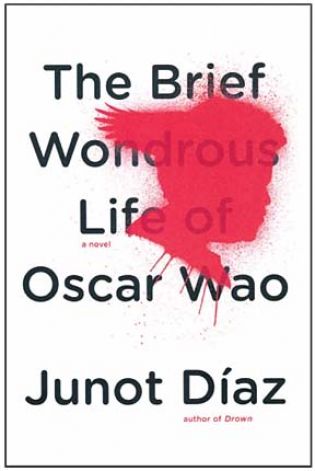
brief wondrous life oscar wao junot diaz reviewWhen artists are really good, I tend to curse at them. G-dd-mn Jane Austen. G-dd-mn Beethoven. G-dd-amn Billy Wilder. Now I’ve got a new name on my curse list. G-dd-mn Junot Diaz.

The Brief, Wondrous Life of Oscar Wao principally concerns its title character, his sister Lola, and their mother, although it does also tell the story of their extended family as well as that of its ostensible narrator, Yunior.

Diaz’ novel is that rare find – a work of current fiction that entirely lives up to its hype. The number of successful elements it delivers is simply ridiculous:

Big vivid characters that make a big splash on the page? Check.

Big vivid characters that are also richly imagined, convincing, and affecting? Check.

Multi-generational saga? Check.

Lots of sex but no sex scenes (thank you Junot!)? Check.

Healthy dollops of magical realism? Check.

Locations exotic to the typical American reader of literary fiction: hard scrabble New Jersey and the Dominican Republic? Check.

A narrative voice that is part gangster, part geek, and part grad student? Check.

A whole bunch of fanboy references to comic books, science fiction, and fantasy novels (oh god not again)? Check.

A great deal of untranslated Spanish dialogue, narration, and commentary? Check.

A third-world history lesson — in this case about the hyper-over-super-achieving sadistic Dominican dictator Trujillo and his thirty year reign of terror — much of which is told through jazzy footnotes? Check.

A story focused on the wild, uncompromising, irrational, destructive but all the same soul-sustaining power of love? Check.

A satisfying ending that unites all these elements in an organic whole that meets Nabokov’s definition of art, “beauty plus pity”? Check and check.

G-dd-mn Junot Diaz.

The only criticism of the novel I have is a flaw in the narrator which, as it turns out, isn’t a flaw at all. In the beginning of The Brief, Wondrous Life of Oscar Wao, Yunior pushes the comic book/sci-fi/fantasy references so hard that they almost entirely obscure the character of Oscar.

I kept muttering, “I can’t see Oscar, Junot, because all these Lord of the Rings references keep getting in the way.”

But what I realized is that early in the novel, Yunior is a young man who writes like a young man: overly earnest, full of himself, self-absorbed, and inept. He matures as he ages, and his narration matures too, until it is much wiser, more self-aware, more observant and empathetic, and more rueful.

Yunior is also one of those (not uncommon) characters who are their author’s alter ego, to the extent that they often share their creator’s omniscience. Yunior describes many things in the novel which are simply impossible for him to know.

Diaz doesn’t give Yunior the excuse of being the fictional author of the novel. Instead, Diaz shimmers in and out of Yunior’s character, which I think gives the novel more depth, because Diaz keeps getting you to fall into the dream of the story, then waking you up from it.

That’s another element I should have put in my list. Well, I’ll check it off now and conclude with this: G-dd-mn Junot Diaz.

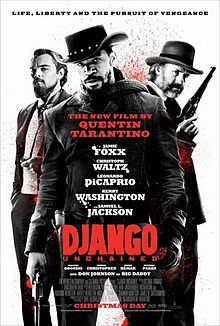
Django Unchained by Quentin TarantinoWhat is the relationship of movies to reality? In a strict sense, there is no relationship at all. The world of imagination, and the conventions and techniques of movie making, exist entirely on their own terms and make their own reality.

On the other hand, I can’t think of any successful movie that does not deal with the truth, at the very least the emotional truth, of human experience. Music and painting can traffic in abstraction and succeed. But movies? Rarely if at all.

Between art and reality comes the great mediator, the artist, who imposes her or his vision on art and reality. Sometimes the result is a rare gift of sublime pleasure and transcendental insight bequeathed to us, the grateful audience, for all time.

And sometimes the result is a steaming hot mess, dumped in our laps, for us to clean up and figure out. Or not.

Ladies and gentlemen, in case you couldn’t guess, Quentin Tarantino’s Django Unchained is irrefutably the latter. Whether it is a brilliant mess, or simply a mess full stop, is the question.

Django Unchained: The Obligatory Plot Summary

Tarantino’s latest movie primarily concerns Django, a slave played by Jamie Foxx, who is purchased and then freed by a German dentist and bounty hunter, King Schultz, played by Christoph Waltz.

Schultz initially buys Django because he can identify the Brittle brothers, who were brutal overseers at a plantation where Django was enslaved and who Schultz wants to track down and kill to collect the reward. After this is accomplished, Schultz frees Django, trains him as a bounty hunter, and decides to help Django find his wife, who has been sold to a particularly sadistic Mississippi plantation owner, Calvin Candie, played by Leonardo DiCaprio. Django and Schultz agree on a plan to free Django wife’s which does not go smoothly, to say the least.

Like many of Tarantino’s films, Django Unchained is a movie about movies. His famous love of old B movies and exploitation flicks is again on overabundant display, in this case spaghetti Westerns and the 1975 movie Mandingo among others.

Also again, Tarantino demonstrates his inability to distinguish his A material from his B material, which is reflected in the movie’s 180 minute running time; in the conversations which spin on at length; in a story line that manages to be too busy and meandering at the same time; and in the climactic gun fights which continue long after real-world human beings would have run out of bullets and blood.

Complicating  Django Unchained, and making it more than a fan-boy exercise and a guilty pleasure (if watching Django is the sort of thing you’d call  pleasure) are its anachronistic sense of humor and especially the moments, which are not frequent but are significant, when Foxx’ Django and Waltz’ Schultz step out of their roles as “characters in a B movie” and into scenes that confront the lived horror and violence of slavery.

Even more complicating is Samuel Jackson’s performance as Calvin Candie’s head house slave, Stephen. Jackson makes Stephen an Uncle Tom so malignant, a character so utterly twisted by servitude and yet so utterly invested in the slave system, that he threatens to break the movie apart; similar to the way that Shylock in Shakespeare’s Merchant of Venice can bring the play to a dead stop (at least for modern audiences).

Django Unchained: Blazing Saddles with Blood and Vengeance

There were moments during Django Unchained when I swore I was watching a Mel Brook’s movie.

This was particularly true during the sequences when Django and Schultz visit a Tennessee plantation owned by Big Daddy, who is played by Don Johnson.

There is a long conversation where Big Daddy tries to instruct his slaves how to behave toward Django, who can’t be treated like a slave because he is a freeman, but who can’t be accorded the same courtesy as a white man. There is also an utterly inept Klu Klux Klan raid led by Big Daddy which Tarantino plays for laughs (and which is an example of Tarantino’s ubiquitous and happy indifference to historical accuracy, since the Klan was founded seven years after the movie is stated to take place).

Equal ridiculous are the clothes Tarantino puts on Foxx for him to play the role of Schultz’ “valet” as they visit Big Daddy’s plantation. Django is decked out in a sky-blue satin fop suit complete with knee breeches and an enormous white neck cloth tied in a bow.

But in these clothes, Foxx’ Django simmers with barely contained anger. He and Schultz have come to the plantation to find the Brittle brothers, the men who also savagely whipped Django’s wife.

At the plantation, Django finds two of the brother’s preparing to whip another young black women for the crime of “breaking eggs”. Ignoring the plan, Foxx shoots the first brother, then seizing the whip, beats the second brother into submission with a ferocity founded in authentic anger, then coldly shoots him as he lies prostrate on the ground.

A British critic noted that Jamie Foxx often seems to not be in on the movie’s joke during Django Unchained.

But I think the truth is that neither Django nor Foxx can accept – could make themselves tolerate, if they tried – that the movie is a joke because the experience of African-Americans under slavery in the United States was manifestly not funny.

This approach to violence is not consistent in Django Unchained. In particular, at the end of the film, Django enters a fantasyland of violent revenge. But the cycling between different attitudes toward violence in Django Unchained keeps demanding we try to reconcile its fake artifice and real truth (yes, I know the redundancy is redundant) while guaranteeing that we can’t.

Which is one of the reason I speculated the adjective “brilliant” might apply to the noun “mess” when discussing Tarantino’s film.

And Django isn’t the only character that complicates our judgments about the film.

King Schultz Gets the Joke in Django Unchained … Until He Doesn’t Anymore

In the beginning of the film, Schultz is a dapper, eloquent bounty hunter who is in the business of “selling corpses” as he cheerfully explains to Django.

Schultz may not necessarily enjoy killing men, but he clearly enjoys outwitting and outgunning them, and his good humor doesn’t obscure the fact that he kills ruthlessly.  (Schultz goes so far as to persuade Django to gun down a wanted man in front of the man’s young son because this is what bounty hunters do.)

In a similar way, Schultz is perfectly reconciled to the existence of slaves and slavery. He despises slavery, mocks those who engage in it, shoots slavers without compunction when it suits his purposes, and befriends Django against all the customs of the time, but at the end of the day, Schultz sees slavery is a nasty fact that doesn’t have very much to do with him.

Until he meets Calvin Candie, at least.  Candie owns Django’s wife, Broomhilda (played by Kerry Washington), and Django and Schultz agree that they will try to rescue her by pretending to be interested in Candie’s “Mandingo” slaves who Candie buys and trains to fight to the death for entertainment.

Schultz can barely disguise the horror he feels watching Candie relish a Mandingo fight, and Schultz is further unnerved the next day as he witnesses Candie taunt a slave who has been traumatized to helplessness by the three matches he’s been forced to fight, then has his dogs tear the man apart.

Still, Schultz retains his humor and his cool enough to carry out their plan, which is to persuade Candie to sell them Django’s wife. The plan goes awry but still succeeds. Candie discovers their intentions, but does sell them Broomhilda at an extortionate price.

Candie draws up the papers nice and legal, Schultz signs them, and then expresses his disgust and contempt for Candie. Candie, in return, demands Schultz shake his hand to finalize the deal.

Instead, Schultz shoots Candie and unleashes a series of events that threaten Django’s life and end in a bloodbath.  Just before he is killed in turn, Schultz apologizes to Django, “Sorry, I couldn’t resist.”

What was tolerable to King Schultz at the beginning of Django Unchained became intolerable to him at the end. The violence is “fake fun violence” until it isn’t. We are watching a “movie about movies” until we aren’t. And Tarantino keeps throwing questions at us faster than we can answer them.

Samuel Jackson’s Stephen is the Shylock of Django Unchained

In The Merchant of Venice, Shylock is the villain and an object of “amusing” abuse who refuses to play his role. He insists on his humanity so powerfully that he fatally disrupts the play’s comic and romantic storylines and sours us on the drama’s heroine, Portia.

For modern audiences, Shylock renders the drama almost unplayable. Shakespeare’s treatment of him so offends our fundamental principles that witnessing Shylock’s humiliation and punishment can only be painful; and since we are a willing audience for the play, it also delivers a sense of complicit guilt.

Samuel Jackson’s head-house slave Stephen plays a similar role in Django Unchained. In front of his masters and other white people, Stephen puts on a minstrel show (there really is no other phrase to describe it) that left me squirming in my seat and grabbing my head. And the fact that it was Samuel Jackson playing Stephen – an actor who I am used to see playing characters with power and agency – made it worse.

In the kitchen and servants’ rooms, Stephen was a tyrant every bit as sadistic as his master, Calvin Candie. Stephen also seems to hate Django, a free black man with power, even more than the whites do, and he conspires to think of a punishment for Django more harsh than anything the whites could think up.

Through it all, Jackson makes us feel that Stephen is still a man – not a character in a movie, not stock villain, not a comic type – but a man who has been horribly damaged by a long life of servitude.

At the climax of the movie, after Django has killed all the whites, he and Stephen confront each other in the plantation house. Django shoots Stephen multiple times, then leaves the old slave screaming in pain as he lights the fuse that will blow up the house and Stephen.

Is this justice? Is this mercy? Or is it Tarantino getting rid of a character no one wants to confront? Amid all the B movie artifice and random jokes, Tarantino asks a lot of hard questions.

Django Unchained – Mess or Brilliant Mess? You Decide

My judgment is brilliant mess because I believe as Chekhov believed, that the role of the artist is to ask questions, not answer them; particularly since when people demand that art answer questions, what they really mean is that art should ask THEIR questions and offer THEIR answers. Thus it has always been with philistines, ideologues, and tyrants. That’s why tyrants don’t much like artists, and artists don’t much like tyrants.

I can’t tell if Django Unchained is the result of deliberate strategy, careless accident, unconscious inspiration, or a byproduct of Tarantino’s unrestrained enthusiasms, but whatever the causes – the results are challenging, disturbing, puzzling, funny, sometimes annoying. For me, that’s plenty.

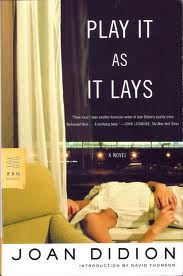
Play it as it lays Didion reviewAlbert Camus goes to Hollywood in Joan Didion’s celebrated 1970 novel, Play It As It Lays.

The story concerns Maria Wyeth, a 31-year-old movie actress of small distinction, as she suffers a vaguely defined emotional / moral / existential disintegration.

Nothing is going well in Maria’s life. Her marriage to a film director is falling apart. Her young daughter is institutionalized because of a severe psychiatric disorder. Maria is not working because – at least it seems to me – she is suffering from a debilitating combination of depression and anxiety. She terminates a pregnancy that results from an adulterous affair and is then haunted by the choice.  And through it all, Maria becomes more distant and indifferent, until she can no longer find any meaning in her life or the lives of the people around her.

Play I As It Lays is composed of 87 fragment chapters written in a elliptical style that largely focus on its characters’ external actions. Didion names Hemingway as one of her influences, and it shows.

Play It As It Lays and Camus’ The Stranger

One of my strongest reactions to Didion’s novel was how much it reminded me of The Stranger. (Spoiler alert, by the by.)

Both novels concern a character that sees life as essentially meaningless. Both characters commit a crime. In the case of Camus’ Meursault, it is the famous murder of an Arab man he encounters on the beach. In Maria’s, it is abetting the suicide of a friend  who shares her bleak view of life.

Meursault is imprisoned for his crime. Maria is confined to a neuropsychiatric hospital for hers, although whether this is the result of legal action or medical judgment or her own choice is not defined. Both are, overall, reasonably happy locked up.

Both Meursault and Maria Wyeth can be seen as monsters or truth-tellers. Both are viewed by other characters in their novels as selfish, self-absorbed, or evil (Maria addresses the question of evil directly in the opening sentence of Didion’s novel) although I don’t think Meursault and Maria are selfish as much as they are as indifferent to their own lives as they are to the lives of others.

Both seem to have one single authentic human connection: Meursault tenuously to his mother, Maria to her daughter Kate. Both novels have a desert setting (Play It As It Lays takes place as much in Nevada as Los Angeles). Both books are written in a clear, brief, terse, and unadorned style.

Both Play It As It Lays and The Stranger also possess a serious flaw, to my mind.

In Camus’ novel, it’s my nagging sense that Meursault commits the murder less from psychology or situation than from Camus’ need for him to commit the murder in order to advance the story. It’s a senseless crime, but it’s motivated neither by an irrational burst of emotion, or carelessness, or anything else I can see.

In Didion’s book, the flaw I see it that Maria Wyeth seems to suffer constant, intolerable emotional pain while at the same time acting with utterly indifference to her life.  These are mutually exclusive states of being. And while the exclusion doesn’t have to be absolute, I’m not sure Didion resolves the contradiction.

What is the nature of Maria Wyeth?

This is one of the more interesting questions a novel can ask about its main character and the best ones often answer it in unsettling ways.

Emma Bovary, for example, is a puzzling and off-putting and challengingly shallow literary character. Can we really take her as a successful simulacrum of a potential actual person? Because a profound occupation with the nature of humans and human life is the essential foundation of the novel, despite what theory geeks and academics might insist otherwise.

On first reading, I thought Maria Wyeth was a successful simulacrum because the novel is written retrospectively.

Play As It Lays opens with Maria in the neuropsychiatric hospital with all the book’s action already in the past. So the coldness and distance with which the book narrates Maria’s descent make sense: she’s simply withdrawn from pain that would otherwise have destroyed her.

The novel’s quick shift from the first person in the first chapter to third person – “a third very close to the mind of the character” as Didion described it in a Paris Review interview – also makes sense because it makes the distance between Maria and her experience greater.

But on the other hand, Didion makes a very big deal out of Maria and “nothing” in Play It As It Lays. Maria asserts in the beginning of the novel that “NOTHING APPLIES”. She explains that  her doctors, about her, “will extrapolate reasons where none exist.”

Maria tells her ex-husband she wants “nothing” and feels “nothing’.  Maria says, in a return to the first person toward the end of Play It As It Lays, “I used to ask questions, and I got the answer: nothing. The answer is ‘nothing.’”

On the last page of the book, Maria declares “I know something Carter never knew, or Helene, or maybe you. I know what ‘nothing’ means, and keep on playing.”

I read all this and I said to myself, “The lady doth protest too much, methinks.” Or is it brags?

Now it is possible that Maria Wyeth, the self-proclaimed Queen of Nothing, at the same time, and with equal sincerity, desperately wants to get out of the hospital, save her daughter, and live with her.  Quite possibly she wants nothing and feels nothing, except when she doesn’t. Holding mutually exclusive convictions is a human trait. In fact, it may be THE human trait.

It also human for a person to regard her experience, insight, and suffering as well as her resilience in the face of these, as unique and remarkable. Arrogance is another common human trait.

But I don’t see where Maria gets her arrogance. She is barely able to hold herself together in the novel from one moment to the next; and yet at the end of Play It As It Lays, we are supposed to believe that Maria has faced and transcended the devastating truth of life nobody else has the capacity to see much less the strength to withstand?

I don’t buy it. I’m not convinced. And because I’m not convinced, that makes Maria, not a simulacrum, but a conceit. Simulacrums speak for themselves, but conceits speak for their authors. And Maria Wyeth does not speak well for Didion.

Let’s wrap up with a little subjective opinion

Part of my reaction to Play It As It Lays is informed by my response to A Year of Magical Thinking, which I thought was a fine book, and made me feel sympathy for what Didion suffered, but which also set my teeth on edge because Didion wrote about the deaths of her husband and daughter in a way that seemed to imply her observations and feelings were unique. (My father said to me spontaneously about the book, “Does Didion think no one else has ever lost someone they loved?”) We could ask a similar question about Maria.

Then also, I’m sensitive to the unspoken conviction among writers and readers that a habit of introspection and a (sometimes) talent for expression gives them a finer soul than normal people. These qualities don’t, although they are often the parents of a particularly offensive and repugnant form of vanity. In its negative form, this vanity will suggest that if you are happy, you aren’t paying attention.

Finally, there are few things I enjoy less than reading a book about rich white people who are self-importantly miserable. My reaction to these characters goes something like this. “If you have an untreated or under-treated or resistant-to-treatment mental health disorder, that’s one thing. If not, then please make some modest effort to unf*** up your life. It might work.”

Now that intemperate outburst may lead you to conclude I didn’t like Play It As It Lays. But I did. It was well written and challenging and gave me a good workout. I had an interesting conversation / argument with Didion as I read it. Can’t ask for too much more than that.

Your Kindle is watching you like the StasiIn addition to attacking the traditional publishing model and starting fierce arguments over whether the rise in eBooks is (paradoxically) causing a decline in literacy, eReaders like the Amazon Kindle and the Barnes & Noble Nook are collecting data on how fast readers read an eBook, the parts they skip, and more according to NPR this week.

Leaving aside the question of whether this is another privacy invasion on the part of Big Data, the article focuses on the question of whether this data can help authors or hurt them.

Scott Turow takes the position that Big Data helps writers by letting them know where, if not why, they lose readers during a story. The novelist Jonathan Evison wonders what would have happened to Moby Dick if Melville had Big Data from readers and listened to it.

All of this reminded me of what I think of as the “continuum of the writer-reader collaboration”.

The act of reading is a collaboration between the writer and reader, an act which the writer begins and the reader finishes. The terms of this collaboration are initially set by the writer. The reader then accepts these terms, or not, but once she does – look out – because the experience and meanings of the book become hers.

Sometimes, the writer sets terms which are friendly to that great and aggregate abstraction known as “the reader”.

In fiction, these terms tend to include a plot featuring a conflict or conflicts, rising action, and a satisfying conclusion; central characters with whom we can identify or empathize; and writing that is clear and straightforward if not elegant, harmonious, or beautiful.

The “reality” of the book roughly conforms to the world reported in newspapers or portrayed in mass media or experienced by another great abstraction, the “average person”.

If the book’s reality doesn’t conform to this world, then it exists in a souped-up one, in which everyone is attractive, rich, witty, and powerful, and has more and better sex than generally experienced.

If the characters have problems in this world, they are exciting and important problems — like saving the world from a rogue nuke or loving a sparkly vampire — instead of boring ones like scraping up money to pay your bills or hemorrhoids.

Books with reader-unfriendly terms tend to be the opposite of all these things or, let us agree for the sake of brevity, Finnegans Wake.

Now there is no necessary causal relationship between reader-friendly terms, reader- unfriendly terms, entertainment, and art. In fact, all these elements, in all proportions, can be found in literature. Shakespeare’s invincible position at the pinnacle of literature in English is based on precisely the fact that he delivers enormous quantities of all four in roughly equal measures.

However, it also seems to me profoundly true that all real innovation in literature is founded on being reader-unfriendly, which is another way of saying “new and confusing”.

I’m not worried about Big Data stifling innovation. Big artists have big egos, and typically think everyone else in the world is an idiot who needs to catch up. They’ve been ignoring expert opinion for centuries. They can ignore Big Data just as easily.

If the next generation Kindle has a camera, however, I am going to stop reading naked.

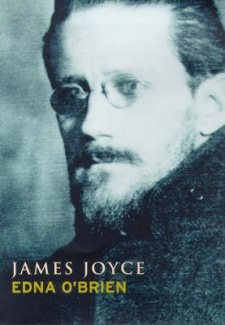
"James Joyce" by Edna O'Brien | Review  BiographyHypothesis: A genius is a person whose books we want to read and whose ass we want to kick.

That certain describes the James Joyce presented in Edna O’Brien’s brief, readable biography of the great Irish writer. O’Brien’s tone in James Joyce is more novelist than academic and that combined with the occasional Joycean flourish, the lack of footnotes, and the appalling bad behavior made me wonder, “Is this all true?”

In O’Brien’s biography, we see Joyce treating his family with contempt and his friends as servants and ATMs. Joyce’s marriage to Nora Barnacle seems to have been based primarily on erotic passion (their sex letters are monuments to skeezy) although they remained together for life and O’Brien does not tell of infidelities by either James or Nora.

O’Brien reports no evidence of Joyce having a relationship with his son Giorgio. Joyce is distraught over his daughter Lucia’s madness, although his insistence that her behavior was a sign of genius rather than insanity smacks of self-aggrandizement as much as denial. Joyce is devastated by the death of the father he ignored while the man was living. As far as we can tell from O’Brien, Joyce cared for no one else.

Through it all, Joyce carousels. And works himself to exhaustion and blindness creating the most significant works of English literature written in the 20th century. The books are worth the price of all this misery. But I’m glad I didn’t have to pay it.

My Antonia by Willa Cather Willa Cather’s My Antonia is one of those novels I saw as having faded into a genteel but deserved obscurity. Anything that struck readers in 1918 as innovative or shocking had long since become quaint, I believed, leaving little to command the attention of modern men and women.

So I was delighted by how good I found My Antonia. Much of my delight came from Cather’s quietly exquisite prose. Her descriptions of the natural world are masterful, although she does a pretty good job of making her characters and situations feel real and convincing, too.

Here is a sample from the narrator’s first impression of the prairie:

As I looked about me I felt that the grass was the country, as the water is the sea. The red of the grass made all the great prairie the colour of wine-stains, or of certain seaweeds when they are first washed up. And there was so much motion in it; the whole country seemed, somehow, to be running.

My Antonia’s episodic structure – the novel is a collage of stories – has a pleasantly proto-modernist flavor (without the tricky syntax). The novel made me wonder about its relationship to Cather’s own life. And in the end, it delivered a grand thematic and emotional wallop.

I warmly recommend it. Here are some details.

My Antonia – The Obligatory Plot Summary

Cather’s novel takes the form of a memoir written by James Quayle Burden, a childhood friend of Antonia’s four years her junior, who arrives in the Nebraska town of Black Hawk on the same day she does. Jim is an orphan from Virginia who has traveled west to be raised by his grandparents. Antonia has immigrated with her family to America from Bohemia (the present day Czech Republic).

For many years, their lives run parallel to each other. First, they are neighbors on country farms situated near each other on a prairie just beginning to be brought under cultivation. Later, they are neighbors in Black Hawk where Jim has moved with his grandparents and Antonia has been hired as a cook and housekeeper. They are separated when Jim leaves Black Hawk to attend university and then settles down to a job and a marriage in New York City. Twenty years later, at the end of the novel, Jim finally returns to Nebraska and seeks out Antonia.

Despite the title, My Antonia is primarily Jim’s story and Antonia and her family can disappear for pages and even chapters at a stretch. The novel finds the time to tell the stories of the hired men who work for Jim’s grandparents; to talk about other immigrant families besides Antonia’s, especially other young farm girls who are hired to work for households in Black Hawk; to describe the residents and observe the culture of the town; and to relate the details of Jim’s love affair with one of Antonia’s friends, Lena Lingard.

Is Jim Burden Willa Cather?

In general, I think it is a bad idea to make inferences about a writer’s life from her novels.

One of the great advantages of fiction is that it allows you to tell readers everything and nothing about yourself – to be wholly candid and entirely private at the same time. And Willa Cather seems to have valued her privacy, considering how many of her private letters and papers she destroyed before her death.

Nevertheless, Willa does make it hard to resist the temptation to equate her with Jim Burden in My Antonia, even though Cather almost certainly intended us to see her as the “I” that appears in the introduction.

Both Burden and Cather moved from Virginia to Nebraska when they were ten years old. Both attended the University of Nebraska (although Jim ultimately earns his degrees from Harvard). Both settled in New York City although their lives are possessed my memories of the prairie. Both write their books, the same book as it happens, in their forties.

Both also admire the same women: the strong, self-supporting, and independent immigrant hired girls who – with the exception of Antonia – never marry or have children.

This brings up the inevitable question of whether Cather was a lesbian and transposed herself into Jim’s character in order to write inconspicuously.

I’m an agnostic on the “Was Willa Cather a lesbian?” question (if that is actually the right question). That she sometimes dressed as a man and used the nickname “William” at university, and that she lived for nearly 40 years with the editor Edith Lewis, are generally known and rather indicative facts.

Whether Cather had sex with Edith or other women is, to the best of my knowledge, unknown and I believe it is equally unknown what Cather considered herself to be, sex or no sex. Cather’s opinion is the only valid one in the matter, of course, and she is beyond the means of telling.

Which leaves the questions of what My Antonia meant to Cather a tantalizing mystery which gives the novel, to me, some extra shimmers of meaning.

My Antonia – The Great America Novel?

This is the crown that Fitzgerald’s The Great Gatsby has worn for decades but I wonder if he didn’t steal it from Cather.

For all their differences, both The Great Gatsby and My Antonia are books profoundly occupied with the past and how happiness resides there rather than the present. They both locate the past in the Midwest and the present in New York City. They are both occupied with a woman from the past, Daisy Buchanan in The Great Gatsby and Antonia in Cather’s novel. And they both derive their greatest emotional power by evoking the natural world of the new continent before it came to be corrupted by men and society.

In Gatsby, it is Nick Carraway dreaming on the last page of the novel of the “fresh, green breast of the new world” the Dutch sailors first saw when they arrived in America, and concluding, “So we beat on, boats against the current, borne back ceaselessly into the past.”

In My Antonia, this fresh world still exists during Jim and Antonia’s childhood, although it slowly disappears as they age.

Indeed, the great thematic arch of My Antonia is the parallel motion of Jim growing from child to adult, and moving from the natural world to the city. Jim spends his childhood on farms in Virginia and then the great unsettled prairie. As an adolescent, he moves into a small country town. As a young man, he goes the University of Nebraska in Lincoln and then Harvard in Boston. As an adult, he settles, marries, and works in New York City.

There Jim finds a world of money and machines, work and relationships as unsatisfactory as Fitzgerald’s characters found it. The difference is that for Jim his old life isn’t utterly irretrievable.

In the last line of the novel he tells us, speaking of himself and Antonia, “Whatever we have missed, we possessed together the precious, the incommunicable past.”

There was no sex in Western literature until 1857.

This is an exaggeration and a simplification of course. (You are reading this on the internet after all.) But not by as much as you might think. Sex does play a role in literature before 1857, but it is very seldom a straight-forward one. Between…

Beowulf (ca 800 to 1,100 CE) and Leaves of Grass (1856)

… there is very little direct examination of sexual desire. Sex is there, of course, but it is always contained within a related topic. Passion is one such topic, giving desire nobility and a certain amount of respectability with its parallels to spiritual ecstasy and religious transcendence.

Madame Bovary - History of Sex in Western LiteratureTo conceive a great passion was certainly admirable. To give in to it was less so – although somewhat understandable – unless you happened to passionately repent afterwards, in which case you were back in the clear, and also had something new to do with all that animal energy.

Love was another one of these topics, a step down from passion in terms of intensity, but a step up in terms of stability, and was perfectly respectable.

This is not to say that passion and love are not valuable human experiences, or that they can’t exist along with desire, or all the literature dealing with either is false.

But the language of passion and love are also a means of not talking about sexual desire, or a means of excusing it, or most importantly a means of dismissing physical desire’s power, whether it’s tales of courtly love, or the story of Emma and Mr. Knightley, or Walt Whitman who with his great moving exuberance unites the body and soul together.

When sex does appear in Western literature before 1857, it is played for comedy through lower-class characters, such as Chaucer’s Wife of Bath or Henry Fielding’s Tom Jones or, much more explicitly, Cleland’s Fanny Hill.

There are more troublesome outliers to muddy the picture. (Did I mentioned you were reading this on the internet? Okay good.)

The Decameron comes to mind and the work of the Marquis de Sade. But let’s agree for the sake of my personal convenience that these are exceptions that prove the rule

Madame Bovary (1857)

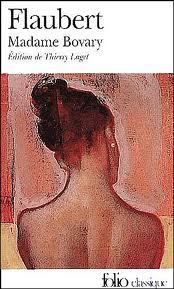
Flaubert’s novel caused a scandal and it’s not hard to see why. In Madame Bovary, he both plainly describes sexual desire and attacks the language in which it had previously been discussed.

Flaubert’s language seems quite tame by today’s standards, but he left no doubt about what he meant. For example, during a meeting with a lover, Flaubert writes that “[Emma] tiptoed over on bare feet to check once again that the door was locked, and in one motion she shed all her clothes; — pale and silent and serious, she fell upon him, shivering.”

Flaubert is just as direct when comes to the romantic language of “passion”. Emma’s first lover, Rodolphe, deliberately and cynically uses that language, and plays the role of the passionate lover, to seduce Emma, and Emma willingly embraces the role, out of a desire for something other than the stifling, self-satisfied, and clueless adoration of her husband Charles.

She again embraces the role with her second lover, Leon, and embraces it more desperately the more she senses the intensity of their relationship fading, and the more she feels the consequences of her deceptions bearing down on her.

Flaubert may have been the first voice to speak plainly about sex and to decouple the physical act from the language of passion and love, but he was followed by a long silence. It seems that Western literature needed the massive social disruption caused by the First World War to make books like …

Ulysses (1922) and Lady Chatterley’s Lover (1928)

… possible. Joyce’s Ulysses is quite explicit about sex, but it wasn’t the perfect book to break the taboo, largely because it was so difficult for many readers to understand.

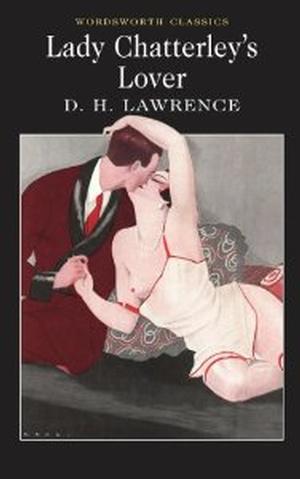
Lady Chatterley - History Sex Western LiteratureLady Chatterley’s Lover did a better job with its plain speaking, and caused a scandal. But instead of silence, these books were soon followed by others, such as Miller’s Tropic of Cancer (1934). Lady Chatterley and Tropic of Cancer were involved in obscenity trials as late as 1960, but these failed, and the subject of sex became ubiquitous in books by the end of the decade.

I don’t see this change as an unqualified success. A great deal of sex in books these days ranges from the merely gratuitous to the frankly pornographic, and is rendered with such an appalling, puzzling, frequently hilarious lack of skill that it can chase you right back to Jane Austen.

On the other hand, the fact of sexual desire, and the fact that desire demands satisfaction, are different matters. These need to be addressed in literature because, like in life, they don’t go away just because they’re ignored. And when desire and love are denied, between consenting adults not restrained by other promises, this denial blights the soul. We can put up with the occasional internet sensation trilogy to gain that.

Massey Content Related to A Brief History of Sex in Western Literature

My 100 word parody of 50 Shades of Grey

My 7 rules for writing sex scenes

My 100 word review of Madame Bovary