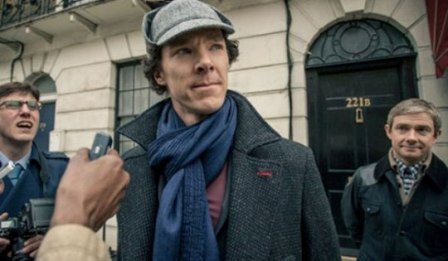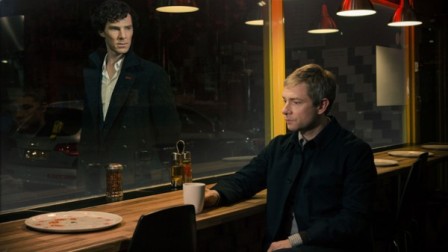
sherlock season 3 episode 3Season 3 of Sherlock ended with the broadcast of “His Last Vow” last night in the United States, and I’m sorry to say it ended — not with a bang — but a thud.

This has been a season of experimentation for Sherlock and I’m happy to give Moffat and Gatiss points for trying new things.  But the results have been, at best, and with generosity, middling.

I thought Episode 1 of Season 3 was weighed too heavily toward comedy, and something like sketch comedy at that. Episode 2 was a ROM-COM romantic comedy. Either of these was preferable, to my taste, compared to the soap opera of “His Last Vow”.

*** Major Spoiler Alert – although you might thank me for saving you the trouble. My wife did. ***

Like the other two episodes this year, “His Last Vow” felt frantic and over-busy, rather than fast-paced and complex — which were significant strengths of the first two seasons. It also taxed my extremely willing suspension of disbelief with its plot line concerning Mary Watson, who is apparently not the down-to-earth, loving, and pregnant wife John Watson needs — but a rogue spy with a very dark past who is on the run from sinister forces and who, among other things, shoots Sherlock. (I’m not making that up.)

We were also treated to the spectacle of Sherlock being outwitted by a Moriarty 2.0 or Moriarty Reloaded and then, to protect John Watson, shooting dead said Moriarty 2.0; followed by Sherlock’s exile to a fatal secret-agent mission in Eastern Europe.

All this would have been tolerable — maybe — if Moffat and Gatiss had honored the relationship- and show-changing dynamics of these stories. But instead, they have John Watson reconcile with Mary (really?) and Sherlock instantly reprieved from his fatal mission because, guess who reappears? Yes, Moriarty 1.0. Did you think he was actually dead? Me neither. Are you wondering why we had to wait an entire season to have Moriarty 1.0 reintroduced? Me too.

I believe that Moffat and Gatiss have not willing embraced parody, and are not trying to yank our chains, but this is not good work; and my disappointment is doubled by how good their work was before, which was not simply good, but excellent.

Redeeming the weakness in the stories this season were Moffat and Gatiss’ feel for their characters in small  moments and the performances of the whole cast, including Benedict Cumberbatch, but especially Martin Freeman, who consistently invested even the most absurd situations this season with complete and moving conviction.

I looked forward to Season 3 of Sherlock with hope and anticipation. I’m afraid I can’t consider a Season 4 with either emotion.

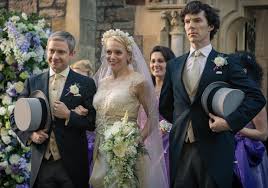
sherlock sign of three season 3Sherlock offered us something new in “The Sign of Three,” which was broadcast last night in the United States: Sherlock Holmes as the hero of a ROM-COM romantic comedy.

The couple in question is Sherlock and John Watson, of course. Sherlock plays the role of the boyfriend as we often see him in movies today: fixated on his work, uncertain of his feelings, and afraid to commit.

John Watson gets the part of the girlfriend, which in The Economist’s brilliant recent phrase means he is “a perky hybrid of nursemaid [and] personal assistant.” (The Economist also added “sex worker” which is not germane in this case.)

All is fine on Baker Street until John falls in love with Mary and threatens their bro-mance. The relationship deepens, but is also complicated, when John asks Sherlock to be his best man, which requires Holmes to both think about his feelings and confront the fact he doesn’t like to think about them.

Watson and Sherlock bond during a drunken stag night, which lands them in jail. Sherlock delivers a funny-awkward-touching best-man speech, and following the pattern of the ROM-COM, all ends happy with dancing to 70s music at John and Mary’s wedding reception.

I give the Sherlock-team points for trying something new and surprising me. And I enjoyed the results okay I guess. But ideally, I’d like my reaction to innovation to be “Well done!” and not “What the heck?” and “What the heck?” was my reaction.

Part of my difficulty is that the tone of “The Sign of Three” is so different from that of the first two seasons that I might as well have been watching another show entirely. A bigger problem for me is that a lot of the episode felt as if it could have been almost any romantic comedy that rolls out of Hollywood. Or worse, one of dozens of television sit-coms that deliver yucks and “aaawwws!” in equal measures and with equal lacks of flair.

On the plus side, since I think that a Sherlock Holmes story should contain a good mystery, the detective story in “The Sign of Three” was a significant improvement over last week’s “The Empty Hearse.”

Two unsolved and seemingly unrelated mysteries come together and allow Sherlock to unravel and prevent a murder in progress at John and Mary’s wedding. The management of the plot elements and structure was neat (a strength of Moffat and Gatiss that abandoned them last week) and the story played a chess game, and then showed us how it was played, which is something the Conan Doyle did very well when he was on his game.

How to sum up my feelings about Season 3 so far? How about this: “Oh Sherlock, I feel we’re just drifting along on familiarity and habit. You’ve changed. The spark you lit in my heart has dimmed and cooled. Oh please, won’t you make it blaze again next week!”

Sherlock Season 3 empty hearseI was looking forward to the US premiere Sunday night of the new season of Sherlock. So I’m sorry to say I thought “The Empty Hearse” came up short.

As I said in my Sunday post on Sherlock, what I particularly admired about Steven Moffat and Mark Gatiss’ adaptation was the greater depth and feeling they gave to Arthur Conan Doyle’s characters and how well they crafted their plots based on Doyle’s stories. Both those strengths seemed to have abandoned them in “The Empty Hearse” however.

The largest issue at the beginning of Season 3 was how Watson — who believed Holmes had died at the end of Season 2 and intensely grieved for him — would react to Holmes’ reappearance. This could have been a fearful reckoning, but instead Moffat and Gatiss’ play it for yucks and not just once, but again and again; and while the jokes were funny, they were also decidedly beside the point and began to get old as the episode ticked down to its conclusion.

The story also had problems. In the first two seasons, Moffat and Gatiss showed themselves to be masters at creating intricate, compelling mysteries that Holmes satisfyingly untangles while at the same time deepening the conflicts and relationships among their characters.

In “The Empty Hearse,” the terrorist plot is more perfunctory than intriguing; its solution hinges on resolving a single — and not very complicated — mystery; the bomb-diffusing climax is played for more laughs; and the story itself seems unsure of who the bomber is and why he is bomber-ing.

“The Empty Hearse” also doesn’t explain how Holmes faked his death at the end of Season 2. Instead, it offers three speculations, two thrilling and possible, one fake and hilarious (though cruel to Watson if you think about it), none confirmed. It seems as if the last explanation is the truth, but I have my doubts whether we are meant to believe it. The scene feels a bit too coy and a bit too cute to give me confidence. (Maybe I’m wrong.) I actually don’t mind that Moffat and Gatiss leave me in some uncertainty. But in the general messiness of the episode, that feels more like an oversight than their intention.

The result is that “The Empty Hearse” delivers a grab-bag of scenes and sketches that often entertain, sometimes move (primarily on the strength of Martin Freeman and Benedict Cumberbatch’s performances), but plain just don’t hang together. I’m hoping Moffat and Gatiss regain their stride this Sunday. We’ll see.

sherlock winsIn preparation for the American premiere of the third season of PBS’ Sherlock, starring Benedict Cumberbatch and Martin Freeman, I’ve been rewatching the first two seasons and reading the original stories and novels by Arthur Conan Doyle. And I’ve come to a conclusion. Sherlock is superior to its source material.

Explaining why I think Steven Moffat and Mark Gatiss’ adaptations are better than Conan Doyle’s work is relatively easy. Deciding how much credit Moffat and Gatiss get for their success was more more tricky. In the end, however, I think Doyle gets most of it.

What Arthur Conan Doyle Did Right

What Conan Doyle did superbly right in his stories and novels is create the vivid, particular character of Sherlock Holmes, who deserves his enduring fascination and appeal.

I think this fascination springs first from the fact that Sherlock Holmes is a fully-formed literary character who is at the same time largely two dimensional (a quality he shares with the other characters in Conan Doyle’s stories, unfortunately).

The reason this contradiction succeeds so brilliantly is that Sherlock Holmes seems to be suffering from an autism-spectrum disorder, which explains his intellectual powers, his deep knowledge of arcane subjects, his passionate focus on problems that interest him, his inability to read social cues or manage social interactions (though indifference might be the cause), and in particular, the but-faint glimmers we get of Holmes’ interior life.

With most of the characters in Sherlock Holmes, we cannot penetrate beyond their surfaces because they have no character beyond their surfaces. With Holmes, his impenetrability is part of his essence; we don’t understand him well because Holmes is indifferent to such questions himself; and perhaps the greatest mystery of all in the stories is the nature of Sherlock Holmes’ soul.

Conan Doyle gets full marks for investing Holmes with extraordinary powers of observation, analysis, reasoning, and deduction, and for creating compelling examples of these qualities in action.

Finally, he gets credit for filling his stories with intriguing hints: the loneliness of John Watson after his return from the Afghanistan wars; the suggestion that Mycroft Holmes occasionally “is the British government”; and of course the huge dramatic potential found in the character of Professor Moriarty.

What Conan Doyle Did Not Do At All

The problem is that Conan Doyle often does too little with these characters, and frankly too little with many of the stories in the Holmes canon; and I keep thinking the problems rise from either Conan Doyle’s lack of skill as a writer or his lack of interest in the stories themselves.

A Study in Scarlet is a good example. All the good things about Conan Doyle’s Sherlock Holmes stories are right there, already in place, right out of the gate: the character of Sherlock Holmes most especially, his great intellectual powers, and an impressively worked-out mystery.

But then there are the problems. Holmes and Watson meet cute, and Holmes jumps right off the page like Athena from the head of Zeus, but the management of the beginning of their relationship feels perfunctory. Doyle needs Watson and Holmes to come together and so they do; and the most basic of Holmes-ian questions is not answered, namely “Why?”

Then it is hard to read A Study in Scarlett and without concluding that Doyle simply does not manage plots very well. The majority of the story is advanced through exposition and halfway through the novel, the telling is handed over to the murderer and the scene abruptly shifts to the American West, where begins the long and tedious explanation of the murderer’s motives which involve dastardly Mormon polygamists and the outrages they commit against an innocent girl. (I’m not making that up.) Holmes utterly disappears and it is Holmes that makes Doyle worth reading.

The Final Problem – the story that features Holmes’ famous death at the Reichenbach Falls – has related problems. Here we discover Moriarty and see the only time Holmes and his arch-nemesis meet face to face. Moriarty is interesting. The conversation between Moriarty and Holmes is interesting. Doyle makes the friendship between Holmes and Watson, as they flee Moriarty, feel convincing. But the great chess game of move and counter-move Holmes tells us he’s playing with Moriarty happens entirely off the page, and we get no hint of the details. Worse, the death of Holmes also happens off the page. All this material has huge potential. Conan Doyle, and his readers, just need someone to come along and exploit it.

That’s Where Moffat and Gatiss and Their “Sherlock” Comes In

Perhaps the reason Sherlock Holmes is so enduring in adaptation is precisely because Arthur Conan Doyle’s source material is so full of untapped possibility. In any case, along come Steven Moffat and Mark Gatiss – the latest in a long succession of people to take on the job – and succeed brilliantly.

First, they add a layer of internal conflict to the stories by filling out the characters and making their emotions drive the stories as much as the criminal mysteries. Holmes isn’t a natural candidate for the role, but Watson with his war experience and manifest loneliness is.

Moffat and Gatiss bring that loneliness forward, use it to help us understand how the friendship between Watson and Holmes developed so quickly, and most importantly make Watson the main character of their stories and his friendship with Holmes the show’s great beating heart. (I should say that Martin Freeman gets equal credit for the success.) Doyle gave us stories that entertain and delight. Moffat and Gatiss make Sherlock move us as well.

They get even more out of their adaptation of Mycroft Holmes. They add the perfectly logical deduction of sibling conflict between Mycroft and Sherlock; give the brothers contrasting yet similarly cold temperaments; and follow-up on Conan Doyle’s hint that Mycroft “is the British government” and make him England’s spy-master which opens up a rich vein of new conflicts and stories to pursue.

The espionage thriller aspects of Sherlock work particularly well with the increased role Moriarty plays in these stories (an idea that long pre-dates Moffat and Gatiss of course). Moriarty runs a vast, shadowy international criminal conspiracy which in technique and operations is largely indistinguishable from a nation-state’s intelligence service or for that matter a terrorist group. All three run themselves in similar ways: it is their motives and goals that differ.

So Moffat and Gatiss use Mycroft and Moriarty to produce both long-arc conflicts, that is plots that arc through a season or several seasons and tie the whole show together, and as drivers within individual shows, which each have a beginning, middle, and satisfying end. (Well, except for the Hound of the Baskerville’s episode, to my tastes.) Watson plays a similar role, with the emotions of his character producing both long-arc and short-arc conflicts.

I like Moffat and Gatiss’ updating just fine too, although I suppose I can see the point of those people who think it is “gimmicky”.  But to set the stories in modern London, you really do have to lay aside Holmes’ dependence on tobacco and cocaine, and you really do have to add cell phones, the internet, and texting.

I also like the “flashy” or “showy” editing, when the scene goes slow-motion and text labels and assorted graphics fly across the screen to illustrate Holmes’ thoughts. These are gimmicks. But they also solve the problem of having Watson ask, “My god, Holmes, how did you figure that out?” and Holmes saying “Elementary, my dear Watson ….” I think we all have had enough of that, haven’t we?

Then there is the running joke about Holmes and Watson being gay. On the one hand, I confess to thinking it is sort of funny. On the other, I’m beginning to think that cheerful jokes about homosexuality are as reactionary as the homophobia still rampant in America and elsewhere. After all, on the most essential level, it should be irrelevant whether Watson and Holmes are or aren’t gay. What is essential is that they care for each other.

Maybe the most interesting question of all is “Why does Sherlock Holmes continue to be so popular?” There must be something about the character that resonates deep in the culture. I have no answer, currently. Maybe after I watch Season 3 I will. Can’t wait to start!

to hack or not to hack

To hack or not to hack, that is the question.

An article in the New York Times last month describes several start-up companies whose goals are “to do for books what Netflix did for movies and Spotify for music.”

As an incentive for authors and publishers to add their work to these online collections, the companies promise to deliver insights into reader behavior: how many finished the books or skipped to the end, which passages readers lingered over and which they skimmed, and so on.

The article goes on to question the viability of the business model, and quotes one writer who is both interested in seeing this reader data and worried that it might reduce her creativity or her willingness to take risks.

All in all, “E-Books are Reading You” was a good article. Thoroughly reported. Balanced in its considerations. And temperate.

This is more than I can say for the Letters to the Editors selected by the Times to publish in response to the article, under the headline “Writers Desperately Seeking Readers,” which are as neat a collection of vanity, arrogance, contempt, elitism, and reductionist thinking as you are likely to find on a mere one-eighth of a standard broadsheet.

From this description, you might think I didn’t like these letters. But I did. Because they encapsulate so many of things I find wrong with writers.

I’m not going to out the authors of these letters – they are quite easily found through Google with the information I’ve provided anyhow – I’ll simply provide my response to what they wrote. To wit:

Art is a supremely individual expression.

Yes, I agree with that.

It doesn’t ask permission; it doesn’t take an exit poll and adjust accordingly.

It doesn’t? You mean no artist has ever taken an audience’s reaction into account? How about the opinions of mentors, other artists, editors, agents, critics, friends, spouses, or lovers? Where does acting on feedback end and pandering begin? Or does the definition depend on the status of who is giving the feedback?

Artists say what they know … they have no choice in the matter.

Yes, I agree with that too. Unfortunately.

And it’s our privilege to be brought into their world.

Our privilege? I would like to decide for myself whether entering that world is a “privilege”. Many times it is. However, from my experience, when someone declares that my attention to their work is a “privilege” this is often a sign that it ain’t. In any case, I think an audience’s attention to a work of art is also a “privilege” that is earned by the artist, rather than something that is his or her natural right. Or something to be demanded in a fantasy-fascist world where the artist, self-proclaimed or otherwise, rules as a cult-of-personality dictator.

Once artists start asking how many “likes” they’ve garnered, or listening to customer-satisfaction surveys to increase their sales, they’re no longer making art: they’re moving product.

Okay, here we go. Did Shakespeare move “product”? Because we have a fair amount of evidence that he did, from his output and popularity, to his becoming one of the owners of the Lord Chamberlain’s Men, to the records of his investments and property purchases including New Place in Stratford. Will didn’t start rich. But he ended up that way. And he did so while becoming, as it turns out, the immortal genius of literature in English.

Then we have the famous Robert Greene, who seems – with some scholarly doubt, but not too much — to be referring to Shakespeare in his comment about “an upstart Crow, beautified with our feathers … [who] supposes he is as well able to bombast out a blank verse as the best of you.”

I have two points to make here. The first is that earning money from art, and earning it through popular success, is in no way incompatible with the highest artistic achievement; and the examples of this are so numerous and so decisive you would think there would be no need to have the discussion. Dickens. Bob Dylan. Heck, even Nabokov. I bet you can name plenty of your own. All these guys made serious coin. But not one of them ever once considered the satisfaction of their “customers”? (Well, I’ll give you Nabokov.) No real artist ever once bent to a requirement of a pope with gold or a publisher who could pay or to what people or a patron seemed to like? They never once took a commission? Really? Hum.

The second point is that a great number of the attitudes I’m spanking the hell out of here, possibly to my peril, are not really about art. They are about the vanity of people who want to be seen as artists and who jealously guard the elevated social status that perception confers.

This is where Greene comes in to play. Greene was a university-educated playwright who clearly believed Shakespeare was infringing on his turf. Where is Greene’s work now? Or consider where the reputation of Shakespeare’s two long “art” poems sit compared to his plays.

Another way to say it is that the intention to create art is no guarantee of artistic success just as the intention to please an audience is no guarantee of artistic failure. And these are just two of the many complex factors, complexly interacting, that actually drive the act of creation.

Writers such as these could be described as ‘tech savvy’ or known by an adjective that predates the digital age: hacks.

A variation on the theme here, but a couple points. First is the idea that a “hack” appears to be someone who acts on aggregate feedback from a large audience. The author of this letter describes himself as an editor. I assume that if a writer listens to his editorial feedback, he does not think this makes the writer a hack. But if so, I would like to know the reasons why acting on his advice is not pandering too.

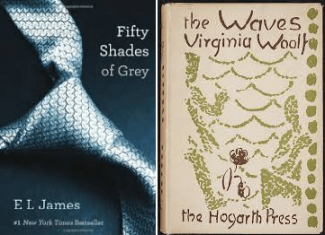
Hovering around the fringes of these letters are two relevant ideas. The first is the genre fiction / literary fiction divide, in which the former is characterized by the low-quality pursuit of money and the latter by the high-quality pursuit of art. The second is that the categories are absolute. You are either Fifty Shades of Grey or you are The Waves; you are either a hack or you are not; you either listen to everybody or you listen to nobody but your own genius muse.

But there is actually a wide spectrum between these two poles and different artists, and different works by the same artist, fall all over the place between them. Some work that is perceived to pursue popularity and profit turns out to be art (Shakespeare again). Some work that is perceived to be art sinks into rightful oblivion. Some art is art and some crap is crap. Then there is a whole lot of mediocrity muddling around in the middle. It’s all incredibly hard to categorize, and the best we can do is begin with individual reactions to individual works.

I’d like to think that valuing integrity over popularity is fundamental to … writing books.

Ah, the idealism of youth (the writer identifies himself as 19). Actually, he seems like a nice fellow and I have no desire to criticize him. But question. Are integrity and popularity mutually exclusive?

Because by now, you know I don’t think they are and that most books are built, in part, from some combination of integrity and popularity: or if you will, the amount of work the reader performs to approach the author versus the amount of work the author performs to approach the reader. Also, popularity we can measure in all sorts of ways. How do we measure integrity?

Let’s keep going. Is integrity founded on intention or results? Let’s say for example – I don’t know this, but give it to me as a “for instance” – that E.L. James intended to write a good / high quality / literary book but her talent wasn’t up to the task of producing anything other than Fifty Shades of Grey. Does that mean the novel has integrity?

If Joyce wrote Ulysses in cynical bad faith, does that mean we should reject the book? And if Jonathan Livingston Seagull was written with total sincerity – which would make it even scarier in my opinion, but anyhow – does that mean we should embrace it?

In the end, I suppose I’m saying that it is the work that matters. The work is certainly much easier to access compared to the artist’s good or bad faith, in any case.

Well, that about wraps it up. Hope you have a good day. Now I have to get back to reading Count Fabio and the Sexy Pirate Queens on my Kindle. I’m skipping the dull parts.

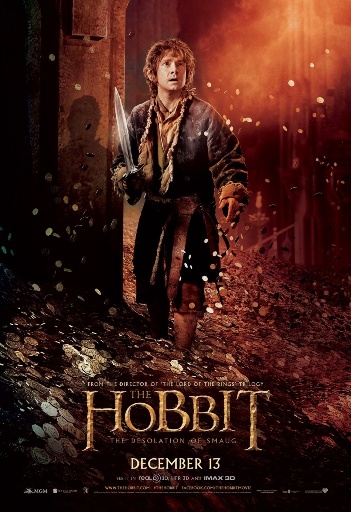
desolation of smaug hobbit peter jacksonThe only element of any real interest in Peter Jackson’s The Hobbit: The Desolation of Smaug is the question “What went wrong?” and even that is a pretty dull question because the answer is clear enough: the money people wrapped their fingers around the neck of this movie and strangled it to death.

By saying this, I am not trying to absolve Jackson of his responsibility. He signed the contract, cashed the check, and put his name on the film.

But Jackson was faced with formidable challenges in making Smaug. The biggest challenge was how to manage the legacy brand that he had created through Lord of the Rings, in which the safest route to profit was to deliver basically the same goods in basically the same package, even if those goods had grown a bit stale (ie, the preferred approach of the money people).

Jackson also had to keep his eye on the huge non-English-speaking and/or non-Western audiences for The Desolation of Smaug, since spectacle translates more easily than dialogue, and since special effects are less likely to cause cultural offense than stories or characters.

Jackson decided (or was asked) to pad out a book that would have potentially made one good film into three movies, with a total running time pushing eight hours. And while we’re at it, let’s note Smaug is the middle of the three films, with no natural beginning or end to help give shape to the story.

But with all that said, I’m surprised by how badly Jackson flubbed Smaug considering how well he managed the earlier Lord of the Rings films, in which he balanced character with action, drove the story through both internal and external conflicts, and gave shape to the overall plot.

The Desolation of Smaug is a plodding, tedious, frantic mess. I think the main culprit is the decision to expand the book’s story rather than edit it down. All the padding – particularly filming events that occur off the page in the book – destroys whatever dynamic tension the story arc in the Desolation of Smaug might have achieved and gives us a jumbled collection of scenes instead.

These scenes are not driven by situation, since the situations in Smaug are so many and so various that the connections among them quickly become lost; and these scenes are certainly not driven by character or emotion, which means the talents of at least two very good actors – Martin Freeman as Bilbo and Ian McKellan as Gandalf – go entirely to waste, with what moments of real human feeling they sometimes find soon swept away in the general noise and hubbub.

The result is a whole-movie version of what happens when actors find themselves stuck in a play that really doesn’t work. They fall back on acting bigger, louder, faster to cover up a lack of sense.

In the case of Smaug, this bigger-louder-faster extends to the action sequences and special effects, which are fine as far as they go, but they turn the film into just a roller-coaster ride: viscerally thrilling at times but empty of meaning.

I don’t have a problem with entertainment being entertainment, and businesses working to cash in big by selling to big audiences, but films don’t have to be as desultory as The Hobbit is to earn money for their investors. Joss Whedon’s The Avengers demonstrated that last year. Peter Jackson proved it with his Lord of the Rings movies. Entertainment can excel as high craft, without aspiring to or needing to achieve the goals of art. Craft is a worthy goal. Unfortunately, Smaug isn’t craft. It’s crap.

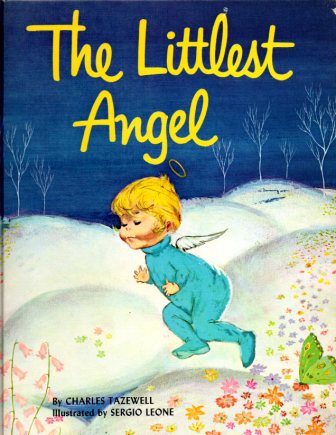
the littlest angel charles tazewell“The Littlest Angel” is a great book. Not because it is actually great as in “very good.” But because it combines a deep (and I would say offensively manipulative) sentimentality with a deeply subversive take on Christian theology which makes it a genuinely strange book pretending to be merely a nice one.

I’ll give you my reasons why I think this in a moment. But first, in case you don’t know the story, here is the set-up.

“The Littlest Angel” is a children’s story written in 1946 by Charles Tazewell which follows heaven’s littlest angel, who can’t sing on key or arrive on time or keep his halo on straight or fly without tumbling through the air.

One day, he’s summoned to speak with the Understanding Angel and the Littlest Angel explains there was nothing for a small angel to do in heaven and he was homesick for earth. The Understanding Angel asks “what would make him most happy in Paradise” and the Littlest Angel asks for a box he’d left under his bed at home. He’s given the box and the Littlest Angel becomes a model citizen of heaven.

Sometime later, God announces that Jesus would soon be born in Bethlehem and every angel in heaven prepares a gift. After thinking and thinking, the Littlest Angel decides what the infant Jesus would like best is his box from home. The Littlest Angel gives his gift proudly, but grows ashamed of the “small, rough, unsightly box” filled with “useless things” compared to “all those other glorious gifts” just as God reaches out his hand to the box.

It is at this point in the story that I begin crying. Every single damn time.

Well, I don’t actually cry. I just become physically unable to speak. Which was a problem when I was supposed to be reading “The Littlest Angel” to my children. It went like this:

Younger son: “Mommy! Daddy’s making those funny faces and not reading the story.”

Wife [walking into the room]: “Again?”

Me: “Just finish the book and leave me alone.”

So what is in the box? Tazewell tells us …

A butterfly with golden wings, captured one bright summer day on the hills above Jerusalem, and a sky-blue egg from a bird’s nest in the olive tree that stood to shade his mother’s kitchen door. Yes, and two white stones, found on a muddy river bank, where he and his friends had played like small brown beavers, and, at the bottom of the box, a limp, tooth-marked leather strap, once worn as a collar by his mongrel dog, who had died as he had lived, in absolute and infinite devotion.

Then “The Littlest Angel” gets very particular, by which I mean it flirts with heresy, because Tazewell has God say this about the box:

This small box pleases Me most. Its contents are of the Earth and of men, and My Son is born to be King of both. These are the things My Son, too, will know and love and cherish and then, regretful, will leave behind Him.

What I like about the story is that Tazewell suggests with the contents of the Littlest Angel’s box that the glories of life, consciousness, and creation are expressed mostly fully in the smallest things. Then Tazewell says explicitly God values these things; and not only values them, but states his son Jesus will regret leaving them behind as the Littlest Angel did.

Normally, we understand the purpose of the incarnation of Christ to be the redemption of sin through Jesus’ sacrifice on the cross, motivated by his and his father’s love for humanity, and the earth a poor miserable place compared with heaven. In Tazewell’s story, the emphasis is on the incarnation as an act of radical empathy, with Jesus embracing the suffering AND the joy of human life, and sin shuffled off to one side, which frankly is where I think it belongs. Original sin has always struck me as the equivalent of God breaking our legs so sometime later he could claim credit for resetting the bones.

All this sounds good enough, but the problems with “The Littlest Angel” are larger than its virtues. First, we have the issue that the pathos of the story is founded on the death of a child, which is difficult to manage without making the reader feel cheaply manipulated, and this is exactly what Tazewell does. I do feel manipulated and the fact that Tazewell’s manipulation works on me only increases my resentment.

Second, “The Littlest Angel” is a frequently toxic combination of the cloying and the fascist – which is to say it is sentimental. Sentimentality is a big cartoonish emotion, equally useful in provoking copious weeping or torch-lit rallies, and sweetishly easy to gobble down.

Think of sentimentality as a big piece of Coca Cola cake (search the recipe, it’s delicious) versus the beef steak, wheat berries, bitter greens, and red wine of the real thing.

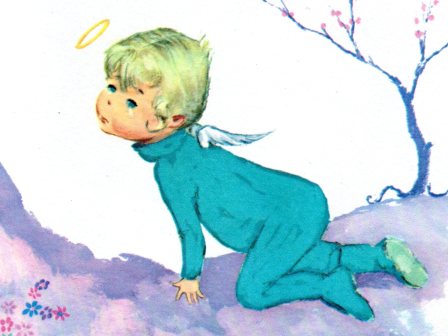
“The Littlest Angel” is lousy with sentimentality as I think you can tell from the way Tazewell describes the contents of the box. And it gets worse in the Children’s Press, Chicago copy the littlest angel sergio leoneI have which features the 1962 illustrations by Sergio Leone (same name, not the film director). Check out the little guy:

He’s an avatar of Aryan cuteness in blue footie pajamas which is particularly galling since Tazewell tells us the Littlest Angel died in Jerusalem before the birth of Christ. Do you think there were a lot of radiantly blond, blue-eyed little tykes running around Jerusalem in footie pajamas circa 10 BCE? You do? Okay, I won’t argue, but you clearly have come to the wrong shop.

Also while we are at it, not to be overly picky, but if the Littlest Angel died before Christ’s incarnation on earth — and we know he did because the gift of which the Littlest Angel is ashamed is for the baby Jesus — then what the hell (excuse my language) is the Littlest Angel doing in heaven?  Because he ain’t supposed to be there. If you accept that salvation is achieved through Christ alone, and Jesus’ sacrifice redeemed us from and only Jesus’ sacrifice could redeem us from Original Sin, then the Littlest Angel should be burning in hell fire. At least that explains why the Littlest Angel doesn’t have any relatives to keep him company in heaven. They are all in the other place.

Now where was I? Oh yes. Somewhere in “The Littlest Angel” is a story worth telling. Maybe I’ll take a whack at a revisionist version some day. Or maybe I’ll just it tuck away for when my children have children and let them decide what they think of it for themselves. In either case, I’m keeping my copy.

Neil Gaiman NeverwhereIf the task of the fantasy novel is to create an engaging new world and tell an absorbing story in it, then Neil Gaiman’s Neverwhere delivers the goods just fine. If it is do more than these, then Neverwhere comes up a bit short.

Neverwhere is primarily the story of Richard Mayhew, a pleasant but vague financial analyst in the modern City of London (or “London Above”), and the Lady Door, a member of the aristocracy of “London Below” which is a realm of fantastical or historic persons and places below the city tied together by the London Underground.

Richard finds Door lying injured on a city street and is soon drawn into her desperate attempt to flee the killers who murdered the rest of her family while simultaneously seeking to understand the reason why her family was murdered.

Along the way, we’re introduced to a satisfying number of delights. These include the murderous Misters Croup and Vandemar, a Dickensian pair straight out of nightmare; the Floating Market where all the contending citizens of London Below gather under a general truce to plot, trade, and revel; a large group of colorful supporting players; and the angel Islington who is still mourning its failure to save the people of Atlantis from destruction.

Gaiman’s invention is not endless, however. His plot has just enough twists to keep the story in pleasant motion. Gaiman often reaches for the word or phrase you’d expect, to the extent that I was often completing his sentences in my mind as he did on the page. His Angel Islington and Richard’s snobby rich girlfriend come straight from central casting. And at best, his characters have just enough distinct qualities to be sufficient for the story – which is to say they have two.

So the young lady Door is waif-like yet resolute. The Marquis de Carabras is amoral but scrupulous in the paying of his debts. The Black Friars are kind but a touch sinister. Most particularly, and not successfully, Richard Mayhew is hapless and heroic.

Mayhew is mostly paralyzed by fear and protected by the other characters out of pity, except for a few moments when he rises to a challenge that has defeated scores of men and women from London Below over the course of centuries. One challenge is the dread “ordeal” and the other is the great “Beast of London” which lurks in a labyrinth. Neither of these victories seems probable and Gaiman makes them less so by frequently playing Mayhew’s character for laughs.

This gets at my two disappointments with Neverwhere, which I had expected to like better based on Neil Gaiman’s reputation. The first is that none of the characters were sufficiently developed that I could feel an emotion toward them and so feel that something was at stake while reading Neverwhere; and what should be at stake in reading is our hearts. Mine was never engaged.

Secondly, what binds a fictional world together and makes it breathe, whether it is utterly fantastical or obsessively mundane, is its emotional tone: how the author feels about the world he or she has created. I don’t think Gaiman ever decided how he felt. Instead, he has the ha-ha mostly feckless Richard Mayhew stumbling around a story that is threatening and apocalyptic. This makes Neverwhere entertaining for sure. But it doesn’t make it anything more.

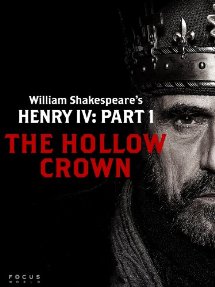
hollow crown henry iv part 1The 2012 BBC “Hollow Crown” production of Henry IV, Part 1 is the perfect public television adaptation of Shakespeare. It is superbly acted and directed, cleanly written, and briskly paced, without offering large innovations in staging or interpretation.

These kinds of productions of Shakespeare largely succeed or fail on the quality of the acting, and Eyre’s four core players deliver the goods in aplenty. Joe Armstrong’s Hotspur lives up to his name without the one-note shouting the role makes all too easy. Simon Russell Beale is superb as a panting Falstaff stripped by age of his vitality. Tom Hiddleston mines gold from a core of sadness in his appealing Prince Hal.  And the incomparable Jeremy Iron combines his delectable trademark world weariness with a relish for power as King Henry IV, convincing us we are watching a man who would seize, and keep, his crown at any price.

Richard Eyre’s understanding of the relationships between the characters is as good as his actors. Henry IV, Part 1 is a play of fathers and sons, or more accurately mismatched fathers and sons, with Eyre’s screenplay and direction emphasizing how much Henry IV believes Hotspur would make a better Prince of Wales than his own son – even saying as much to Prince Hal’s face. And yet, there is a foundation of love and respect between the two men which eases their reconciliation.

Eyre’s Falstaff is even more interesting. Falstaff’s behavior has always been objectively ugly: he is a drunkard, a liar, and a thief who will do anything to promote his own self interest regardless of the consequences to other people.

But Falstaff is usually played as a person who successfully hides his ugliness behind his enormous wit and affability as well as his genuine affection for Prince Hal. With Beale’s Falstaff, the ugliness shines through and we are left in doubt of his real affection for Prince Hal in every scene except one, when Falstaff asks Harry to “banish not him thy Harry’s company: banish plump Jack, and banish all the world.”

Harry does and will, of course. Harry often treats Falstaff with contempt and that Beale’s Falstaff is contemptible makes Harry’s rejection of him, and of the tavern life, easier to understand and accept. But not completely.

My major problem with Henry IV, Part 1 has always been Prince Hal’s sudden – I would say extremely sudden – transformation from antic to earnest. Shakespeare has Hal explain it this way:

So, when this loose behavior I throw off
And pay the debt I never promised,
By how much better than my word I am,
By so much shall I falsify men’s hopes;
And like bright metal on a sullen ground,
My reformation, glittering o’er my fault,
Shall show more goodly and attract more eyes
Than that which hath no foil to set it off.
I’ll so offend, to make offence a skill;
Redeeming time when men think least I will.

But I’ve always found this explanation perverse, and particular, and not very convincing, and more, disappointing because  Shakespeare is a master of ambiguous characterization and this piece of exposition ain’t.

I like the idea much better that a young man, born to rule and expected to rule, might wish to hide from the role he ultimately can’t refuse, and that this would explain his behavior, and make him more sympathetic.

Hiddleston’s sad Prince Hal reaches toward this explanation.  His Harry is not antic and then earnest, but instead there is an earnestness beneath the antics that makes his performance particularly moving.

The “Hollow Crown” production of Henry IV, Part 1 zips along at a clean two hours and gives you a sense of the whole play while allowing each scene to breathe. Eyre does not make an effort to approach the play on terms other than its own. There are no striking modern parallels or contemporary topical relevance slapped on the drama. Instead, Eyre trusts – and trusts right – that a genius author, good actors, and the enduring universality of human nature are all the justification the performance needs.

Henry IV, Part 1’s production design, sets, and costumes will strike the modern non-specialist historian eye as consistent with how England in 1403 might well have looked, except for the smart, beautifully tailored leather jacket Hiddleston wears. (Tom gets to keep his movie star locks rather than submitting to the punishment of a bowl cut too.)

Those who have Branagh’s 1989 film version of Henry V fixed in their memory will find the Boars-Head Tavern a familiar place and Eyre’s Battle of Shrewsbury a close copy of Branagh’s Agincourt, except for the snow. But these are quibbles. This film is a fine achievement and well worth watching.

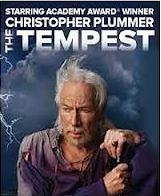
the tempest christopher plummerDes McAnuff’s 2010 Stratford Shakespeare Festival production of The Tempest starring Christopher Plummer is less like a violent storm at sea than a warm spring shower that freshens the flowers.

Plummer delivers a pleasing, avuncular Prospero who is mostly good company and who finds the most comedy in the banished Duke of Milan’s lines. This allows Miranda (Trish Lindstrom) to be funnier, too; and the lightness extends through the whole production, especially into the exquisite and hilarious clowning of Trinculo (Bruce Dow) and Stephano (Geraint Wyn Davies).

These choices cause several problems, however. A post-anger Prospero, who has already chosen forgiveness over vengeance, drains the play of much of its drama. It also makes the character of Prospero make less sense. Prospero is a benevolent bully, and Shakespeare gives you plenty of examples of both benevolence and bullying throughout the play. When McAnuff underplays the bullying, it leaves the viewer feeling something is a little off.

This feeling is intensified by the casting of a white-skinned and red-haired Miranda, an African Caliban (Dion Johnstone), and an Indonesian Ariel (Julyana Soelistyo). I’m not a huge fan of “critique of colonialism” productions of The Tempest, but I can see their point, and McAnuff seems to have gone out of his way to emphasize the critique and then dismiss it.

On the plus side, Plummer is a delight throughout the production and gets to stretch his wings at the end of The Tempest, when he is renouncing his powers. The emotion of these scenes is intensified by the fact Plummer was 80 at the time, so that the actor and the role merged.

Finally, this is a filmed stage play, but it is a play filmed with great care. You never lose the sense you are watching a play, performed before a live audience, but at the same time you don’t feel that the camera work has been inhibited by the constraints of the theater’s physical space.

Overall, I liked this production of The Tempest and encourage you to seek it out. It is currently available on Netflix in the States.