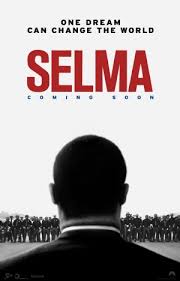
Selma MovieFor a movie as universally praised – and as well deserving of that praise – as Selma, the film is getting curiously little positive attention lately.

Despite examining the life of arguably the most important American of the 20th century (Martin Luther King Jr.) and one of the major events in that century (Civil Rights), the discussion of U.S. history Selma has provoked is dominated by questions of the film’s representation of Lyndon B. Johnson, the president during the Selma marches.

And despite being better written, acted, and directed than the vast majority of films Hollywood produces, including the “issue” films through which the industry loves to celebrate itself, Selma was largely snubbed by the Oscars.

The question is Why? Having considered carefully, I’ve come up with the answer. Because director Ava DuVernay didn’t make the white guy the hero.

Now this sounds like the kind of provocation on which bloggers depend, but it happens to be my true opinion. And highly defensible. Here’s why.

Selma the Movie Versus History

The first thing to know about any work of art that dramatizes historical people and events is that when the needs of the dramatist conflict with the truth of the historian, the truth of the historian always loses.

This is the nature of storytelling, and we would all be better off if more storytellers would acknowledge this fact up front and more historians would stop bitching about storytellers failing to do their jobs for them, and instead embrace the opportunity to talk about history that movies like Selma offer.

The right questions we should ask film-makers like Ms. DuVernay are What did you change? and Why did you change it?

These are the questions DuVernay answered in a January 5 Rolling Stone interview. She reduced Johnson’s role in Selma because she was “interested in making a movie centered on the people of Selma” and because she wanted to portray Lyndon Johnson as a “reluctant hero”.

That is what she achieved. Watching the movie, and reviewing the historical arguments swirling around it, the worst you could say about DuVernay’s LBJ in regards to the Voting Rights Act is that he saw it as somewhat less of a priority than the historical LBJ. But both Johnsons worked with Dr. King, both Johnsons cared about the bill, and both worked to get it passed.

You wouldn’t know this from the reaction of Joseph Califano, a top Johnson aid from 1965 to 1969, who acts as if DuVernay did a full-on Shakespearean Richard III hatchet job on Johnson; who claims Selma was all Johnson’s idea and implies LBJ cared more passionately about voting rights than the people of the Civil Rights movement; and whose self-righteous appeal to the “facts” of history don’t quite fit the facts he quotes (see the New Yorker article).

Califano and other critics are on much more solid ground when they complain that the movie portrays Johnson as behind the FBI secretly taping Dr. King’s extra-marital affairs. If they want to ding DuVernay for that, have at her. While I think the spying is important to include in Selma, the way DuVernay included it in the film is clunky and her defense of the inclusion, clunkier.

But in all the outrage over the horrendous slander against Lyndon Johnson people like Califano express, it would be nice if they paused to also express some outrage at the government spying on one of its own citizens to stop him from claiming rights guaranteed by the Constitution.

Or perhaps even a little outrage over the fact that men in the pay of government routinely beat the living sh*t out of people – beat these people with impunity and without consequence – as they tried to claim the same rights. If the truth about LBJ in 1965 is worth getting upset over, shouldn’t the truth about everyone else in 1965 still matter too?

Selma the Movie, What Sells Tickets, and The Great Oscar Snub

The answer is clearly “no” or the experience of the men and women of the Civil Rights movement would be part of the conversation too. To understand the reason why it’s not, the best place to go is Hollywood.

Hollywood is even more attuned to what people want than governments, because while governments can make you give them money whether you like it or not, Hollywood has to convince you to open your wallet through pure selling.

Mostly what Hollywood sells are fantasies of sex, money, love, power, and freedom from social restraint. Occasionally, they sell stories about inspiration, uplift, and redemption. And occasionally within this subset of inspiration, the stories are about real people and real events.

But there are rules that must be followed. Some of these rules are that such movies should be simplistic, over-obvious, and end in triumph. An iron-clad rule is that they must make the audience (that is “white people”) comfortable by assuring them they are right-thinking, right-acting human beings firmly on the right side of history.

Call this the Dances with Wolves model or if you like, the “white savior” model, which is what DuVernay told Rolling Stone she wanted to avoid making Selma. And boy she sure did.

Her Selma gets the formula half right. The movie clearly identifies the “bad” white people like Alabama Governor George Wallace and Selma Sheriff Jim Clark who we can all congratulate ourselves for despising. But Selma then fails to give us (again “us” means “white people”) the counter-balance of the unambiguous white hero whose actions are absolutely essential to achieving the ending’s triumph and with whom we (“white people” still) can identify.

DuVernay takes away LBJ as simple hero and then does more. She mixes into her Lyndon Johnson qualities that fall between those of the obvious hero and those of the obvious villain – those inaccuracies previously discussed. She has King say all those who do nothing while innocent people are killed share complicity in those killings. And she closes the movie with Common and John Legend singing a song (“Glory”) that explicitly connects Selma to Ferguson, which when you compare the news footage of the two events look, ah, kinda similar.

The result? A whole lot of white people going frickin’ bat sh*t because Selma suggests that maybe they aren’t quite as right-thinking and right-acting as they’d like to believe.

This seems to me to be the heart of the matter. The objections to the historical inaccuracies in Selma look strangely out of proportion to the inaccuracies themselves until we see them as damaging the image of LBJ as “white savior” and so damaging the self-esteem of people like Califano who want to identify with him as such. What else would explain Califano over-playing Johnson’s importance to voting rights, after bitterly complaining Selma under-plays it, except that Califano is reflexively defending his self image?

This also explains the strange pattern of Oscar snubs the academy has bestowed on Selma. No person associated with Selma was nominated. Many of these nominations went to other less accomplished, though perfectly serviceable “serious” films like The Imitation Game and The Theory of Everything. Only Selma the movie itself and the closing song were nominated. In other words, things.

Things the academy can claim as their own, celebrate, and congratulate themselves as right-thinking, right-acting people for celebrating.

That is what they sell, after all.

Tock Tick

Tick tock as we drink our coffee.
Tick tock as we check the scores.
Tick tock as we sip our cocktails.
Tick tock when we close the door.

Tick tock the clothes are dirty.
Tick tock the bills lie unpaid.
Tick tock the lawns grow wilder.
Tick tock the beds sleep unmade.

Tick tock our griefs grow colder.
Tick tock days are long in age.
Tick tock the twilight’s failing.
Tick tock the low candles fade.

The Money Girls

Beauty is marketing to the
Money girls and they spend
With lavish precision because
Big dreams need big budgets.

Seal-sleek hair, shinning pumps,
Pearl earrings, suit and skirt,
All elegance and no sex they
Interrogate their prey with
Smooth questions; and when

Your answers satisfy they slide
Their treasured secrets from
Leather cases softer and more
Durable than flesh, click-clasp,
Showing what you long to see:
MBAs and GPAs, KPIs and ROIs.

Will they be content after they
Eat the world and don’t grow fat?
Will work and reward fill the void
Or just gild it over? I can’t say, but

The money girls will spend their youth
In acquisitive pursuit, and if those years
Go to hard waste, they can’t buy them back.

Published in the Fall 2014 edition of Apeiron Review.

I’d say we drowned the voice of
The deep Atlantic in Katy Perry.

Or banished mystery with
Mini golf and Skee ball.

Or caught chaos in a box and
Turned it into taffy for children.

But the truth is the ocean
Tamed herself: salt-sweet,

Warm as milk, and lolling up to
Lick our hand like a friendly dog.

Thanks to Philadelphia Stories for publishing “Down the Shore” in 2014.

shakespeare

Portraits of “Shakespeare” from Wikipedia

The greatest and most amusing — and most tedious – literary conspiracy theory bouncing around is the assertion that “Shakespeare” the genius dramatist was not actually the historical William Shakespeare but some other far more deserving (and often far more aristocratic) person.

The various theories against Shakespeare’s authorship are amusing because conspiracy fans insistent on them so stubbornly while arguing for versions of the “truth” that often require a greater suspension of disbelief than the generally accepted “Shakespeare” story. These theories are tedious because they entirely miss what is important about Will.

But to the entertainment first. There are a couple reasons why Shakespeare conspiracy theories are so persistent. The one good reason is that there are relatively few documented facts about the historical William Shakespeare’s life, and within these few strong facts that link him to the authorship of the plays. This lack of conclusive documentation offers a fertile opportunity for the paranoid at loose ends for an object on which to fix their obsessions; or academics in need of their next publishing topic; or the occasional aesthete who is offended by the idea that the brightest star in English literature was also a grubby businessman.

This fertile opportunity is supplemented by two dubious assumptions that the conspiracy fans like to promote as self-evident facts. The first is that it is impossible for a person to become an artist of any quality unless he or she has received a highly privileged education. The second is that it is impossible for an artist to write persuasively about persons or topics unless he or she has had direct experience with those persons and topics; which in Shakespeare’s particular case means kings, queens, and nobles for the persons and the dynamics and psychology of power within a monarchy for the topics.

The first assumption of the conspiracy fans is dubious because it is contradicted by life. We can find many examples of people with intelligence, talent, energy, and determination who thrived without an elite education or special privileges. Robert Zimmerman, a college dropout from Hibbing Minnesota whose family possessed no special distinction moves to New York City and within a few years explodes into the culture as Bob Dylan. By the logic of the conspiracy fans, such an artistic life should not be possible and Dylan’s works should actually be the secret production of Pete Seeger, son of a Harvard-trained musicologist and a concert violinist who enjoyed all sorts of advantages and opportunities. (I’m not trying to bust on Pete here, just saying.)

The direct experience assumption is even more problematic. First, it assumes that the characters of the nobility and the dynamics are monarchical power are fundamentally different from those of – for example – ordinary people competing for position in a theater company. And yet we often find Shakespeare’s nobles sympathetic and their problems familiar. If these nobles are a different breed than us, why would we understand or care about them? If they aren’t a different breed – and that is my assertion – then Shakespeare would not need to have been at court to write about them and we would not need to be nobles to care.

Even worse, the direct experience assumption denies that artists possess any real creativity. If artists can only depict what they know or have experienced personally, that makes them, at best, recording clerks in whom the power of imagination is largely irrelevant.

Also, if we apply this logic consistently, then we’d have to delegitimize enormous numbers of artistic works. What are we going to do with all those paintings of the crucifixion? Clearly, no painters were present at the death of Jesus. Did the real author of Macbeth – Shakespeare or otherwise – personally know a murderous king? Because if he or she didn’t, by the conspiracy fan’s logic, the play couldn’t have been written and shouldn’t exist. Unless Melville survived a whale attack, he couldn’t have composed Moby Dick. And so on. There are convenient ways to get around this problem, of course. The most convenient is to assert that direct experience is necessary for acts of artistic creation. Except when it’s not.

These two assumptions cause additional mischief. Since they are used to “prove” Shakespeare couldn’t have written the plays attributed to him, they also push the conspiracy fans to identify university-educated playwrights such as Ben Jonson or Christopher Marlowe, or various aristocrats such as the Earl of Oxford, as the real Shakespeare. This produces some of the most fun to be had with the conspiracies, because the explanations are considerably more fantastic and more unlikely than Shakespeare’s own dullish biography.

In the case of Christopher Marlowe, as an example, the problem is that Marlowe was killed in 1593 while Shakespeare continued to write plays for a good twenty years afterwards. How does that work? Did Marlowe leave a trunk-full of unfinished plays? That’s quite an incredible explosion of unexploited creativity. Why didn’t Marlowe publish the plays himself or make arrangements to do so? How did Shakespeare get a hold of them? Were they written in secret? If so, why? How come nobody else except Shakespeare knew about them? Or if other people did know, why did they not care Shakespeare was presenting the plays as his own?

Or take this possibility. Marlowe faked his own death (perhaps to avoid a heresy investigation), succeeded at faking his death, was never found out, continued to write plays, used Shakespeare as a front to present these play, was never discovered or exposed as the real author, and presumably died in anonymous peace sometime around the time Shakespeare retired without Marlowe reappearing at the last moment to claim credit before he joined the bleeding choir invisible.

Really? As a potential movie starring Tom Hiddleston, stuff like this sounds superb. As history, considering we are talking about private citizens and matters that do not touch the vital interests of a state, it’s pretty ridiculous. The problems with the conspiracies generally fall under the categories of motive and means: why would another writer pretend to be Shakespeare and how did he pull it off? By contrast, all we need to believe about Will was that he was a slightly unlikely, extraordinarily talented autodidact.

When it comes to Shakespeare isn’t Shakespeare conspiracies, I fall back on that old stand-by: Occam’s Razor. In the absence of evidence to the contrary, the simplest explanation for an occurrence should be preferred. In this case, the simplest explanation is that “Shakespeare” really was Shakespeare and he really did write Hamlet and As You Like It and all the other plays. And until such time as new reliable evidence appears, which demonstrates that what sounds pretty ridiculous is gosh-darn-it the truth, that is where I will settle.

These who enjoy canvassing the question may continue to do so with all liberty, of course. But after a little time I find the whole debate boring. And depressing. Because what really matters about “Shakespeare” is our experience of his work, which is so wonderful, so deep, so multi-various, so entertaining and consoling. Who Shakespeare was doesn’t really matter. It’s what Shakespeare created that matters. Listening to the people who don’t understand that is amusing, for a minute or two. Then it becomes tedious.

Flight Behavior Barbara KingsolverBarbara Kingsolver is such a good writer that she can make you forget — or forgive — some pretty substantial problems in a novel. This is a good thing because Flight Behavior has several although it is still a book well worth reading.

Flight Behavior has a number of shortcomings, but these do not include its language or characters, which are solid, complex, persuasive, and satisfying.

The novel’s central character is Dellarobia Turnbow who like many Kingsolver characters is a woman with an intelligence, spirit, and sex drive too large for her circumstances. In Dellarobia’s case, these circumstances are a small Appalachian town, an ill-matched husband acquired through a high-school pregnancy, a small confining house with two young children, and subsistence farming on the land of her resentful in-laws.

As Flight Behavior opens, Dellarobia is set to destroy (and so escape) her marriage through a particularly reckless and desperate act of adultery. When she climbs up the wooded hills of her husband’s family’s land to meet her lover, she discovers the entire Monarch butterfly population of North America, which has settled for the winter in rural Tennessee rather than deep in Mexico, because of climate change. The vision of the butterflies turns Dellarobia around, literally and figuratively, and send her life in new and remarkable directions.

There is a great deal in Flight Behavior to enjoy and admire. Each of Kingsolver’s characters walk on to the page fully formed, convincing, and distinct: from Dellarobia’s husband Cub, to her best friend Dovey, to her family and the people in her church, to Dr. Ovid Byron, the lepidopterist who appears to study why the Monarchs have so radically changed the migration patterns hard-wired into their DNA. Kingsolver makes it easy to understand and empathize with her characters even when they aren’t necessarily likable. Her conversations are a pleasure to read. And she makes the emotional arc of Dellarobia’s story moving and real.

The problems in Flight Behavior come from its plot construction, which is a bit of a mess, and its “big themes” which are didactically over-emphasized to the extent that readers might feel the need to take notes in case there is a test at the end.

The plot problems begin with Dellarobia’s reaction to the butterflies, which she feels is some species of religious revelation, which causes confusion in Dellarobia and controversy in her church.  This is a fine and intriguing idea, and fair enough. The problem is that the religion angle fizzles out before we are a third of the way through Flight Behavior with no more explanation than Dellarobia and everyone just seemed to forget about it.

Another plot line that fizzles is Dellarobia’s romantic obsession with Ovid Byron that goes on for a tantalizingly long time before we discover it is the shaggiest of shaggy dog tales. Then for good measure, when we are in the home stretch, Kingsolver drops on us one of those shocking personal secrets that typically form the “big surprise” of 19th-century novels, only to have all the characters involved immediate disappear for the rest of the book, the surprise unexplored and unresolved. In a novel that clearly demonstrates its commitment to conventional plot architectures, these qualities can only be seen as flaws.

The biggest of Flight Behavior‘s big themes is global warming, which is not only disrupting the life cycles of the Monarch species but seemingly the weather of Dellarobia’s home as well, making the precarious economics of the Turnbow and neighboring farms more precarious still. Kingsolver clearly believes the globe is warming and human activity is a cause (as does the consensus of the scientific community and me too, by the by) but she pursues this theme through long conversations between Dellarobia and Ovid, which weaken the novel while having no impact what-so-ever on public opinion. The novel is weaker because Kingsolver’s management of the exposition is ham-handed and her talking points way too obvious. As for public opinion, climate-change deniers are thin on the ground among readers of literary fiction to begin with, and the few members of that choir who might be in need of a sermon on global warming are not going to be moved. Few things are less persuasive than a lecture. Particularly when your audience is captive and you had promised them a story not a seminar.

Kingsolver also has a reasonable amount to say about the conflicting world views, mutual misunderstanding, and reciprocal lack of respect between the religious, conservative, working-class (at best) residents of rural Tennessee and the wealthy, well-educated liberals who descend on Dellarobia’s home to study the butterflies, agitate to protect them, or use the Monarchs as an occasion to indulge their self-righteous narcissism. Like with her handling of climate change, the problem with this theme is that it is too often explored through explicit, long expository comments from Dellarobia. There’s nothing wrong with big ideas in novels, but big ideas in novels work best when they are implicit and handled with subtlety.

The good news is that there is so much good stuff going on in Flight Behavior, and Kingsolver’s talent is so mature and sturdy, that your pleasure will be only mildly diminished by the novel’s problems. And you’re likely to be impress by how well the book succeeds in spite of them.

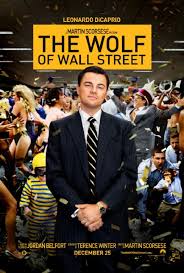
the wolf of wall streetMartin Scorsese’ 2013 movie The Wolf of Wall Street (now on streaming) is not a morality tale. It is not a caustic satire. It is not even a black comedy. It is – simply – a Three-Stooges, gross-out, id-driven comedy. Full stop.

There are a whole bunch reasons why this is hard to see. The film is based on a real-life figure (the penny-stock impresario and fraudster, Jordan Belfort) whose crimes are emblematic of the Wall Street which brought ruin to middle-class American prosperity and much of the world economy. It stars Leonardo DiCaprio rather than Will Ferrell. It is directed by Mr. Scorsese who is rightly celebrated as a master of American cinema (Raging Bull, Taxi Driver). And it gives high-minded critics the rope of just enough material – largely the result in my eyes of the film editor Thelma Schoonmaker’s yeowoman’s work imposing some order on the magnificent, exhilarating, and exhausting chaos – to hang themselves.

This rope includes the moral queasiness we feel laughing at pain and cruelty – and ignoring victims – which straight-up comedies avoid by making themselves obviously straight-up comedies (in which we are laughing at “types” rather than “real” men and women). It also includes certain characters and situations which seem to have been imported from an entirely different movie: in particular, the FBI agent Patrick Denham (Kyle Chandler) who pursues Belfort with an intensity, complexity, and ambiguity missing from the rest of the movie, but also the briefly presented dissolutions of Belfort’s two marriages. And it includes the possibility of seeing The Wolf of Wall Street as a meditation on three human themes – appetite, addiction, and selfishness – that resonant with all the Three-Stooges, appalling, and hysterical excess.

It is, however, only the appalling and hysterical excess that makes a durable impression in The Wolf of Wall Street. The celebrated scenes are all outrageous, horrifying comedy. Matthew McConaughey tutoring a wide-eyed DiCaprio on the essentials of Wall Street success: greed, client manipulation, cocaine, and masturbation. DiCaprio whipping up his traders into a berserker frenzy. All the glossy, sleazy, tawdry parties, the highest density of f-bombs ever recorded in cinema, and the massive drug consumption that makes Al Pacino’s Scarface look like a teetotaler. Most especially, the already famous extended scene in which DiCaprio and his business partner (Jonah Hill) consume way too-many Quaaludes and deliver a genius piece of physical comedy that is likely to become standard in film-school curriculums.

Perhaps you can wrestle legitimate meaning from all the exuberance of making in The Wolf of Wall Street, but that work has been entirely assigned to the audience it seems to me. “We made it. You figure it out,” is the final message. Which makes The Wolf of Wall Street a kind of Benny Hill Goodfellas, a far-better Scorsese film with which it shares the same basic story arc and a similar character as anti-hero. But instead of taking us deep into the life of Henry Hill, The Wolf of Wall Street serves up a bunch of running around, yucks, and tits.

twelve years a slave mcquIs it possible for a movie to tell a truth its audience does not want to hear?

We know that movies can sell the pretty lies of propaganda more persuasively than other medium. In fact, you could say the definition of a movie is a “pretty lie”. But can a film tell an “ugly truth”?

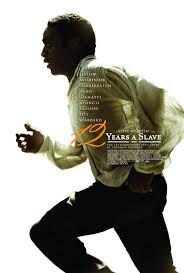
12 Years a Slave, the newest winner of the Oscar for best picture, directed by Steven McQueen and starring Chiwetel Ejiofor, is the rare film that allows us to answer “yes” to this question.

There are a lot of reasons films like 12 Years a Slave are so rare. The essential one, however, is the simple fact that you have to sell tickets to movies.

The average price of admission to a movie in America last year was $8.35 and if you were an adult attending a non-matinee showing, $12.00 to $15.00 was more like it.

In aggregate, people will lay down money to be entertained by a movie. They will especially slap down coin to participate in a filmed fantasy: sex, wealth, power, revenge or justice, adventure, romance, agency, freedom, lives lived with noble meaning and purpose.

Sometimes, they will pay to see the truths of their real lives expressed for them by a film. Even less often, but still sometimes, people will pay to watch a movie that tells an ugly truth about someone else.

But people do not want to pay for the experience of confronting an ugly truth about themselves. Because it damages their self-esteem.

There is a growing body of social science research (see this recent piece on the vaccines-cause-autism myth as an example) that finds when people are confronted with evidence that contradicts one of their dearly held beliefs, they end up clinging even more strongly to that belief.

That’s why so many “issue” movies are sanitized, prettified, heavy-hand pieces of didactic crap in which an exceptional, self-sacrificing hero from the victimizer class achieves some sort of redemption for the victimized class, often while a representative sample of the victims stand admiringly off to one side.

This is because it is nearly impossible to show an audience an ugly truth unless you give them a big, honking, obvious, unambiguous way of disassociating themselves from that ugly truth. Thus the self-sacrificing hero from the victimizer class and thus the speech (or speeches) in which said hero firmly articulates the principles we all eagerly embrace so we can feel like good people.

The remarkable, harrowing, painful, brilliant achievement of 12 Years a Slave is how little of this it does and consequentially how powerfully it succeeds as art and history and moral persuasion.

As you doubtlessly know by now, 12 Years a Slave, tells the true story of Solomon Northup, a free black man from New York state who is kidnapped into slavery. The film focuses on the brutal daily reality of Solomon’s life as an enslaved man: the what-should-be-impossible to endure physical, emotional, and psychological suffering that Solomon and the men, women, and children who are enslaved with him do endure until they die.

Director Steven McQueen keeps the focus on Solomon’s suffering and refuses to allow us to look away. We are immersed in Solomon’s experience, in a firestorm of words he cannot risk speaking, of emotions always felt but seldom expressed because their expression will bring him destruction, either from the hands of white slave-owners or his own enormous interior pain.

As Solomon Northup, Chiwetel Ejiofor is simply astounding. The role requires Mr. Ejiofor to do everything and nothing. To feel and to show us that feeling and to show us Solomon hiding that feeling. To not speak and to show us the words he does not speak. To show us a life in which every minute of that life is anguish and exhaustion – sometimes gentle but usually unbearable.

There are many indelible scenes in 12 Years a Slave, but for me the most unforgettable is the one where a slave-owner named Edwin Epps (Michael Fassbinger) forces Solomon to whip Patsey, a young enslaved woman with whom Epps is malignantly, sexually obsessed. (Patsey is played by Lupita Nyong’o, who won an Oscar for the role.)

The whipping nearly breaks Solomon and is devastating to Patsey as well. Solomon’s reaction, the red mist of blood that rises from Patsey’s back each time the lash strikes, her uncontrollably weeping, and the deep furrowed wounds from the whip McQueen shows us, all should put to an end – for the last time – to the lie that slavery was a just “particular institution” or a “benevolent institution”; or the lie that abolition was a less worthy cause for liberty than the liberty of slave-states to determine within their borders who did and who did not deserve the right to the freedoms promised by the Declaration of Independence and the Constitution; or the lie that slavery was a mere minor blemish on the glorious, now persecuted culture and history of the American south specifically and America in general; or the lie that the suffering of enslaved men, women, and children has been overstated and oversold, and in any case, slavery is in the past and so it is far past time for people to shut up about it.

McQueen does a good job of not letting his audience off the hook in this movie – and by “his audience” I should be specific and say the audience not escaping the hook is “American white people” and fair enough – but there are two stumbles in Twelve Years a Slave.

The first is in the characters of the slave-owner Edwin Epps and his wife, who both shade far enough into psychotic villainy that McQueen could allow his audience to say that it was only a few crazy bad slave-owners who did crazy bad things to enslaved people.

A bigger problem is the abolitionist carpenter name Bass who helps Solomon regain his freedom. Bass is played by Brad Pitt and as the exceptional, self-sacrificing hero from the victimizer class who achieves a redemption of sorts for Solomon – and who while at it, also delivers a few neat little speeches that articulate the principles we all can eagerly embrace and so feel like good people – Pitt stands out like a big fat sore thumb.

I get the feeling this was not exactly McQueen’s choice. Pitt was one of the film’s ten producers, and of the ten, the only generally recognizable big Hollywood gun in the group. When the best picture Oscar was announced, Pitt was the first producer on stage, the first producer to take his Oscar, and the first producer to speak — though he spoke briefly and graciously, and mostly to introduce McQueen.

If the price of getting 12 Years a Slave in theaters was to give Pitt a few glamour moments, it was a price well worth paying. But the movie would have been better served if Pitt had switched roles with Paul Giamatti, the slave-trader who knows Solomon is a kidnapped freeman and sells him any way. Pitt’s glamour would have made a bracing contrast to his character’s actions, and Giamatti would have made the audience-hero-surrogate less pretty, less preachy, less courageous, less unconflicted. Less like the person we would like to be. More like the person most of us are.

Thelma Louise and Emma Bovary

Susan Sarandon, Geena Davis, and Isabelle Huppert as Emma Bovary

There is a great depressing theme in 19th-century literature of woman who – thwarted in their efforts to achieve independence and agency – turn to suicide.

Lily Bart in House of Mirth dies from an (accidental?) overdose of a sleeping drug. Edna Pontellier in The Awakening drowns herself. Anna Karenina throws herself under a train. And Emma Bovary poisons herself with arsenic. There is no place for the lives they desire in the worlds they live, and so death becomes the only liberty they can choose.

This theme jumped up and slapped me in the face recently when for the first time since 1991, I watched Thelma & Louise, starring Geena Davis and Susan Sarandon, and directed by Ridley Scott.

The film concerns two women who plan a weekend getaway together. Thelma (played by Davis) wants to escape from her bullying lout of a husband and Louise (played by Sarandon) is looking for a break from her job as a diner waitress.  When a man Thelma meets at a bar tries to rape her in a parking lot, Louise shoots him dead and sets the movie in motion.

Thelma and Louise travel cross-country from their native Arkansas, simultaneously fleeing from the law following them in pursuit and toward a freedom that the film embodies in the American West. But society – or the machine of the plot – drives them to a choice between prison and death. Thelma and Louise choose death.

Thelma & Louise & Emma Bovary

There are a whole bunch of differences between Gustave Flaubert’s Madame Bovary and Ridley Scott’s film (including artistic quality) but the characters and in particular the situation of the characters are similar, and it is with the similarities among the characters that I would like to start.

Geena Davis’ Thelma is a more obvious match for Emma Bovary than Sarandon’s Louise. Like Emma, Thelma is trapped in a marriage to an (at best) mildly successful buffoon in a provincial town that severely circumscribes her choices. Also like Emma Bovary, Thelma knows vaguely – and feels deeply – that something is wrong with her life, but isn’t able to articulate what the problem is and lacks the power to make effective changes. So Thelma, like Emma, falls into a transgressive form of rebellion for her time: highway banditry in contrast to Emma’s adultery.

Susan Sarandon’s Louise is a more subtle, and so to my lights, more moving character. She is in her middle-late thirties and seems to feel the possibilities of her life shrinking around her. Scott frequently films Sarandon staring in the mirror and pushing at her just-beginning to age face – often surrounded by younger women. She works in a diner. Her apartment is scrupulously neat and empty. We learn that she was a victim of rape in Texas years before. Her life is circumscribed it seems by age, and loneliness, and trauma. Louise shows hints of complexity in Scott’s often too simple world.

Thelma & Louise is Full of Ridiculous Male Stereotypes … Oh, Wait a Minute

It is a fool’s errand for a man to say a movie (or a book or anything) is or isn’t a feminist movie (or book or anything) – because he can never be right – so I’m not going to even try – but I will say that Thelma & Louise provides a great deal of rich material for people brave enough to wade into the discussion.

Part of the material is the panorama of male villains who seem over-the-top until you start thinking about them, and then they start to look pretty typical. So we have the insulting, demeaning, and emotionally abusive husband of Thelma.  We have the self-entitled rapist who thinks Thelma owes him sex because he wants it. We have the charismatic stud who knows how to tickle Thelma’s nether regions, then steals her money without a qualm (Brad Pitt). And we have the cool boyfriend – Louise’s in this case – who just isn’t quite ready to commit, but who is just nice enough to seriously mess with a woman’s head (Michael Madsen).

Another part of the material is Davis and Sarandon’s appropriation of typically male film tropes. You don’t have to look very hard to see Thelma & Louise as a remake of Butch Cassidy and the Sundance Kid (even the titles echo) or, for that matter, dozens of other films about men. You have the deep but platonic friendship. The cheerful flouting of the law in pursuit of their own best desires. Sexual liberty. The possession and expert use of fire arms combined with a reluctance to commit actual acts of violence. The freedom of the vast American west.

The comparison breaks down when it comes to motivation. Newman and Redford choose their outlaw status from what seems to be pure joie de vivre. Thelma and Louise are driven to it by an act of (wholly justifiable in my mind) revenge. Louise shoots the man who assaults Thelma – but only after she has safely rescued Thelma from him.

If Thelma & Louise were a typical revenge film, and Louise were a man, the movie would have been devoted to the male Louise tracking down the rapist and brutally killing him in a world where police do not exist. But since Louise is a woman, and Thelma and Louise take the tools of men into their own hands, the police track them down and put half a battalion of firepower on their asses instead. Particular, ain’t it?

Thelma & Louise: Deeply Subversive or Crassly Exploitative?

What prevents Thelma & Louise from being a great movie – as opposed to the moderately good to pretty good film that we have – is Ridley Scott’s weakness for empty, pretty spectacle and his heavy-handedness.

There is a glossy glamour in his shots that screams out “Hollywood!” instead of serving the story. Many times, Thelma and Louise seem as driven by the film’s desire to deliver a popular action movie as they are by the circumstances of their lives and society. You would be hard pressed to call any of Scott’s characterizations subtle (except for some of the details in Sarandon’s performance previously noted) and there is no ambiguity.

The problems are nicely contained in a scene near the end of the film, in which Thelma and Louise confront a trucker who has been making crude comments at them throughout the movie. The man is crass, sexist, and deeply stupid. When he refuses to apologize, Thelma and Louse shoot his truck which erupts in an enormous fireball while the man yells “Bitches from hell!” It’s sorta satisfying and sorta fun, I admit. But it also feels cheap.

As does the ending, when Thelma and Louise drive their convertible over the edge of the Grand Canyon and the shot freezes in mid-air, the frame brightens to white, and we’re treated to a montage of happy Thelma and Louises from earlier in the film instead of the wreckage of blood, bone, and metal which is their real end.

There is a lot in Thelma & Louise that can leave you unsettled and unhappy if you look for it. But when Scott has to choose between selling unsettled and unhappy – or selling KA-BOOM! Wow! Ha ha ha! – well, he chooses the ka-boom.

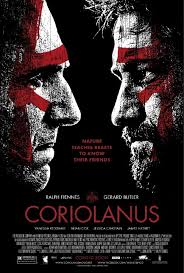
ralph fiennes coriolanusIn his 2011 film adaptation of Shakespeare’s Coriolanus, director and star Ralph Fiennes delivers a first-rate movie from one of the Bard’s second-rate plays.

Coriolanus is Fiennes’ debut as a director and his adaptation of Shakespeare’s play is impressive. The story concerns a 5th century Roman general, Gaius Marcius Coriolanus, who earns renown for his victories over Roman’s enemies, the Volsci.

Coriolanus is encouraged to run for consul, but his extraordinary pride and inflexibility alienates the common people, whose nominal support Coriolanus needs to win office. Coriolanus is branded a traitor and expelled from Roman instead, at which point he offers his services to the Volscian general he previously defeated and leads the Volscian army’s attack on Rome.

Fiennes places his Coriolanus in a modern, unidentified European country that feels like the former Yugoslavia in which much of the film was shot, and creates a compelling portrait of a militaristic nation with weak democratic institutions threatened by both internal and external strife.

Viewers are likely to recognize the influence of such filmmakers as Paul Greenglass and Kathryn Bigelow on Fiennes’ direction, but his mastery of their techniques is so complete and so visceral that I can give him nothing but credit for his success.

Fiennes gets strong performances from all his cast, including Gerard Butler, Brian Cox, and especially Vanessa Redgrave, who delivers a knock-out performance as Coriolanus’ she-wolf of a mother. For good measure, Fiennes gives a harrowing, malignant performance himself as Coriolanus.

My only quibbles with Coriolanus derive from the source play, not Fiennes’ work, and even these quibbles arise from Shakespeare falling short of his best work rather than some intrinsic flaw.

Shakespeare’s poetry in Coriolanus is quite strong and his plot construction better than usual. What’s lacking is the signature “inwardness” of his best characters (to use Harold Bloom’s apt word) and these characters’ ability to change.

Coriolanus never “overhears himself talking to himself” (Bloom again) and certainly does not change. That Coriolanus is utterly inflexible and lacks self-awareness are the drivers of his tragedy, and so perhaps necessary to the play. But this means the work does not quite achieve Shakespearean greatness.

Still, that leaves us with a play very good indeed, and one to which Fiennes in this film does full justice.