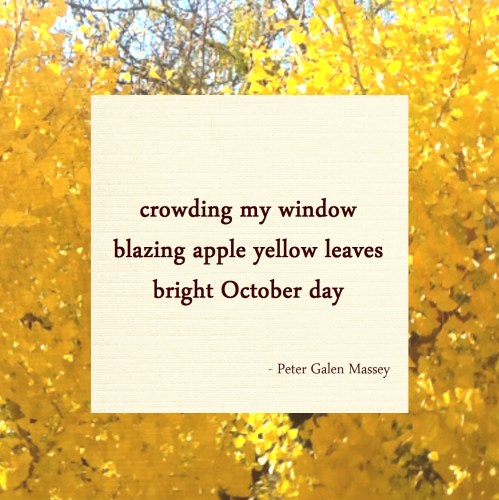
crowding my window / blazing apple yellow leaves / bright October day
crowding my window / blazing apple yellow leaves / bright October day
Posted in Haiku | Tagged haiku, haiku about fall, haiku about nature, Poems | Leave a Comment »

a sketch of shadows / on a stone wall gilded by / the blinding gold sun
Posted in Haiku | Tagged haiku, Poems | Leave a Comment »
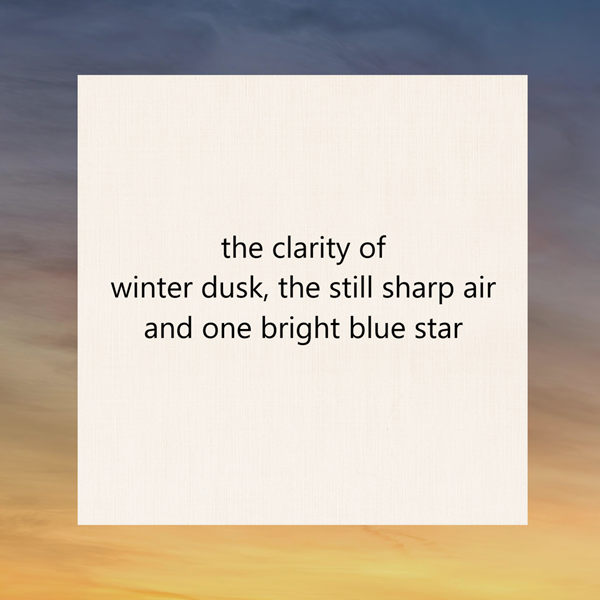 the clarity of / winter dusk, the still sharp air / and one bright blue star
Posted in Haiku | Tagged haiku, haiku about winter, Poems | Leave a Comment »
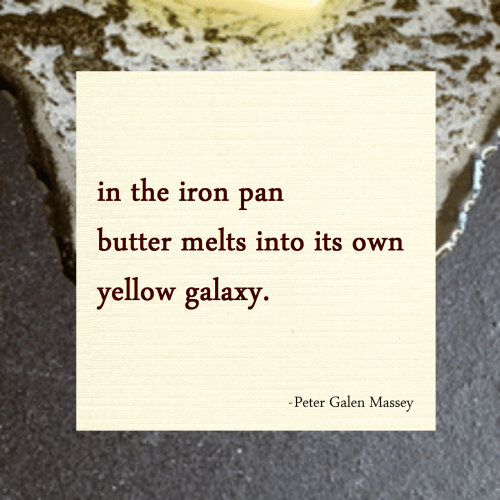
in the iron pan / butter melts into its own / yellow galaxy
Posted in Haiku | Tagged haiku, Poems | Leave a Comment »
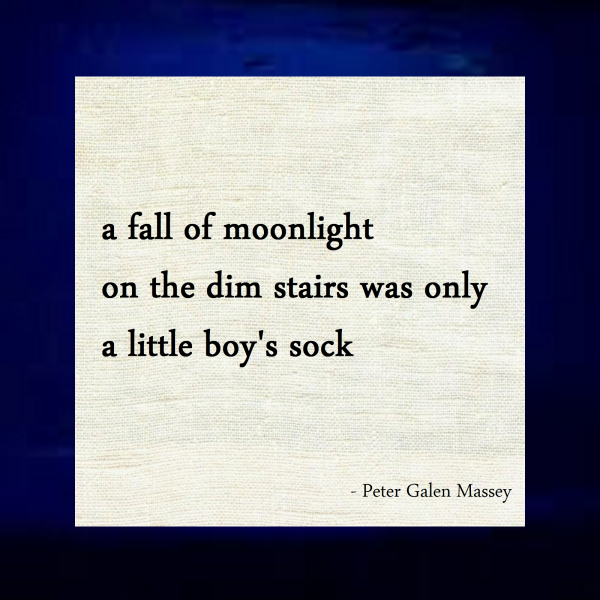 a fall of moonlight / on the dim stairs was only / a little boy’s sock
Posted in Haiku | Tagged haiku, Poems | 2 Comments »

I marked / These reds / On this canvas / In a place and time / Now forgotten by all save / A few dry scholars. But these / Reds are proof of my living hand, / Colors as alive as the taste of warm / Wine in your mouth.
Posted in Haiku | Tagged Poems | 2 Comments »

Do you want to write a Literary Novel but don’t know how to start? Fear not!
Follow these 11 easy steps and you too can write a masterpiece of fiction. Soon, you will enjoy critical praise, fawning audiences, fancy cocktail parties, cushy academic appointments, prestigious fellowships, and modest sales. Does that sound good? Then let’s get it going!
It’s the rare comic novel that joins the pantheon of literature. Comedy works in your favor if you excel at tragedy too (Shakespeare), if it is suffused with deep undercurrents of sadness (Chekhov), or if it comes with dazzling social insights (Austen). Otherwise, you are condemned to lightweight status no matter how blinding your brilliance.
A corollary to Step 1. No one who is happy is a serious person. Happiness indicates you are entirely lacking in the basic insight necessary to be sad or that you have been hoodwinked by capitalism, the church, the NFL, Cosmo magazine, the makers of antidepressant medication, or the Republican party.
Extroverts don’t sit in rooms by themselves reading about other people’s lives. They are out in the world living their own lives. Always make your Literary Novel about your audience. Your audience is introverts.
A corollary to Step 3. Being an introvert doesn’t do you much good unless you are living your interior life more deeply, more consciously, and more fiercely than everyone else is living theirs. Passionate introspection and self-conscious brooding are to introverts what sky-diving and tech start-ups are to extroverts: high-status ways of demonstrating you are more successful than your peers.
A corollary to Steps 3 and 4. It doesn’t do you much good to live a passionate interior life if you can’t get the damn thing out of your head and into the world prancing around impressing people. So make your characters impossibly articulate especially in circumstances that should render them speechless, such as tumbling inside a fatal avalanche or porking the hottie of their dreams.
This is especially important if you are a male writer. Size definitely DOES matter to the male literary novelist and the bigger the better. You don’t want to be dangling some elegant slender volume praised for its jewel-like perfections when you are standing next to Jonathan Franzen, do you?
If you are a woman, you have it easier. You can say exactly what you want to say, in exactly the number of words you need to say it – and no more – and trust the intelligence and good taste of your readers to recognize your qualities. You should also trust you will hear a lot of sniffing about lady writers.
Never make the mistake of entertaining the reader. You might accidentally become a popular success and popular success is for hacks. (Just ask Shakespeare or Twain or Fitzgerald or Nabokov or … well you get the point.)
The easiest way to make your Literary Novel boring is to assume that every passing thought you have is a rare gift to the world that must be shared. If you’ve ever used social media, this should be simple enough. Another easy way to bore the reader is to avoid plot. Be sure to let people know your book is deliberately boring by giving interviews in which you talk about subverting reader expectations or offering a stinging critique of the zombie-producing distractions of a debased all-for-profit culture.
Hey, we coughed up forty bucks for the hardcover version of your frickin’ doorstop. We want our money’s worth. That means big words and lots of them. Even if they don’t quite work in the sentence.
A corollary to Step 8. One of the most important reasons people read Literary Novels is to look and feel smarter than people who don’t. Obscure references are essential to this process. So make sure you put in plenty. I mean, you do want to be the next Sirin right? (Did you get my reference? You did? Welcome to the club! You didn’t? Ha ha!)
You should always criticize society in your Literary Novel as long as you are criticizing its insidious lack of liberal progress. Never criticize society for being too progressive. That is not literature!
Express outrage no one has fixed the problems you identify. Imply every problem would magically disappear if it weren’t for the malignant, soul-deadening, tyrannical machinations of the power elite. Do not make the mistake of offering solutions to the problems you see. Literary Novels are not in the solutions business.
This is the most important step of all. Your Literary Novel must be difficult to read. Remember, a truly original work of art is indistinguishable from a hot mess to its first audience. Further, no one is going to spend the time carefully reading an interminable and terminally boring new Literary Novel to figure out if it is a hot mess. They are going to play it safe and praise the book instead. This works great for you unless you really are a genius in which case, honey I’m sorry to tell you, you’re screwed.
That’s it! I look forward to your Literary Novel appearing in The New Yorker ten years from now. I did mention these bastards take a long time to write, and cause you unbearable suffering while you write them, didn’t I?
Posted in Literature | Tagged Fiction, Literature | 2 Comments »
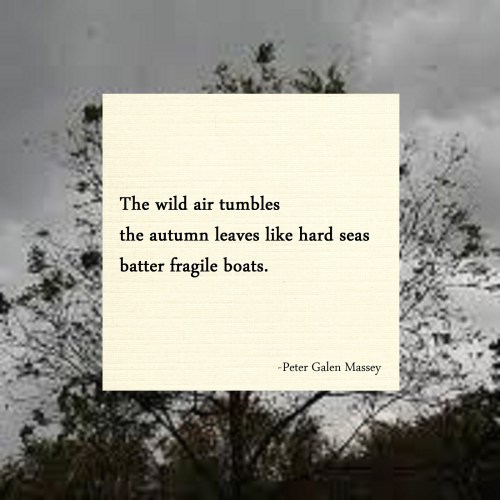
The wild air tumbles / the autumn leaves like hard seas / batter fragile boats.
Posted in Haiku | Tagged haiku, Poems | Leave a Comment »
“Texas” (Three Fragments)
Turbines tumble tumble through the hot air,
Like the wings of the archangels who chased
Night and chaos over the rim of the world in
The wrath of God’s creation, and came to rest
In the soft light of the first morning of Texas.There today the light before light with everything
Quiet except for the birds screaming in the dim
Trees and your thoughts wandering after those
Who have died or who are serving overseas or
What you’re chasing and what it pays and why it’s
Necessary, before you rise and dress and in your
Car rushing rushing with all the rest eight lanes
Of impatience furious to eat the endless distance
Between bed and the towering diamond-blue glass
Fortresses of wealth, the office parks with graceful
Trees and glittering fountains, the new merchant
Plazas on the new black roads, the box stores, the
Strip malls wearied by sun and subsistence, the
Cinder-block workshops, steel-tooled and machine
Oiled, the trailer-offices squatting on the site of
New prospect or old defeat, ragged air appliance
Rasping out feeble cool against vinyl-metal heat,
The heavy industry fairie kingdoms cracking crude
To naphtha kerosene paraffin diesel sulfur and tar,
The glinting purgatories of health, the dingy rooms
Machine bedded and ravaged age, the grey cubicles
Of counseled grief, kitchen, corridor, laundry, house
Children, house children, house children, eight lanes
Of hunger blood throbbing through interstates and
Access roads, vivid desire and dull necessity in metal
Boxes rushing everywhere, life mind heart rushing,
Until day ends, retirement eases, or death comes to
Tally his final accounts.***
Nature loves all her children hard, but she loves her
Texas children harder; sends them with a laugh and
A kick out the door to find something for supper.This rich land will wrestle you, take your youth, take
Your strength, give you cash in cattle, cotton, corn,
Sorghum, and wheat. This hard red earth more scab
Than skin will yield hard living if scraped, pierced,
Worked in dust and heat, through relentless sun,
Asphalt fume, with truck and tool and no excuses:
No one to catch you if you fall and no one asking
To be caught.***
There’s no fair fighting for our hard machines:
Time and earth will take them, concrete, circuit,
Polymer, steel, with one puff float all into endless
Mind, soft seeds blown from the dandelion head;
No fair fighting for our tender bodies, time frail,
Flesh blood bone souls man woman child, all
Floating, angels tumbling tumbling through the
Cooling air, the soft light, the last evening of Texas.
Thanks to Blast Furnace for publishing “Texas”.
Posted in Haiku | Tagged Poems | Leave a Comment »
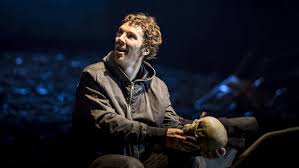 For nearly four acts, Benedict Cumberbatch, starring in the National Theatre Live broadcast around the world yesterday, is the best adjusted – and best – Hamlet I’ve seen. That the production falls flat in Act V is a disappointment, but does not take away from the many accomplishments of this fine staging.
Any performance of Shakespeare’s “Hamlet” succeeds or fails primarily on the strengths of its lead actor and Cumberbatch’s Hamlet is very good indeed. He fully and convincingly engages with all of the character’s emotions: Hamlet’s grief, his sorrow, his anger, and especially Hamlet’s humor which is the lightest and most sparkling of all the readings of the Danish prince I’ve seen.
This is the result of the intriguing choice of making Cumberbatch’s Hamlet extremely well adjusted, considering his circumstances. Hamlet is typically played as having been unhinged by grief over his father’s death, his mother’s quick remarriage, Ophelia’s rejection of his love, and the disturbing appearance of his father’s ghost. (It can be argued that the text demands this reading.)
This leads Hamlet to contemplate suicide and to embrace a half-madness which serves both to disguise the threat a sane Hamlet poses to his uncle’s stolen crown and to disguise the insane parts of Hamlet from easy recognition.
In Cumberbatch’s Hamlet, his madness is all tactic to confuse Claudius. This makes Cumberbatch’s “antic disposition” particularly playful and makes his Hamlet particularly likeable because the whinging, self-importance, and condescension frequently seen in the Danish prince are muted. It does mean, however, that Hamlet’s contemplations of suicide come off as passing thoughts, rather quickly forgotten.
Cumberbatch isn’t the only good performer in this National Theatre Live production. Ciaran Hinds is very good as a false, awkward, and cowardly Claudius unequal to the tasks of playing either the public or the private role of king. Sian Brooke’s is moving as an Ophelia whose vulnerability is evidence from the beginning of the play, and whose descent into madness is credible and heart-breaking. Anastasia Hille’s Gertrude manages to yell at top voice and convince us of her passion in her confrontation with Hamlet.
This is more than I can say for the actors playing Laertes and Horatio both of whom rely on volume when emotional connection with their roles seems to desert them. (Are bellowing Horatios the new style? It’s not a good style.) Polonius, Rosencrantz, and Guildenstern are played for laughs and deliver. The Player King is meant to be a bad actor and succeeds competently.
Like most staging of most Shakespeare, the National Theatre Live production tries new things, some of which work and some of which don’t. The generally accepted version of Shakespeare’s “original” text has been edited more than usual, with many scenes moved around and lines traditionally spoken by one character often spoken by another. This emphasizes the elements of Hamlet the director seems to want to emphasize and works just fine until Act V (more on that in a minute). For many of Hamlet’s soliloquies, Cumberbatch steps out of the action of a scene and is isolated in a spotlight (very effective). There is at least one instance where the characters are running frantically around on stage while music pounds and strobe lights flash (this should be banned from the stage by statute). The duel scene is so rushed and hugger-mugger that it felt like Gertrude and Claudius were alive one moment and dead the next. When Hamlet is exiled to England, the stage is inexplicably filled with black dirt, a gimmick making pretense toward grand visual metaphor though exactly what the metaphor might be, who can tell?
Finally, there is the problem of the Cumberbatch Hamlet in Act V of the National Theatre production. Or rather the lack of problem. The foundation to Hamlet’s universal appeal is his struggle against a life whose pain and demands are more than he can bear, but whose alternative – death – is unappealing. Hamlet’s personal drama comes from his eventual philosophical acceptance of or passive resignation to this condition (take your pick), culminating in Hamlet’s conversation with Horatio that ends with the words, “Let be.”
Since Cumberbatch’s Hamlet bears up reasonably well under his pain and the task of avenging his father’s murder, he never gets to acceptance or resignation. He simply dies from the machinations of Claudius and Laertes, about as happy and unhappy as he ever was.
This does not detract from my forming conviction that Cumberbatch’s Hamlet is the best and most appealing I’ve seen on screen. Not to mention the sexiest. I hope the National Theatre makes this production of “Hamlet” available for streaming eventually. I’d like to see it again.
Check out my other reviews of Hamlet movies starring Laurence Olivier, Mel Gibson, and many more.
Posted in Shakespeare Movies, William Shakespeare | Tagged Literature, William Shakespeare | 1 Comment »


 Peter Galen Massey