Archive for 2013

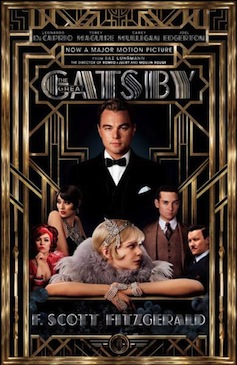
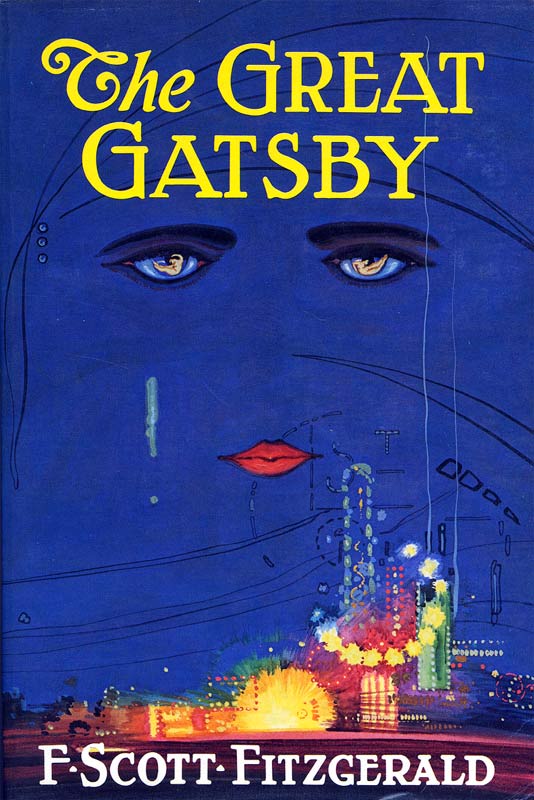
The Great Gatsby, classic cover designJulie Bosman published an interesting article on the front page of the The New York Times yesterday about competing cover designs for two paperback editions of The Great Gatsby. (The article is here.)  The first is a re-issue of the classic Gatsby cover familiar to readers old enough to have read Fitzgerald’s masterpiece in high school or college. The second is the tie-in edition for the movie starring Leonardo DiCaprio and directed by that genius of brilliant excess — or hawker of wretched excess, take your pick — Baz Luhrmann.

Much of the article describes the different markets at which the two cover designs are targeted, and different sales strategies behind each. Readers already familiar with the novel are likely to choose the classic design, while readers just discovering the book are more likely to be attracted by the movie version.

Behind one of these strategies, however, are certain attitudes toward literature which I find — well, let me be gentle in my expressions here — contemptible. Allow me to explain:

How does the cover design of The Great Gatsby change the novel? (Hint: It doesn’t.)

The Great Gatsby, movie designAssuming that texts in today’s competing versions of The Great Gatsby are identical, how do the differing cover designs affect the experience of reading the novel?

The answer is they don’t. Just like reading Gatsby on a tablet rather than on paper doesn’t change the experience, as long as you think what is essential about a novel is reading the text. Is engaging the words on the page. Is entering into a conversation with the author as you read the book.

Now, the cover design can influence your expectations of a novel you haven’t read. And if those expectations are different than your reading experience, you may come to a different conclusion about the book than you might have otherwise. But all sorts of things influence our expectations of a book. Its status in the canon. The opinions of reviewers and friends. Advertising. Our mood and experiences. Our age.

But once you’ve read a book, how does anything other than having read it affect your expectations on re-reading it? Especially a novel like The Great Gatsby, which a lot of people have read. Or put another way…

If the cover design of The Great Gatsby doesn’t matter, why does anyone care?

Because people do care. Or at least we know for certain that one SoHo bookseller quoted in the article cares, because he says so. “It’s just God-awful,” he says, referring to the movie tie-in version. (I agree, by the way. It is pretty bad.)

But it doesn’t sound like this bookseller objects to the fact the cover design is ugly. Allow me to quote the article.

As to whether the new, DiCaprio-ed edition of “Gatsby” would be socially acceptable to carry around in public, [I’ve withheld  the name, you can find it in the article] offered a firm no. “I think it would bring shame,” he said, “to anyone trying to read that book on the subway.”

Shame. Really. Why?  Is it because the important thing about The Great Gatsby is not reading The Great Gatsby but being seen reading The Great Gatsbyespecially being seen reading an edition of The Great Gatsby which signifies that you aren’t some hick coming late to the art party?

I realize I’m speculating aggressively here, with a certain amount of snark, but it’s hard to think what else our bookseller friend might have meant.

Also, while I’m at it, why the hell would you care what strangers in a city of 8.3 million people think of you? Are you likely to ever see them again? What’s the point of trying to impress people you don’t know?

Also, while I’m at it, shouldn’t we be happy if a person decides to read The Great Gatsby because the movie-cover persuaded him to pick it up? Shouldn’t we hope more people will read the books we like? I would think the answer to these questions is “yes”.

Unless of course the point of great novels is not to read them or share them, but to use these books to create an exclusive club that allows us to feel special and look down on everyone else.

Allow me to be blunt. If I haven’t been already. People who use art to bolster their social status or personal vanity are philistines. They don’t care about art. For them, it’s just another accessory to flash, like a fancy watch or a cocktail  made with a certain brand of liquor.

And people who use art to exclude or denigrate others are the mortal enemies of art; enemies because the purpose of art is to connect and communicate, to inspire and delight, to comfort and challenge, to upset and exhaust, but always to leave us with a deeper experience of the life and consciousness and creation we share.

There is no connecting in an exclusive club, just arrogance and self-congratulation and rigid insularity and pettiness. These are pretty contemptible qualities.

I think I’ll pass on the opportunity to join and go get the new ugly Gatsby instead. I hear it’s available at Walmart.

Somewhat Related Content

Here’s a post on the aura of art that got started by a discussion in the comment section below.

Read Full Post »

This American author is deadIn The New York Times this week, Scott Turow published an op-ed on publishing and eBooks titled “The Slow Death of the American Author”.

Following my habit, I won’t summarize the piece (since you can read Turow’s thoughts here). But I will throw out a few more-or-less random notes. Here we go.

Publishers Put the Screws to Authors on eBook Royalties

Turow says in the piece that publishers limit “e-book royalties to 25 percent of net receipts. That is roughly half of a traditional hardcover royalty.”

My first reaction to this is “huh?” because it sounds like Turow is saying that authors often get royalties of 50 percent of net receipts on hard covers. Unless publishers subtract their costs from this net before calculating the royalty, or unless Turow means the actual dollars paid are roughly double, this sounds very high and totally sweet.

Now, I have to admit I haven’t seen many book contracts in a while, and none of them for general fiction. So I’d be happy for information from someone with current experience in the industry. Also, if any publisher would like to provide a sample contract – perhaps with my name on it? – that would be okay-dokay too.

Anyhow, as for the complaint that publishers put the screws to authors, all I can say is, “What else is new? It’s a business. The point is to buy low, sell high, and sleep on a pile of money.” At least publishers are willing to pay authors something, even if the word “pittance” is germane. As opposed to these folks.

Pirating of E-Books Are a Threat to E-Books

This is a different problem and one about which I can’t be as flip. Many eBooks authors are finding the best way to combat getting screwed (or ignored) by publishers is to sell directly to the reader.

As you may know from my other posts, I am quite keen on this model, although I don’t think it is the utopian revolution described by some of its more enthusiastic boosters.

However, if e-Book piracy becomes as endemic as other forms of media piracy, then the model breaks down. And leads to this question: What reason will writers have to create good work?

Writers Should Write for the Love of Writing

Yeah, that sounds nice, and to a large – but not absolute – degree, it’s true. All good writing starts with enthusiasm and love, I agree.

But that doesn’t mean the only reward for writers should be personal satisfaction; and the folks who claim otherwise are either individuals eager to read books for free or companies that have business models which substantially depend on the enormous amount of free content on the web. (A big piece of the value electronic device manufacturers and internet service providers offer to their customers is access to free content. Pirate sites monetize their piracy by selling advertising, much of it through our giant friend on the internet, Google.)

Also, to paraphrase Turow, and to borrow from King Lear’s advice to Cordelia, writers who get nothing for their writing will eventually write … nothing. Or more accurately, writers will write less, and the quality of their writing will decline, if they can’t get paid for their work.

Those at most risk are the mid-list, middle-brow  authors. Successful genre writers are likely to always make enough money to keep writing about vampires or serial killers, particularly it they can sell rights to movie or television producers. Writers with real artistic talent will find a perch in a college or university that is happy to pay them hard cash for the prestige of their name and a light teaching load.

Everyone else? I hope they make a beautiful corpse.

Related Articles:

“Scott Turow and his Sinking Ship” (criticalmargins.com)

Read Full Post »

Evan Hughes has written an interesting piece on eBooks, the publishing industry, self-publishing, and the future of writers and readers for wired.com

I won’t summarize the article (since you can read it here) which nicely describes many trends reported elsewhere in the recent past; but I will make a few observations about points that particularly struck me. Here they are:

Successful Self-Published eBooks Are Serials Written in Pulp Genres

The writers who’ve had success self-publishing eBooks seem to work largely in traditional pulp genres like science fiction, crime, horror, romance, and erotica. These writers produce books in series, each of which creates an intense desire to read the next, just like one tasty potato chip makes you desperate to eat another. The digital format lets you satisfy that desire instantaneously and buy the next volume, from any place at any time.

As a bonus, you don’t have to figure out how to get rid of the damn thing once you’ve finished it. The pleasure in pulps is all about reading the next one, not re-reading the ones you already own, which tend to lie around the house and glare at you reproachfully for having paid $30.00 for the hard cover. Passionate fans are excepted from this problem.

All of which makes me feel better about my own lack of self-publishing success with Queen of the Nude since my mistake was not following this model. (I’m rationalizing because I’m feeling vulnerable today.)

I seem to have written erotica. Good! But I’ve actually written a commercial fiction / literary fiction hybrid. Bad! And it is not the first in a series. Bad! And I pretty much wrap everything up on the last page. Bad! I’m doomed. Okay, enough whining.

Only Writers Who Aren’t Yet Successful Need Publishers

Traditional publishers offer writers only two services of any real value today: some modest – but highly unreliable – assurance of quality and marketing muscle which they may or may not flex. (Big guaranteed advances also count as a service, if you can get one.)

These services are useful primarily to writers who might deserve an audience but don’t have one. Successful authors, self-published or otherwise, don’t need help building an audience, and these audiences generally don’t need an assurance of quality because they have already have a decent idea of what they will get.

This means, right now, traditional publishers only offer compelling value to those writers least likely to make them money. And these companies have got to be sweating blood at the thought of the moment when eBooks capture a great enough percentage of all book sales that writers like Stephen King decide they can make more coin without them.

Because when this happens – and I don’t usually pretend I can predict the future, but I think it is a when – the traditional publishing industry will need to find new ways to offer writers and readers value. Or cease to exist.

Books Still Need Paper Copies to Sell Books?

This is an intriguing assertion. According to Hughes, lots of data suggests that while people like to buy books online, they still like to discover these books in stores. So books published on paper and sold in bricks-and-mortar stores will always be essential to publishing.

I’m not sure this is true, however. People discover books many ways, particularly from friends, reviews, and social media as well as advertising.

I enjoy browsing in bookstores and buying books from them (one of the few forms of shopping I actually like), but I’m hard pressed to think of an occasion when I have ever bought a book I had wholly discovered in a store.

Like traditional publishers, bookstores are going to need more new ideas to survive. I don’t believe either is fated to go extinct. But I don’t see a solution to their problems, either.

Read Full Post »

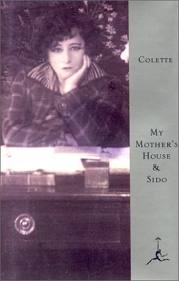
Cover of Colette's "My Mother's House"In My Mother’s House, the French author Colette has pulled off one of the most difficult tricks in literature: she’s written a compelling memoir without having a compelling story to tell.

Colette offers readers no major events in My Mother’s House – no plot, no drama, and very little conflict. Instead, she presents a kaleidoscope of memories about her family, pets, neighbors, and the French village in which they lived.

Occasionally, she will relate an important family story. For example, Colette tells how her older sister abandons their family after her marriage and leaves their mother to stand in helpless agony outside of the house in which her estranged daughter has gone into labor with her first child.

But for the most part, Colette fills the book with incidental events and small details, such as how her father offered to teach a neighborhood woman the meaning of love for “six pence and a packet of tobacco” and how her mother intentionally distracted the local priest during his sermon “by swing[ing] her watch ostentatiously at the end of its chain”.

What makes the book more than a collection of brilliantly realized sketches, however, is its organization around the themes of love and death. My Mother’s House is infused with the knowledge that everything Colette loved from her childhood – her mother, her father, her brother, the beauty of her mother’s garden – have passed away.

In the chapter titled “Laughter,” Colette’s mother warns her husband not to try to die before her. Instead, Colette writes…

He did try, and succeeded at the first attempt. He died in his seventy-fourth year, holding the hands of his beloved, and fixing on her weeping eyes a gaze that gradually lost its colour, turned milky blue, and faded like a sky veiled in mist.

Colette’s mother follows her husband into death and Colette experiences other losses as well. She tells how the beauty of nature has ceased to move her the way it moved her as a child, and Colette describes how her own daughter, at the age of nine, will soon lose her sense of childhood wonder.

My Mother’s House gains much of its power from the force, clarity, and simplicity of Colette’s writing, which reads like the work of a master of English prose even though its translated from the French. Colette’s book also gains power from the passion that lies beneath her descriptions. Literature can be a furious bulwark against death, in which the writer refuses to accept that all she loves best in life – her mother, her family, the richness of her consciousness – will disappear.

In My Mother’s House, Colette has ensured they won’t. They remain vibrantly alive in its pages, which is perhaps the greatest accomplishment any writer can hope to achieve.

Notes on the Author. Sidonie Gabrielle Colette, one of France’s most respected writers, was born in Burgundy in 1873 and died in Paris in 1954. She wrote dozens of books, including the novels Cheri and Gigi; was elected to the Academie Goncourt; and was the second woman to become a Grand Officer of the Legion of Honor.

Read Full Post »

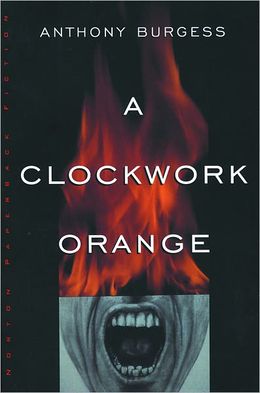
a clockwork orange anthony burgess reviewAnthony Burgess’ A Clockwork Orange succeeds purely on the strength of its narrator’s voice – but what a voice!

The novel’s story is told by 15-year-old Alex who lives in a vaguely dystopian, vaguely futuristic country that seems to be Britain.  Alex can check off every item under the DSM definition of sociopath. He bullies his parents and friends. He brutally assaults people at random. He gang-rapes a woman, rapes two young girls, and kills an old woman while trying to burglar her house. Alex regards this as all good youthful fun. When confronted by authorities, he knows how to pantomime innocence or remorse. When punished, he laments that no one cares or feels sorry for poor Alex.

All this promises to make Alex pretty ugly company, but sociopaths are often noted for their charm and wit, and Alex  has these in aplenty – not to mention exuberance, intelligence, formidable powers of observation, and a passionate love of classic music.

He also has the advantage of “nadsat,” the famous Russian-influence English slang Burgess invented for Alex, which puts the violence Alex commits at a remove from the reader and lends it a fantastical, almost fairy-tale quality.

Burgess described A Clockwork Orange as a “jeu d’esprit” that he wrote in three weeks, and it certainly feels like a book created in a burst of white-hot inspiration and imagination.

And it is a good thing, too. Because the “philosophical” parts of the novel, for which A Clockwork Orange is often complimented, strike me as (at best) heavy-handed and (at worst) laughably obvious.

So the philosophical meditation part of A Clockwork Orange goes like this.

First, Alex runs around assaulting, raping, and murdering. Then he is sent to prison where he is subjected to  behavior modification that physically incapacitates him any time he thinks about committing violence.  Then he un-behavior modifies himself by jumping out a window. Then he decides it’s time to grow up,  find a nice wife, and have a cute baby.

Get it?

In case you don’t,  Burgess sprinkles handy hints throughout the novel. So there is a book within a book, also titled “A Clockwork Orange,” from which Alex helpfully reads a summary passage on how you shouldn’t turn men into mindless machines. There is also the prison chaplain, just before Alex goes for his behavior modification therapy,  worrying out loud to the young man:

Does God want goodness or the choice of goodness? Is a man who chooses the bad perhaps in some way better than a man who has the good imposed upon him?

Burgess leaves us in no doubt of the answer to this question, and since he has created the world in which the question is asked, he gets to arrange his “facts” and “reality” to support his talking points. (Ayn Rand was a great one for doing that too.)

A Clockwork Orange is also noted for its satirical elements, and these were better than the philosophy, but not exactly revelatory. The police, politicians, Christianity, and what look like Communist intellectuals all get a good bracing spank and that was fine.

For me, one of the interesting things about reading A Clockwork Orange was how it compared and contrasted to Graham Greene’s Brighton Rock.

Greene’s novel features Pinkie, another murderous teenage British sociopath at the center of another “novel as meditation” – this time on the nature of sin and morality. Greene’s novel doesn’t deliver the same jolt of pure linguistic bliss as A Clockwork Orange, but it doesn’t bludgeon you with its themes either. It’s a close call, but I like Greene’s book a little better. I would fully recommend reading both, however.

Read Full Post »

Shakespeare's Hamlet

Go ahead. Cut my lines. I dare you.

Many of Shakespeare’s plays are baggy loose monsters — but Hamlet may be the baggiest and loosest of them all.

It’s hard to stage the full text in less than four hours unless you take it at a dead run; and considering there are scenes and even characters which could seemingly be cut and make the play better, why wouldn’t you?

But here’s the thing. Hamlet can look a mess on stage. But it has a near perfect harmony among its thematic elements. And once you seem them, it is difficult to consider (well, at least for me) anything but judicious line edits.

Here are my arguments against making the most common cuts:

Fortinbras

When directors are looking to save time, Fortinbras is usually the first to go. The problem is that Fortinbras is the play’s essential frame.

It is clear that Shakespeare intended Fortinbras to play this role. Like Hamlet, Fortinbras is the son of a king who shares his father’s name and who is seeking to avenge his father’s death and recover his kingdom from a usurper.

Fortinbras is also uniquely tied to Hamlet. As we learn from the gravedigger in Act V, Hamlet was born on the day his father slew Fortinbras’ father. Fortinbras achieves his revenge barely five minutes after Hamlet’s death. The correspondences between the two characters are so exact they must be deliberate.

Fortinbras offers two important contrasts to Hamlet. The first is that Hamlet is only interested in personal revenge. He acts with indifference to his responsibilities as a powerful prince and there is not much evidence that Hamlet actually cares he isn’t king.

Fortinbras also wants his revenge, in his case by attacking Denmark, but he won’t do it in defiance of his Uncle Norway.  Despite his personal motivations, Fortinbras acts like a politic prince.

The second contrast is that Fortinbras is patient, resolute, calculating, bold, and opportunistic.  Fortinbras manages events in his life while accepting they are often beyond his control and keeping his eyes on his goal.

By comparison, Hamlet cycles between paralysis and recklessness.  He tends to either over-manage or under-manage events, and his Act V fatalism leads him to walk into a contest that both he and Horatio sense is a trap.

The result? Hamlet is complicit in the destruction of the entire Danish royal family. Fortinbras seizes the crown of Denmark without striking a blow.

Ophelia & Laertes

This sister and brother are too central to the plot of Hamlet to disappear, but they often get trimmed.  And these cuts reduce Ophelia and Laertes’ role as a double for Hamlet.

Like Hamlet, Ophelia and Laertes also have a murdered father, and between them they reflect Hamlet’s reactions to his murdered father – except Ophelia and Laertes follow their reactions through to conclusion.

Hamlet is believed to have gone mad either because of grief for his father’s death or despair over Ophelia’s rejection of his love. He also contemplates suicide.  Ophelia actually goes mad with grief from her father’s death and actually does commit suicide.

I also believe she feels despair over Hamlet’s rejected love, sharpened by his murder of her father. There is a great deal of evidence that Hamlet and Ophelia’s relationship was serious (Hamlet’s behavior in the graveyard makes little sense if it wasn’t) and more than enough circumstantial evidence to convince me it was sexual.

Both Laertes and Polonius worry about Ophelia losing her virginity to Hamlet. Hamlet taunts Polonius and Ophelia in explicitly sexual terms after Ophelia obeys her father and rejects him. Ophelia’s madness is full of talk of sex and unfaithful lovers. None of this makes much sense if Hamlet and Ophelia shared a mere chaste flirtation.

Laertes is, of course, the wronged son who actually does “with wings as swift as mediation … sweep to [his] revenge”.  He acts with the kind of blinkered recklessness with which Hamlet believes he should also act.

Like Hamlet, Laertes is focused only on his personal revenge, not the political implications of conspiring with the king to murder the heir to the throne. And he dies the same death as Hamlet, from the same weapon and same poison.

One detail of Laertes story also reveals the politics that are largely invisible in the play. Even though he is not a member of the royal family, Laertes shows up in Denmark and instantly becomes the leader of a rabble ready to make him king.

Why couldn’t Hamlet have organized the same men to depose Claudius? He was, by Claudius’ report “loved of the distracted multitude”. Fortinbras would have seized the opportunity in one red hot minute. Hamlet, apparently, never saw his chance or gave it a thought.

The Player King & Queen

I get why a director would cut these speeches. The dumb show that proceeds the Player King and Queen does everything needed to advance the plot. Other scenes and speeches emphasize the point that practically every character in Hamlet is playing a role (you could go as far to say that Hamlet’s tragedy was he was forced to play roles to which he was not suited). The Player King’s speech is hard to follow. And the topic of the scene is not particularly relevant to the major themes of the play.

But I will say this. It is interesting that the most honest and authentic conversation in the whole play (excepting those between Hamlet and Horatio) occurs between two actors playing actors in a play within a play.

I also think it is interesting that Hamlet chose this text for the actors to play. The scene suggests how Hamlet might have viewed his parents’ relationship, regardless of the actual and unknown truth of the matter.

Polonius & Reynaldo

Honestly, you could whack this entire scene and not do Hamlet any harm at all. Other than hinting that Polonius might not have been a complete idiot for his entire life, and providing some additional comedy – if you want that – I don’t see the point. I’m always surprised when this scene appears in a production.

Let’s Whack “the morn, in russet mantle clad” Etc.

All of which is not to say (Reynaldo withstanding) that with a sharp pencil, and a little work, a director couldn’t easily save her audience 30 or 40 minutes of sitting. There’s not too much pure purple junk in the play, although those lines of Horatio’s at the end of Act I qualify.

I find almost every word Hamlet says entertaining, but I’m also aware other people might reasonably conclude that the man never shuts up; and if these people trim some of his words, particularly if they are making a Hamlet movie, I may not like it, but I don’t blame them.

Polonius also talks on and on, which is the point and also the joke, but generally the point is gotten and the joke exhausted well before Polonius finishes up. You can excise lesser lines of lesser characters and some of the duller clowning of the gravediggers. That would all be fine.

But please leave Fortinbras alone. We really need him!


Read Full Post »

Hamlet David TennantBased on its reputation, I was expecting to like the 2009 Royal Shakespeare Company production of Hamlet, directed by Gregory Doran and starring David Tennant, much better than I did.

Every Hamlet rises or falls on the performance of the title-role actor, and Tennant had both strengths and problems. He has the perfect look for the part, and he nailed the Danish prince’s anxiety and snark. But when it came to exploring Hamlet’s anguish and rage, he fell back on acting BIGGER and LOUDER. As I result, I don’t think Tennant connected with full emotion to the part, so I didn’t feel much emotion watching him.

Another problematic performance was Patrick Stewart’s Claudius.  I liked his wise and even-tempered reading; however, Stewart’s usurper was so amiable that he failed to convince me he could kick a dog much less kill his brother, seduce his brother’s wife, and plot the treacherous murder of their son.

On the plus side, the women of the play were pretty good. Mariah Gale’s Ophelia was strong and self-possessed, even in madness where she was more angry than wounded. (Jean Simmons’ guppy out of water reading of Ophelia in Olivier’s movie version was a low point of Hamlet on film.) Penny Downie’s Gertrude was quite good, too, except for the Act IV bedroom scene with Tennant, when she seem to fight his big and loud with her own big and loud.

Also on the plus side, Doran’s Hamlet is funny. He seizes every opportunity the play allows to read lines as comic. This means Polonius really takes it on the chin, although I also enjoyed the utter bafflement Tom Davey’s Guildenstern projected whenever the dialogue didn’t require him to reveal a faint glimmer of understanding. (He gave Osric a run for his money. ) Good fun too were the expressions of impatience, disbelief, credulity, and exasperation the actors wore whenever anyone, not just Polonius, made a long speech. All the joking diminished the tragic punch of the staging, however.

Now, my quibbles. I have no idea in what time period this Hamlet was meant to be set. Tennant was the complete modern hipster. Horatio dressed like a middle-aged academic circa 1982. Claudius and Gertrude had the air of a rich mid-20th century power couple. Polonius resembled an Elizabethan courtier on dress-down day. Different soldiers carried weapons from vastly different centuries. If there was a point to all this variety, I missed it.

Finally, Doran cut roughly seven lines from “To be, or not to be”.  God knows there are vast tracks of Shakespeare – particularly in the history plays – which can be given the boot to everyone’s benefit, but editing Hamlet’s most famous speech accomplishes nothing beyond gratuitous shock value.

On my Hamlet list, I’d put the Tennant version right above Ethan Hawke’s. See my list of best Hamlet movies.

Read Full Post »

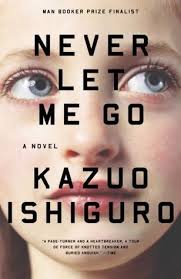
never let me go ishiguro rviewCan you appreciate a book without particularly liking it? That was my reaction to Kazuo Ishiguro’s 2005 speculative or experimental or science-fiction novel (read the review then pick your adjective), Never Let Me Go.

 Never Let Me Go focuses on three characters – Tommy, Ruth, and the novel’s narrator Kathy H. – who are students at what seems to be an upscale private school called Hailsham in what seems to be England in the 1980s.  But something isn’t quite right.

The disquiet begins with the first chapter in which an adult Kathy talks about her work as a “carer” for “donors”.  The story quickly returns to Kathy’s childhood at Hailsham where the students are only taught art, where the teachers are called “guardians”, and where not only are parents and the outside world never mentioned, but where they seem to barely exist.

As it turns out, there is a good reason for all these strange facts. The students of Hailsham are clones who are being raised to adulthood for the singular purpose of providing organ donations to “normal” men and women. The last donation is fatal.

And with that realization, we follow Ishiguro down his rabbit hole, and pop up in the world of Kafka or Beckett (as other reviewers have well noted before me); but unlike the fantastical worlds of Gregor Samsa’s middle-class family apartment, or Vladimir and Estragon’s desolate country road, the world of Never Let Me Go never quite achieves a coherent internal logic. Which means I don’t think the novel is an entirely successful experiment.

But before I get to these objections, let me talk about what I think Ishiguro did right.

The Flat Affect of Kathy H. Is Pitch Perfect. And Hard to Take

 Kathy H.’s narrative voice in Never Let Me Go is cool – even cold – dispassionate, and elusive. She leaves an enormous amount unsaid about the feelings and experiences of clone donors. They all seem to embrace their fate with a combination of resignation and acceptance. The four stages of donations are not described. Post-operative pain or complications are vaguely acknowledged, at best. Every donor dies off the page. No one knows where the bodies are buried. If they are buried.

Kathy H.  describes strong emotions, even in herself, with a matter-of-fact tone that prevents us from feeling them. She doesn’t seem to want our sympathy, and her coolness makes our empathy harder.

But all this seems exactly right. Asking someone to remain alive in feeling who has been bred and raised like cattle; who has helped the people she loves die in the service of a society that treats them as spare parts; and who herself is now facing the same death – all that is too much.

Kathy H. should be shut down as person. And if that makes our empathy harder, then it should be harder, because it is a catastrophic lack of empathy in Never Let Me Go that makes the genocidal slavery of the clones possible.

And I would go further and say since any injustice committed by one human against another has as its foundation a failure of empathy, then the novel pushes us to strengthen the quality which is the solution to its (fantastical) horrors.

Never Let Me Go: An Inadequate Portrait of Human Life

You might think after that statement I don’t have any serious criticisms of Never Let Me Go. But I do.

My first criticism is based on the indications that Ishiguro wants us to understand the experience of Kathy H. and Tommy and Ruth as universal. We know this explicitly from the February 2005 interview Ishiguro gave to The Guardian in which he said:

There are things I am more interested in than the clone thing. How are they trying to find their place in the world and make sense of their lives? To what extent can they transcend their fate? … Most of the things that concern them concern us all.

We also know it implicitly because it is not just Kathy H. who responds to her fate with resignation and acceptance. Every clone responds with resignation and acceptance. If there are variations from these two emotions in the world of Never Let Me Go, we have no report of them.

This is a barren and withered portrait of human life; and while it is an accurate description of some human lives, it is entirely inadequate representation of the human race I know.

That race, too, strives with might and contends with blood. That race, too, loves with a fierceness that will break before it quits. That race, too, rejoices and despairs. That race, too, knows beauty as well as horror. That race, too, seethes for justice in the face of injustice. That race, too, believes beyond all reason, beyond the heavy evidence of experience. That race, too, endures and endures.

Where are these lives too in Never Let Me Go?

Clone Organ Donors: Extraneous and Finally, a Distraction

My other problem with Never Let Me Go is that I think it was a mistake for Ishiguro to situate his science-fiction nightmare in what otherwise appears to be England in the middle-late 20th century.

It would have been fine if Ishiguro had transformed the premise into something more familiar: say a children’s cancer ward in which Kathy H. could have been an orphan and ward of the state, the other characters had dysfunctional families, and so on. Then Ishiguro could still have explored the things in which he says he was most interested without all the fussing with clones.

Or he could have set Never Let Me Go in some dystopian alternate Earth-like world sometime in the past or future, in which it would be easy to accept the clones because that’s what happened in this world. (Think of Panem in The Hunger Games.) That would also have been fine and easy to do.

But as it is in Never Let Me Go, I kept stopping and saying to myself: “Wait, exactly how does this clone-donor society thing work again?”

How did England, barely ten years after the defeat of Nazi Germany, the exposure of the death camps, and the end of the Nurenberg Trials, transform itself from a reasonable progressive Western society – as these things go – into a moral monster? Did the rest of the Allied powers acquiesce or participate? How did England get the entire medical profession to ignore the Hippocratic Oath? Where there no objections from the religious communities? Did anyone object? Who was making money from this? Was there an underground railroad for clones? What was the system of control? As young adults, the clones seem to be able to roam at will. What stopped them from disappearing into society, where they would be indistinguishable from other human beings? Why didn’t the clones go all Rambo on the murderous bastards running the system? As an American, I can name entire states – hello, Texas – that would rise up in violent defense of themselves. How did science perfect cloning months after the discovery of the DNA double helix, but still need another 30 years to invent the Walkman?

Also, I’m not a big fan of the novel of social comment, but the premise clearly suggests that our societies are capable of such actions, but doesn’t go any further with the suggestion.  This combination of provocative and perfunctory doesn’t sit well.

Should You Read Never Let Me Go?

Never Let Me Go is two books in many ways. As the story of three people dealing with horrors not at all dissimilar from real ones in the world today, I thought it was pretty good. As a speculative science-fiction novel, it would have needed to speculate much harder and much more thoroughly to be a success

Read Full Post »

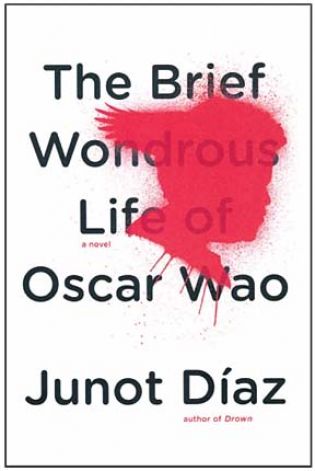
brief wondrous life oscar wao junot diaz reviewWhen artists are really good, I tend to curse at them. G-dd-mn Jane Austen. G-dd-mn Beethoven. G-dd-amn Billy Wilder. Now I’ve got a new name on my curse list. G-dd-mn Junot Diaz.

The Brief, Wondrous Life of Oscar Wao principally concerns its title character, his sister Lola, and their mother, although it does also tell the story of their extended family as well as that of its ostensible narrator, Yunior.

Diaz’ novel is that rare find – a work of current fiction that entirely lives up to its hype. The number of successful elements it delivers is simply ridiculous:

Big vivid characters that make a big splash on the page? Check.

Big vivid characters that are also richly imagined, convincing, and affecting? Check.

Multi-generational saga? Check.

Lots of sex but no sex scenes (thank you Junot!)? Check.

Healthy dollops of magical realism? Check.

Locations exotic to the typical American reader of literary fiction: hard scrabble New Jersey and the Dominican Republic? Check.

A narrative voice that is part gangster, part geek, and part grad student? Check.

A whole bunch of fanboy references to comic books, science fiction, and fantasy novels (oh god not again)? Check.

A great deal of untranslated Spanish dialogue, narration, and commentary? Check.

A third-world history lesson — in this case about the hyper-over-super-achieving sadistic Dominican dictator Trujillo and his thirty year reign of terror — much of which is told through jazzy footnotes? Check.

A story focused on the wild, uncompromising, irrational, destructive but all the same soul-sustaining power of love? Check.

A satisfying ending that unites all these elements in an organic whole that meets Nabokov’s definition of art, “beauty plus pity”? Check and check.

G-dd-mn Junot Diaz.

The only criticism of the novel I have is a flaw in the narrator which, as it turns out, isn’t a flaw at all. In the beginning of The Brief, Wondrous Life of Oscar Wao, Yunior pushes the comic book/sci-fi/fantasy references so hard that they almost entirely obscure the character of Oscar.

I kept muttering, “I can’t see Oscar, Junot, because all these Lord of the Rings references keep getting in the way.”

But what I realized is that early in the novel, Yunior is a young man who writes like a young man: overly earnest, full of himself, self-absorbed, and inept. He matures as he ages, and his narration matures too, until it is much wiser, more self-aware, more observant and empathetic, and more rueful.

Yunior is also one of those (not uncommon) characters who are their author’s alter ego, to the extent that they often share their creator’s omniscience. Yunior describes many things in the novel which are simply impossible for him to know.

Diaz doesn’t give Yunior the excuse of being the fictional author of the novel. Instead, Diaz shimmers in and out of Yunior’s character, which I think gives the novel more depth, because Diaz keeps getting you to fall into the dream of the story, then waking you up from it.

That’s another element I should have put in my list. Well, I’ll check it off now and conclude with this: G-dd-mn Junot Diaz.

Read Full Post »

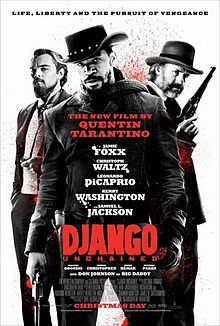
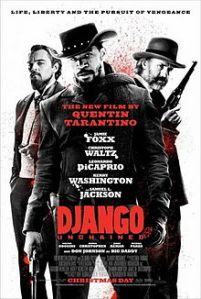
Django Unchained by Quentin TarantinoWhat is the relationship of movies to reality? In a strict sense, there is no relationship at all. The world of imagination, and the conventions and techniques of movie making, exist entirely on their own terms and make their own reality.

On the other hand, I can’t think of any successful movie that does not deal with the truth, at the very least the emotional truth, of human experience. Music and painting can traffic in abstraction and succeed. But movies? Rarely if at all.

Between art and reality comes the great mediator, the artist, who imposes her or his vision on art and reality. Sometimes the result is a rare gift of sublime pleasure and transcendental insight bequeathed to us, the grateful audience, for all time.

And sometimes the result is a steaming hot mess, dumped in our laps, for us to clean up and figure out. Or not.

Ladies and gentlemen, in case you couldn’t guess, Quentin Tarantino’s Django Unchained is irrefutably the latter. Whether it is a brilliant mess, or simply a mess full stop, is the question.

Django Unchained: The Obligatory Plot Summary

Tarantino’s latest movie primarily concerns Django, a slave played by Jamie Foxx, who is purchased and then freed by a German dentist and bounty hunter, King Schultz, played by Christoph Waltz.

Schultz initially buys Django because he can identify the Brittle brothers, who were brutal overseers at a plantation where Django was enslaved and who Schultz wants to track down and kill to collect the reward. After this is accomplished, Schultz frees Django, trains him as a bounty hunter, and decides to help Django find his wife, who has been sold to a particularly sadistic Mississippi plantation owner, Calvin Candie, played by Leonardo DiCaprio. Django and Schultz agree on a plan to free Django wife’s which does not go smoothly, to say the least.

Like many of Tarantino’s films, Django Unchained is a movie about movies. His famous love of old B movies and exploitation flicks is again on overabundant display, in this case spaghetti Westerns and the 1975 movie Mandingo among others.

Also again, Tarantino demonstrates his inability to distinguish his A material from his B material, which is reflected in the movie’s 180 minute running time; in the conversations which spin on at length; in a story line that manages to be too busy and meandering at the same time; and in the climactic gun fights which continue long after real-world human beings would have run out of bullets and blood.

Complicating  Django Unchained, and making it more than a fan-boy exercise and a guilty pleasure (if watching Django is the sort of thing you’d call  pleasure) are its anachronistic sense of humor and especially the moments, which are not frequent but are significant, when Foxx’ Django and Waltz’ Schultz step out of their roles as “characters in a B movie” and into scenes that confront the lived horror and violence of slavery.

Even more complicating is Samuel Jackson’s performance as Calvin Candie’s head house slave, Stephen. Jackson makes Stephen an Uncle Tom so malignant, a character so utterly twisted by servitude and yet so utterly invested in the slave system, that he threatens to break the movie apart; similar to the way that Shylock in Shakespeare’s Merchant of Venice can bring the play to a dead stop (at least for modern audiences).

Django Unchained: Blazing Saddles with Blood and Vengeance

There were moments during Django Unchained when I swore I was watching a Mel Brook’s movie.

This was particularly true during the sequences when Django and Schultz visit a Tennessee plantation owned by Big Daddy, who is played by Don Johnson.

There is a long conversation where Big Daddy tries to instruct his slaves how to behave toward Django, who can’t be treated like a slave because he is a freeman, but who can’t be accorded the same courtesy as a white man. There is also an utterly inept Klu Klux Klan raid led by Big Daddy which Tarantino plays for laughs (and which is an example of Tarantino’s ubiquitous and happy indifference to historical accuracy, since the Klan was founded seven years after the movie is stated to take place).

Equal ridiculous are the clothes Tarantino puts on Foxx for him to play the role of Schultz’ “valet” as they visit Big Daddy’s plantation. Django is decked out in a sky-blue satin fop suit complete with knee breeches and an enormous white neck cloth tied in a bow.

But in these clothes, Foxx’ Django simmers with barely contained anger. He and Schultz have come to the plantation to find the Brittle brothers, the men who also savagely whipped Django’s wife.

At the plantation, Django finds two of the brother’s preparing to whip another young black women for the crime of “breaking eggs”. Ignoring the plan, Foxx shoots the first brother, then seizing the whip, beats the second brother into submission with a ferocity founded in authentic anger, then coldly shoots him as he lies prostrate on the ground.

A British critic noted that Jamie Foxx often seems to not be in on the movie’s joke during Django Unchained.

But I think the truth is that neither Django nor Foxx can accept – could make themselves tolerate, if they tried – that the movie is a joke because the experience of African-Americans under slavery in the United States was manifestly not funny.

This approach to violence is not consistent in Django Unchained. In particular, at the end of the film, Django enters a fantasyland of violent revenge. But the cycling between different attitudes toward violence in Django Unchained keeps demanding we try to reconcile its fake artifice and real truth (yes, I know the redundancy is redundant) while guaranteeing that we can’t.

Which is one of the reason I speculated the adjective “brilliant” might apply to the noun “mess” when discussing Tarantino’s film.

And Django isn’t the only character that complicates our judgments about the film.

King Schultz Gets the Joke in Django Unchained … Until He Doesn’t Anymore

In the beginning of the film, Schultz is a dapper, eloquent bounty hunter who is in the business of “selling corpses” as he cheerfully explains to Django.

Schultz may not necessarily enjoy killing men, but he clearly enjoys outwitting and outgunning them, and his good humor doesn’t obscure the fact that he kills ruthlessly.  (Schultz goes so far as to persuade Django to gun down a wanted man in front of the man’s young son because this is what bounty hunters do.)

In a similar way, Schultz is perfectly reconciled to the existence of slaves and slavery. He despises slavery, mocks those who engage in it, shoots slavers without compunction when it suits his purposes, and befriends Django against all the customs of the time, but at the end of the day, Schultz sees slavery is a nasty fact that doesn’t have very much to do with him.

Until he meets Calvin Candie, at least.  Candie owns Django’s wife, Broomhilda (played by Kerry Washington), and Django and Schultz agree that they will try to rescue her by pretending to be interested in Candie’s “Mandingo” slaves who Candie buys and trains to fight to the death for entertainment.

Schultz can barely disguise the horror he feels watching Candie relish a Mandingo fight, and Schultz is further unnerved the next day as he witnesses Candie taunt a slave who has been traumatized to helplessness by the three matches he’s been forced to fight, then has his dogs tear the man apart.

Still, Schultz retains his humor and his cool enough to carry out their plan, which is to persuade Candie to sell them Django’s wife. The plan goes awry but still succeeds. Candie discovers their intentions, but does sell them Broomhilda at an extortionate price.

Candie draws up the papers nice and legal, Schultz signs them, and then expresses his disgust and contempt for Candie. Candie, in return, demands Schultz shake his hand to finalize the deal.

Instead, Schultz shoots Candie and unleashes a series of events that threaten Django’s life and end in a bloodbath.  Just before he is killed in turn, Schultz apologizes to Django, “Sorry, I couldn’t resist.”

What was tolerable to King Schultz at the beginning of Django Unchained became intolerable to him at the end. The violence is “fake fun violence” until it isn’t. We are watching a “movie about movies” until we aren’t. And Tarantino keeps throwing questions at us faster than we can answer them.

Samuel Jackson’s Stephen is the Shylock of Django Unchained

In The Merchant of Venice, Shylock is the villain and an object of “amusing” abuse who refuses to play his role. He insists on his humanity so powerfully that he fatally disrupts the play’s comic and romantic storylines and sours us on the drama’s heroine, Portia.

For modern audiences, Shylock renders the drama almost unplayable. Shakespeare’s treatment of him so offends our fundamental principles that witnessing Shylock’s humiliation and punishment can only be painful; and since we are a willing audience for the play, it also delivers a sense of complicit guilt.

Samuel Jackson’s head-house slave Stephen plays a similar role in Django Unchained. In front of his masters and other white people, Stephen puts on a minstrel show (there really is no other phrase to describe it) that left me squirming in my seat and grabbing my head. And the fact that it was Samuel Jackson playing Stephen – an actor who I am used to see playing characters with power and agency – made it worse.

In the kitchen and servants’ rooms, Stephen was a tyrant every bit as sadistic as his master, Calvin Candie. Stephen also seems to hate Django, a free black man with power, even more than the whites do, and he conspires to think of a punishment for Django more harsh than anything the whites could think up.

Through it all, Jackson makes us feel that Stephen is still a man – not a character in a movie, not stock villain, not a comic type – but a man who has been horribly damaged by a long life of servitude.

At the climax of the movie, after Django has killed all the whites, he and Stephen confront each other in the plantation house. Django shoots Stephen multiple times, then leaves the old slave screaming in pain as he lights the fuse that will blow up the house and Stephen.

Is this justice? Is this mercy? Or is it Tarantino getting rid of a character no one wants to confront? Amid all the B movie artifice and random jokes, Tarantino asks a lot of hard questions.

Django Unchained – Mess or Brilliant Mess? You Decide

My judgment is brilliant mess because I believe as Chekhov believed, that the role of the artist is to ask questions, not answer them; particularly since when people demand that art answer questions, what they really mean is that art should ask THEIR questions and offer THEIR answers. Thus it has always been with philistines, ideologues, and tyrants. That’s why tyrants don’t much like artists, and artists don’t much like tyrants.

I can’t tell if Django Unchained is the result of deliberate strategy, careless accident, unconscious inspiration, or a byproduct of Tarantino’s unrestrained enthusiasms, but whatever the causes – the results are challenging, disturbing, puzzling, funny, sometimes annoying. For me, that’s plenty.

Read Full Post »
« Newer Posts - Older Posts »