 like a sigh in sleep / like a wave glazing the sand / i’ll slip away home
 feel her weight heavy / for the earth. this is a task / of the working day
like a sigh in sleep / like a wave glazing the sand / i’ll slip away home
feel her weight heavy / for the earth. this is a task / of the working day
Posted in Haiku | Tagged haiku, national poetry month, Poems, poetry | Leave a Comment »
 clatter of dishes / clangor of the ancient bells / soft conversations
 the tri-tone siren / wails through the quiet cloister / another passion
 on the duomo wall / the pigeons and prophets stand / judging the tourists
 this flesh and this stone / are too light for the rising / passion of my soul
 life flows abundant / like the bright waters of all / the fountains of rome
I particularly like this poem because it breaks all the rules of haiku. It features five haiku instead of a single poem (which is wrong). Has a title (which is wrong). Makes direct statements rather that hinting at meaning (which is very wrong). Ignores the natural world (which is mostly wrong but allowable under limited circumstances). And best of all, offers something new (why have rules if you don’t follow them?).
I’m not opposed to traditional haiku, of course, and you’ll find poems I’ve written that follow the established rules. I just don’t feel the need to limit myself to the typical elements of haiku, and most of all I am interested in attempting to expand the form and write poems worth reading. You will judge for yourself whether I’ve succeeded.
Posted in Haiku | Tagged haiku, Italy, national poetry month, Poems, poetry | Leave a Comment »
 a green willow sways / buttercups bloom on the bank / as the virus spreads
 days and days and days / i clasp my hands together / all i feel is bone
 full streets are empty / and ballfields have grown again / into wilderness
 they are alone now / their bodies in a dim hall / waiting for nothing
 this yearning for you / fills my sails, longer than years / wider than the sea
I wrote these poems during the first year of the coronavirus pandemic and I think they remain today an accurate portrait of my experience. The first haiku is from March 2020, when the Covid lockdown began just as spring was arriving in my hometown. Loneliness and isolation dominate these poems, and they are shared by the living and the dead. Four years later, I think this poem composed from five haiku stands up and remains a true picture of the time.
Posted in Haiku | Tagged Coronavirus, covid, covid-19, death haiku, haiku, modern haiku, Poems | Leave a Comment »
 live on little mouse / i cannot hunt one more cold / and lonely creature
Posted in Haiku | Tagged haiku, modern haiku, nature haiku, Poems, poetry | Leave a Comment »
 the ocean is wide / and my green heart close, caught in / the wonder of time
Posted in Haiku | Tagged haiku, modern haiku, Poems, poetry | Leave a Comment »
 i tend my garden / as a meditation. hope / in a broken world
 here there is not thirst / from the stone the water flows / inexhaustible

no theory no word / no intent. i was taken / by the song alone

so cruel these fine tools / the kill jar and the glass case / for the butterflies

the rising music / promises even weary / souls can fly away

in the grand station / the undulating echoes / an ocean of sound

on the steel blue glass / a hushed jet slips and shivers / the city dreaming

a low stone grey sky / the cold heavy on our bones / faint lights in the dusk

in the still grey dawn / the falling snow is ashes / from the burning year

sit close, drink the wine / the stronghold of love will stand / against all assault

our fear is their strength / these secrets we imprison / in our tyrant hearts

before the long night / there is still time for poets / to speak one true word
 let your laughter rise / through the velvet evening sky / and delight the moon
 joy is a bubble / a shimmering rainbow world / lighter than the air
The 5-7-5 syllable structure of haiku in English approximates the seventeen mora of haiku in Japanese. The equivalence is not exact because a mora is a unit of sound, and it is common in English for one syllable to contain two mora. Diphthongs, which have two vowel sounds in a single syllable, are an example.
For traditional haiku in English, it is common to divide the poem into two parts using a cutting word. The first part presents an image from nature. The second part comments on the first, in an implicit rather than explicit fashion, often using a second image. These are the typical rules of haiku.
As you have probably noticed, I follow the 5-7-5 syllable format and ignore the other rules when it suits me. I often find it useful to divide the poem in two and place a break at the end of a line, as haiku that follow the rules do. This is a good solution to the challenges of the format and can yield good results.
I also find it useful to break the poem in the middle of the line, as the last haiku in this collection does to place the emphasis on the word “hope”:
i tend my garden
as a meditation. hope
in a broken world
Breaking the poem into two parts isn’t the only solution to the haiku format. Another solution is to make a single statement, which you can organize into clean phrases (see “before the long night” above) or use enjambment to jump across the lines like this:
the rising music
promises even weary
souls can fly away
In this haiku, much of its effect comes from wanting the words “music” and “promises” and “weary” and “souls” to sit in the same lines. The enjambment creates a feeling of motion and flight. The break between “weary” from “souls” is particularly important to this effect.
This analysis leads to an interesting question. If I don’t follow the constraints of the 5-7-5 format, do we get a better poem?
the rising music promises
even weary souls
can fly away
I’m not sure this version is better but it has a different feeling: stillness, calm, and certainty rather than the feeling of motion. This poem is an example of how the haiku format, like any poetic format, influences the results.
Finally, three equal lines – independent but interrelated – are a solution to the 5-7-5 syllable count, like this haiku from the December section:
a low stone grey sky
the cold heavy on our bones
faint lights in the dusk
This is my favorite solution because I find these haiku the most difficult to write and because they yield results closer to painting or photography than poetry. There’s no meaning in this haiku, but rather space for the reader to decide the message of the poem for herself. There is image, mood, and feeling. A portrait of a moment of consciousness without comment.
This leads me to a related topic. One of the requirements of traditional haiku is that the meaning is implied not stated. Meaning should be there but it should sit in the tantalizing distance, a dazzling insight or deeper feeling waiting to be discovered by the reader, if she is clever enough.
I think this is the result of restricting haiku to the subject of nature, which offers us beauty, mystery, wonder, awe, and terror but no information about its meaning or purpose. Nature is a fact. It expresses no opinion on why it exists. And haiku about nature, respecting their subject, should express no opinion either.
Clearly, I don’t follow this rule. Not so much from stubborn contrariness (although doubtlessly there is some of that too) but from the desire to write a poem that hasn’t been written before. Which means I often prefer to make direct statements in my haiku or no statement at all.
This is also the effect of expanding my subject beyond nature to human experience. The mountains may not have opinions but we do, and we can keep ourselves very busy expressing them. Which explains the tension in much of my work. The quiet acceptance you find in traditional haiku is a kind of wisdom. Fool that I am, I’m still banging on the door of consciousness, demanding answers, demanding whatever is behind that door to open up.
Posted in Haiku | Tagged haiku, Poems, poetry | Leave a Comment »


These are haiku about death or more accurately, poems about death, dying, time, and memory. Death is a common theme in haiku although traditional poets tend to deal with it implicitly through poems about nature and the seasons, which if you follow the stricter rules of haiku are the only allowable topics for this type of poetry.
For various reasons, I don’t follow these rules and that is particularly true in this collection of haiku. Perhaps the most important rule of haiku is that meaning is implied rather than stated and boy do I break that rule with a vengeance with these poems. They are all statements, except for the first one. I normally consider myself allergic to the “get out your pencils kids, this is the stuff that’s going to be on the test” school of poetry but there is no evidence of the allergy here.
That said, I’m fairly pleased with this collection. (I wouldn’t post it if I weren’t.) One of my goals when I write haiku is to find unpoetic subjects. The clearest example of this is the “knife found my hand” haiku, which is about a murder in a London park that happened a few hours after my wife and I walked through it. The killer was deranged and the poem which sits inside his head is deranged as a result. The “endless black waters” haiku was inspired by a visit to the Paris catacombs, which left me in a state of existential crisis that I needed to treat with several glasses of French wine. The last haiku is about my mother’s death and while I think it could have been written by thousands of other people too, it does accurately reflect my feelings so I have kept it on my publish list.
As a final note, the title of this post over-determines the meaning of several of the haiku. The “oh that this flesh” poem is about more than mortality. I don’t think about “black worlds” as just discussing dying. If reading these death poems have left you depressed, a good tonic could be my haiku about love.
Posted in Haiku | Tagged haiku, Poems | Leave a Comment »
 mirror on mirror / the wide waters flowing with / the light of the sky
Posted in Haiku | Tagged haiku, Poems | Leave a Comment »
Haiku are the easiest and hardest poems to write in English. Haiku are easy to write because they have a simple format which captures the quality or mood of a moment. They are particularly easy to write if you use lines of variable length rather than follow the 5-7-5 syllable structure which approximates the 17 mora in traditional Japanese haiku.
The same qualities that make haiku easy to write also make them hard to write, however. When it is possible for casual poets to write credible or seemingly credible haiku, then the challenge of writing a haiku that deserves the reader’s attention becomes more difficult.
This challenge has been exponentially increased by the emergence of ChatGPT and other AI platforms. Haiku are well suited to machine creation because of their format and reliance on typical poetic themes and elements. Ask an AI to write a poem and you’ll get doggerel. Ask an AI to write a haiku and you can get something someone might publish. And probably has.
It is within these contexts that I will talk about how to write a haiku. My answers are personal and different from the answers other writers might offer. My goal is not to tell you how you should write a haiku. My goal is to describe how I write these poems with the hope you’ll find something useful to your own work.
The best place to start is with the definition, rules, and format of haiku. I’m not starting with these rules because I think you should follow them. I’m starting with definitions because I think knowing which rules you are breaking – and why you are breaking them – will help make your work better.
Haiku are short poems that describe nature and imply emotions. That’s a “correct” definition of haiku. It represents many of the poems written in English and it is consistent with definitions offered by other sources.
For example, the Report of the Definitions Committee of the Haiku Society of America states a haiku is “a short poem that uses imagistic language to convey the essence of an experience of nature or the season intuitively linked to the human condition.”
Their definition goes on to discuss useful concepts such as cutting words, the avoidance of metaphors and titles, and other matters. For a rules-based definition of haiku, this report is an excellent source.
The Britannica Online article states a haiku is “an unrhymed poetic form consisting of 17 syllables arranged in three lines of 5, 7, and 5 syllables respectively.”
The article goes on to say, “Originally, the haiku form was restricted in subject matter to an objective description of nature suggestive of one of the seasons, evoking a definite, though unstated, emotional response.”
The Poetry Foundation says a haiku is “a Japanese verse form most often composed, in English versions, of three unrhymed lines of five, seven, and five syllables [which] features an image, or a pair of images, meant to depict the essence of a specific moment in time.”
The Poetry Foundation page discusses how haiku developed in English and their website contains many examples of haiku that break the rules defined by the Haiku Society of America.
I would also read the works of Imagist poets like William Carlos Williams. The Imagists were interested in haiku and I think there is a great deal of similarity between the intentions and effects of their poems and the intentions and effects of haiku. Consider Williams’ famous “The Red Wheelbarrow”.
The first test of a good haiku is that it answers the question “Does it deserve your attention?” with a “yes.” Unless you write a haiku entirely for your own satisfaction, then the poem is seeking attention from readers and its success is measured by how much it earns.
It is also important that the haiku earn attention from the same readers over time. Any haiku might stumble into being read once. These poems are so short that you often read them before you can stop yourself. But when you return to the same haiku again and again, at different times of your life, that’s a sign the poem is good.
Another test of a good haiku is whether reading it becomes an occasion for contemplation. Poetry has always had a quasi-religious function, which explains why so many poems embrace the ecstasy of the mystic or the didacticism of the Sunday sermon.
In the case of haiku, this function is meditation. Haiku focus on a single moment similar to the way meditation focuses on the present moment. Haiku are often best read in a state of mind where you are open to the thoughts, feelings, and sensations of the poem and accept them without judgment, similar again to the practice of meditation.
Haiku traditionally focus on nature, an all-purpose substitute for God in English-language poetry since the Romantics. Finally, haiku’s use of implied or intuitive meaning – rather than clear statement – make reading them similar to the experience of contemplating a koan in the Buddhist tradition.
All of which explains why Jack Kerouac’s most famous haiku is an excellent example of the form:
The taste
of rain
—Why kneel?
This translation of the famous Basho haiku from an essay in Frogpond is also a good example:
The old pond—
a frog jumps in,
the sound of water.
In the case of the Kerouac poem, the religious context is explicit in the question and implies there is something in the universe worthy of worship and awe. In Basho’s poem, the question is implicit and the haiku takes a neutral position. Perhaps this moment is an intimation of the transcendental meaning of human life or perhaps it is just a random and unremarkable event in our meaningless journey to the void of death.
This is not to say that contemplation is the only experience a haiku can create. You could write a haiku that is purely descriptive or which makes a clear statement or which is humorous or sarcastic. But the traditional form and intentions of these poems make them suitable for reading as meditation, and many of the most successful haiku create a meditative experience.
Another test of a good haiku is whether it has formal or technical or aesthetic beauty. One aspect of this beauty is when the poet successfully solves the difficulty of the form. This is particularly true when the poet follows the 5-7-5 structure but merely writing a brief three line poem can be accomplished enough. Haiku are challenging puzzles and elegant solutions to challenging puzzles have a beauty of their own.
By this standard, the Kerouac haiku is half successful. It is brilliant in its compression. Six words, six syllables. But its form is a bit of a cheat. “The taste of rain. Why kneel?” works just as well but doesn’t signal that this is a poem and the break between the first and second lines is arbitrary. On the other hand, the translator of the Basho poem finds an elegant way to render in English the elegance of the haiku’s Japanese original.
The music of the words is important in haiku as it is with all poems. By this standard, Kerouac gets full points for the beauty of the assonance between the words “taste” and “rain” and “Why” and “kneel” as well as how the soft sounds of the words match the feelings they create.
The Basho translator also does well with the music. The words “old” and “pond” work together. “Frog” and “jump” both have a nice plopping sound and I hear the splash in “water.” The word “in” breaks the music however, and is unnecessary too. You can count on the average reader knowing that frogs jump “in” ponds and make a sound when they do.
Finally, the design of the poem and the look of the words have an effect on its beauty – so much so that I think you lose half the impact of a haiku when you hear it spoken rather than seeing the words. This is different from most other forms of poetry which are as good or better when they are spoken and the appearance of which on the page largely doesn’t matter, especially once the poem runs to any length.
By this standard, both poems are cluttered up with unnecessary punctuation and capitalizations that give visual weight to the least important word. In the case of the capitalization, it’s the “The” which offends. It’s grammatically correct but the effect is to make a functional word stand out more than the words that carry meaning.
In the case of the em dashes (–), I suppose the idea is they are used as a substitute for the cutting words in Japanese haiku. Except in English, the line breaks and the context do that for you. The same is true of the commas and periods when they occur at the end of line. These are grammatically correct but if poets are going to surrender their work to the tyranny of copy editors, all joy has ended. Kerouac’s question mark is useful for clarity however.
Which means if I were to be foolish enough to edit the work of other haiku poets, I would do this:
the taste of rain
why kneel?
the old pond
a frog jumps
the sound of water
The translator of the Basho poem might argue that this edit unbalances the lines and makes the word water stick out and they would be correct. This is an issue I would resolve by centering the lines of the haiku rather than making them left justified.
I follow the 5-7-5 syllable structure and ignore the other rules when I write haiku. I don’t believe the 5-7-5 format is necessary or required. I use it because working within its constraints paradoxically makes it easier for me to write haiku, because the form creates designs that look right, and because it creates poetic experiences that feel right.
I don’t like associating an image from nature with an implied emotion because this often creates stock poems that have been written hundreds of times. There are no more shopworn images in poetry than nature images and they always seem to end up associated with commonplace poetic emotions: ecstasy, despair, longing, wonder, grief, transcendental love, visionary revelations. Include the human body in the universe of nature images and you get the same result.
Because of this, I prefer to write haiku that are descriptive – more like a photograph than a poem – or that make direct statements. I use similes, metaphors, and titles. I’m always looking for non-poetic images and emotions. This can be difficult. Remove the natural world and the strongest emotions from your haiku and you can create a distinctly unpleasant body of work. All the same, I prefer writing this haiku to writing another poem about flowers.
sprawled on the sidewalk
the blue-gloved cop takes her pulse
the city walks on
I don’t think my haiku should be too personal. The purpose of poetry is to give readers experiences they can make their own when they need them. Poets don’t have deeper feelings or better souls than other people. But if we’re lucky, we have a knack for expressing what other people think, feel, and experience but don’t quite know how to say.
So we need to leave room for readers to enter into the experience of the poem and make it their own. The goal should be for readers to say “that’s how I feel” and not “that’s how I feel too.” Which is why I’ve never been happy with this haiku in addition to the fact it ignores the 5-7-5 structure and has familiar images and emotions.
grey clouds
in a blue sky
my mother’s eyes
Finally, writing haiku is about confronting failure and continuing to work. Most artists have to come to terms with the fact that they are not as good as they would like to be. That includes me and many of the haiku on my website are there to remind me how I failed and what not to do the next time.
That said, I believe I also need to give you examples of haiku I’ve written which I think are good. Among examples of poems that break all the rules except the 5-7-5 syllable format are these:
(cape may)
like scraps of paper
folding themselves into birds
the sea gulls settle
the shimmering light
on the water at sunset
keeps its promises
(broad street)
bright satin, bright brass
the thrilling banjos sing out
as the mummers strut
how soon the joy fades
paper hats and plastic horns
bought on new year’s day
Titles, metaphor, direct statement, the use of haiku as stanzas, no natural images or implied emotions in the case of “(broad street),” and room for readers to decide what the promises might be in the case of “(cape may).” These poems are sufficiently different from standard, rules-based haiku to satisfy me.
When it comes to poems that make direct statements, I like this one. It has mood and metaphor, it solves the challenge of the form, and it describes my process. Like many writers, I don’t find the subjects of my poems. They find me, and this haiku describes how I create the conditions in which I am found.

This image also shows how I’ve solved a problem with poetry on the internet. In print, you can control where the poem is placed on the page which acts as its frame. On the internet, you can’t. A single haiku can get lost on a web page or among the other elements of a site. This image is a way to solve the problem.
Among my descriptive haiku, I particularly like these two. They have mood rather than emotion. They solve the puzzle of the format. In the case of the “snow” haiku, the poem suggests a story but doesn’t tell you what it is.


I like these among my haiku as meditations. It is especially important to frame these poems so they look right to the reader.

There are more examples of haiku poems in the linked post which I think are good.
My personal recommendations are these. Use the 5-7-5 syllable structure to write your haiku. Solving the challenges of the form while paying attention to the look and sound of the poem will yield satisfying results. Look for topics and emotions beyond those expected in haiku. Leave space for readers to enter into the poem and make it their own. Be prepared to fail and follow Samuel Beckett’s advice when you do. “Fail again. Fail better.”
Posted in How to Write Haiku | Tagged Creative Writing, haiku, How to, NaPoWriMo, national poetry month, national poetry writing month, Poems, poetry, writing | Leave a Comment »
 the first rain of spring / smells like your lover’s body / asleep in your bed
heavy grey, pure white / a drama of changing sky / blinding silver, blue
 once in my childhood / all the dandelions bloomed / while i was sleeping
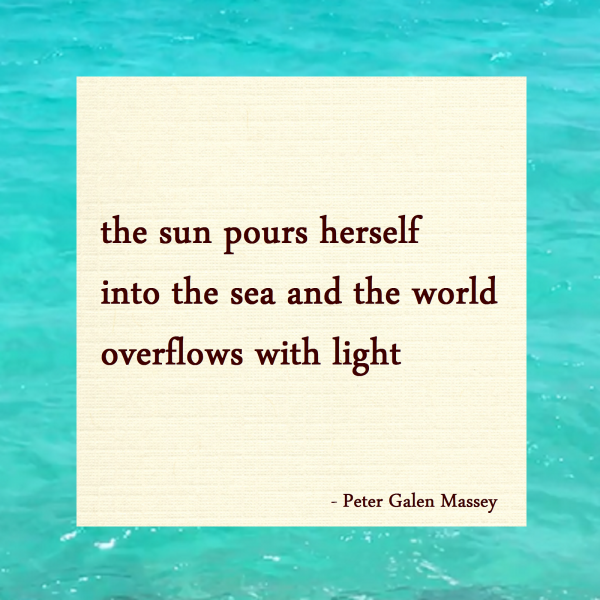 the sun pours herself / into the sea and the world / overflows with light
 boom of a deep drum / rain dappling a silver lake / the sky grows brighter
 clash of katydids / barefoot on the dew lush grass / the bright watching stars
 that shimmering sea / that blue day when our hearts burned / brighter than the sun
 the orange trumpets / bloom like fire, blow summer / a final fanfare
 in the light fresh breeze / a single leaf pirouettes / the air enchanted
 the drab dusk fading / a dirty orange smear like / the day gone to rust
 on the bare brown branch / a fat squirrel anxiously eats / another acorn
blooming in beauty / beauty when faded and dry / life and death are good
 an old lost song and / the fog damp neck when your words / were warm on my neck
 when cold days turn dark / leaf the earth, lemon the sun / steam in summer’s cup
 a pen and ink world / beautiful desolation / snow on ohio
 through the cold branches / in a far corner of sky / a single star shines
Haiku about nature and the season are the customary topics for these poems. If you follow the traditional rules, images of nature and the seasons paired with an implicit emotion are the only acceptable elements of haiku.
For various reasons, I don’t follow these rules. Sometimes I present an image from nature and leave out the emotion although you’ll feel a mood. These haiku I think of as closer to landscape painting than poetry. Other times, I’ll make the emotion explicit, make a statement, or use metaphor or other poetic elements that traditional haiku avoid.
What I’m trying to find is a poem that hasn’t been written before. In a real sense, haiku as a poetic form has been perfected and the subject of nature in haiku has been exhausted. I’m not sure you can write a better haiku about winter than the ones already written, for example. I’m also not sure you can write a haiku about winter different from the ones already written.
One point of my work is to try to find a way to write about nature in haiku that is different from other poems already written, however. For the same reason, I’ll write haiku about love and haiku about death and other subjects outside of nature, or try to tell a story in 17 syllables, or look for emotions outside the set standard to poetry.
I don’t want to exclude nature from my work, because the experience of nature is a fundamental element of human experience. Even when you live in a city, the sky and light and weather are always present and nature is present too despite our best efforts to eradicate it. Sometimes nature is there poetically. The raptors that nest in skyscrapers and hunt the canyons between them. Sometimes nature is there unpoetically. The rat gnawing on a pizza slice between the subway tracks. For more thoughts, see my post on how to write haiku.
Posted in Haiku | Tagged fall haiku, haiku, nature haiku, Poems, spring haiku, summer haiku, winter haiku | Leave a Comment »


 Peter Galen Massey