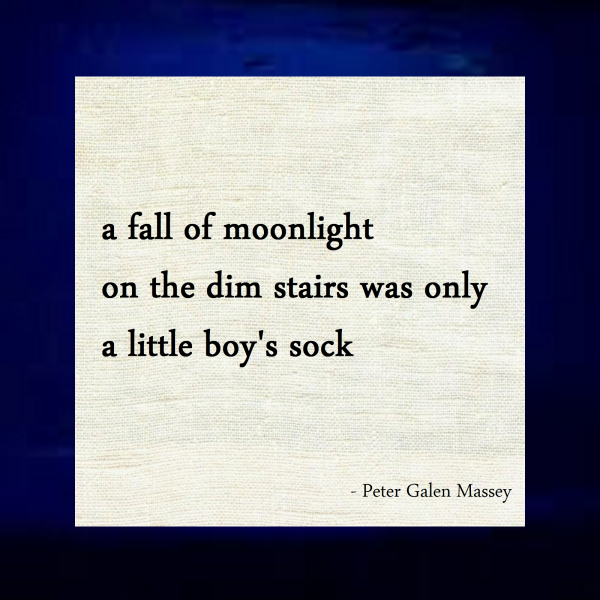
 a fall of moonlight / on the dim stairs was only / a little boy’s sock
Posts Tagged ‘Poems’
Haiku Poem | “a fall of moonlight on the stairs”
Posted in Haiku, tagged haiku, Poems on December 4, 2015| 2 Comments »
“Matisse’ Studio” | Poems
Posted in Haiku, tagged Poems on November 25, 2015| 2 Comments »

I marked / These reds / On this canvas / In a place and time / Now forgotten by all save / A few dry scholars. But these / Reds are proof of my living hand, / Colors as alive as the taste of warm / Wine in your mouth.
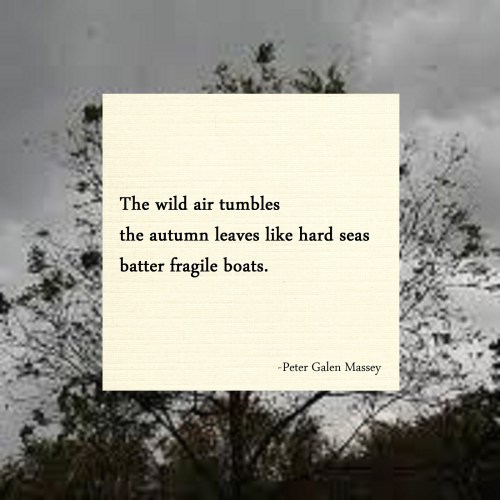
Haiku Poem | “the wild air tumbles the autumn leaves”
Posted in Haiku, tagged haiku, Poems on November 21, 2015| Leave a Comment »
“Texas” (Three Fragments) | Poem
Posted in Haiku, tagged Poems on October 23, 2015| Leave a Comment »
“Texas” (Three Fragments)
Turbines tumble tumble through the hot air,
Like the wings of the archangels who chased
Night and chaos over the rim of the world in
The wrath of God’s creation, and came to rest
In the soft light of the first morning of Texas.There today the light before light with everything
Quiet except for the birds screaming in the dim
Trees and your thoughts wandering after those
Who have died or who are serving overseas or
What you’re chasing and what it pays and why it’s
Necessary, before you rise and dress and in your
Car rushing rushing with all the rest eight lanes
Of impatience furious to eat the endless distance
Between bed and the towering diamond-blue glass
Fortresses of wealth, the office parks with graceful
Trees and glittering fountains, the new merchant
Plazas on the new black roads, the box stores, the
Strip malls wearied by sun and subsistence, the
Cinder-block workshops, steel-tooled and machine
Oiled, the trailer-offices squatting on the site of
New prospect or old defeat, ragged air appliance
Rasping out feeble cool against vinyl-metal heat,
The heavy industry fairie kingdoms cracking crude
To naphtha kerosene paraffin diesel sulfur and tar,
The glinting purgatories of health, the dingy rooms
Machine bedded and ravaged age, the grey cubicles
Of counseled grief, kitchen, corridor, laundry, house
Children, house children, house children, eight lanes
Of hunger blood throbbing through interstates and
Access roads, vivid desire and dull necessity in metal
Boxes rushing everywhere, life mind heart rushing,
Until day ends, retirement eases, or death comes to
Tally his final accounts.***
Nature loves all her children hard, but she loves her
Texas children harder; sends them with a laugh and
A kick out the door to find something for supper.This rich land will wrestle you, take your youth, take
Your strength, give you cash in cattle, cotton, corn,
Sorghum, and wheat. This hard red earth more scab
Than skin will yield hard living if scraped, pierced,
Worked in dust and heat, through relentless sun,
Asphalt fume, with truck and tool and no excuses:
No one to catch you if you fall and no one asking
To be caught.***
There’s no fair fighting for our hard machines:
Time and earth will take them, concrete, circuit,
Polymer, steel, with one puff float all into endless
Mind, soft seeds blown from the dandelion head;
No fair fighting for our tender bodies, time frail,
Flesh blood bone souls man woman child, all
Floating, angels tumbling tumbling through the
Cooling air, the soft light, the last evening of Texas.
Thanks to Blast Furnace for publishing “Texas”.
“Tock Tick” | Poems by Massey
Posted in Haiku, tagged Poems on November 15, 2014| 3 Comments »
Tock Tick
Tick tock as we drink our coffee.
Tick tock as we check the scores.
Tick tock as we sip our cocktails.
Tick tock when we close the door.Tick tock the clothes are dirty.
Tick tock the bills lie unpaid.
Tick tock the lawns grow wilder.
Tick tock the beds sleep unmade.Tick tock our griefs grow colder.
Tick tock days are long in age.
Tick tock the twilight’s failing.
Tick tock the low candles fade.
“The Money Girls” | Poem
Posted in Poems, tagged Poems on September 29, 2014| 5 Comments »
The Money Girls
Beauty is marketing to the
Money girls and they spend
With lavish precision because
Big dreams need big budgets.Seal-sleek hair, shinning pumps,
Pearl earrings, suit and skirt,
All elegance and no sex they
Interrogate their prey with
Smooth questions; and whenYour answers satisfy they slide
Their treasured secrets from
Leather cases softer and more
Durable than flesh, click-clasp,
Showing what you long to see:
MBAs and GPAs, KPIs and ROIs.Will they be content after they
Eat the world and don’t grow fat?
Will work and reward fill the void
Or just gild it over? I can’t say, butThe money girls will spend their youth
In acquisitive pursuit, and if those years
Go to hard waste, they can’t buy them back.
Published in the Fall 2014 edition of Apeiron Review.
“Down the Shore” | Poem
Posted in Poems, tagged Poems on September 11, 2014| 10 Comments »
I’d say we drowned the voice of
The deep Atlantic in Katy Perry.Or banished mystery with
Mini golf and Skee ball.Or caught chaos in a box and
Turned it into taffy for children.But the truth is the ocean
Tamed herself: salt-sweet,Warm as milk, and lolling up to
Lick our hand like a friendly dog.
Thanks to Philadelphia Stories for publishing “Down the Shore” in 2014.
Science Proves It! Reading Literature Makes You a Better Person
Posted in Fiction, tagged books, Fiction, Literature, novels, Poems, William Shakespeare on October 6, 2013| 5 Comments »
 On Thursday, the journal Science published a study (Reading Literary Fiction Improves Theory of Mind) that found people scored better on tests measuring empathy, social perceptiveness, and emotional intelligence after they had read literary fiction than after they had read popular fiction or rigorous non-fiction.
This result cheered members of the literary community and confirmed an idea that I’ve long argued using anecdotal evidence, which is one of the most important functions of literature is to strengthen emotional intelligence.
This function also explains why literature is the only art included in core educational curriculums. The ability to accurately read the feelings of other people is perhaps the most essential skill for living in social groups, and living in well functioning social groups is one of our key adaptations as a species.
So all this is good news — which I greeted with considerable apprehension and unease.
Part of my unease comes from having observed that people who read literature don’t go about the business of becoming better people as often as they go about the business of bragging how they are better people because they read literature.
The Science study is likely to encourage the bragging folks to keep bragging about their exceptionalism; and exceptionalism is fundamentally at odds with the work of empathy, because exceptionalism encourages you to see yourself as different from others while empathy encourages you to see yourself as the same.
The Science study is also likely to reinforce certain class divisions that run right through the middle of literary reading, in which appreciation for literature is used to signal your membership in a high economic status group (ie, rich people read Shakespeare) or in a high social status group (ie, Bohemians read difficult or experimental fiction).
The use of literature as a signal of status is particularly pernicious because it actively works against the whole purpose of reading books, which is … reading books.
Instead, the status-signal readers are interested in reading “classes” of books. They read “literary” fiction not “genre” fiction or “popular” fiction, and so they look for books that conform in obvious and expected ways to these classes, in order to embrace them or reject them — even before they read them (if they ever read them).
In this world, “literary” is a synonym for “quality” and “genre” a synonym for “trash”. The problem with this is that a great deal of tedious, uninspired, self-important, plodding work is praised and a great deal of inspired, insightful, subversive work is ignored.
Now telling the difference between the two can be fiendishly difficult, especially because a truly original book is often indistinguishable from a hot mess on first encounter.
But it is the encounter that is essential: the active, engaged conversation between book and reader.
If the results of the Science study encourage more of this, all to the good. If the study just encourages more sniffing at cocktails parties, then the world will roll on much the same as before.
Dante’s “Inferno” Translated by Clive James | Review of the Poem
Posted in Literature, tagged book reviews, books, Literature, Poems on September 8, 2013| 11 Comments »
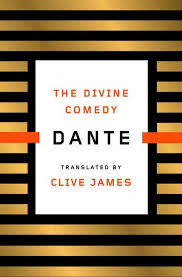 There are two fundamental questions for contemporary readers of Dante’s Inferno translated into English. The first is “What should we make of the story?” assuming we don’t want to pull on our scholar’s togs and get all 1300 CE. The second is “How should we judge our experience of the language?” considering Dante is famously difficult to translate.
I’ll address both questions within the context of Clive James’ new translation of Inferno published as part of The Divine Comedy earlier this year.
What the Hell is Up with Hell?
As you doubtless know if you bothered to click through to this post, the Inferno follows Dante Alighieri, a Florentine Italian born in the 13th century who has lost his way in middle age as he travels through hell accompanied by the poet Virgil in search of (ultimately) God’s love or, as it may be, the hottest platonic one-night stand in all of literary history with his dead and now angelic crush-for-eternity, Beatrice.
Dante’s excellent adventure will take him through Purgatory and finally to Heaven, but first he has to get past hell; and hell is a horrible place to live, although it is unbeatable as a destination if you are tourist, which is essentially what Dante is.
As a fictitious world – and since I am a liberal Christian, I am going to posit hell does not exist – Dante’s Inferno is an unparalleled feat of imagination. Hogwarts may be more fey and witty, Middle Earth may be more thoroughly worked out (though maybe not since Dante drags all of Italy and much of 1300 Europe into his poem). But for sheer originality and ummph-um-pa-pa, nothing comes close to Dante’s hell.
Nothing comes close to the Inferno in the category of high-class torture porn, either. And torture porn is something this monument of world literature doubtlessly is. Dante the poet, rather than Dante the character in the poem, revels in the sufferings he has dreamed up and canto after canto delivers stand-out horrifying and/or disgusting examples of the concept of “poetic justice”.
Hell is supposed to be the expression of divine retribution. Why then does it often feel closer to bloody-minded titillation? This question is probably familiar to anyone who has seen the frescos in medieval Italian churches or Albrecht Dürer‘s gorgeous engravings of the Inferno, but it is worth repeating.
Then there is the issue of just what kind of sins get you into hell and how much shit these sins get you into once you are there.
Dante’s hell starts off sensibly enough. We begin with the virtuous pagans: you were good guys, but you didn’t know Christ so sorry, you’re screwed. Then sins of appetite or emotion that follow along with many of the seven deadly ones: lust, gluttony, and wrath for example. Then heresy. We know medieval Christians were particular about people disagreeing with them, even on the small stuff, so okay fine, we’ll give Dante a pass on heresy. Then violence in the seventh circle – we’re right with you D, we definitely don’t like violence.
But then we get to the eighth circle of hell, where the fraudulent are punished, and here the head scratching of modern humanist readers begins.
Because the eighth circle is filled with panderers, flatterers, astrologists, simoniacs, corrupt politicians, thieves, counterfeiters – while Attila the Hun is rumored to be floating around a whole circle above.
How is it exactly that a guy who raped and killed his way across the Eastern and Western Roman Empires for twenty years is considered a little less bad than someone who made a living out of telling a dull king he was brilliant or proclaiming that since the moon was in the seventh house, now is a propitious moment to make the moves on your lady friend?
And speaking of rape, where are the rapists? Mixed in with the violent I guess, but they don’t merit a mention to all appearances. Where are those that hate? In the eighth circle, the only ones that truly deserve to be there by modern lights are the Sowers of Discord. Traitors are in the ninth and last circle, with Satan in the center of it all.
Dante Loves Him Some Dante
Another particular feature of the Inferno is just how highly Dante thinks of himself. It starts with the foundational premise of the whole Divine Comedy, namely that Beatrice in heaven has persuaded God to give Dante some special help.
Now I know God is all-knowing and all-powerful and his love has no bounds, etcetera; but there are plenty of people in heaven who have friends on earth, and God seems to have issued exactly one golden ticket for exactly one special tour of his magical damnation plus salvation factory, and that ticket went to you, Dante. And you didn’t even need to buy a Wonka Bar to get it.
Then there is the remarkable early canto where poets like Homer, Horace, and Ovid welcome Dante as a colleague and equal. Now I’m not saying they are wrong. Dante is their equal. But – dude – you write yourself into a scene where great dead poets of antiquity say you’re the bomb, and then you get all choked up and grateful about it? I ain’t buying.
It almost seems petty to note, beside these examples, that Dante the character also makes a habit in hell of telling various suffering souls he can make or break their reputations back on earth if they don’t play nice and answer his questions. Apparently, being God’s special project and an immortal poet ain’t enough for D. He has to make sure people know he’s the world’s best PR flak, too.
There’s also the whole Dante-Virgil bromance, or maybe it’s more accurate to call it a major man-crush Dante has on Virgil; and also the Dante getting to decide who goes to hell thing; but I will let these slide because other commentators have noted them and because I believe I might now be trying your patience with this line of criticism. If not my flipness.
The Clive James’ Translation of Dante’s Inferno
I should say before I go forward, offering small praise for great achievements, that Dante consistently writes scenes that are convincingly felt; that many of these scenes are compelling without understanding the background of the characters involved (but not always); and that the Inferno has incredible momentum – it reads fast and short, even with the volume of detail and people it contains.
This is especially remarkable considering that James’ translation of the Inferno is substantially longer than the original because he has woven into his work many explanations about characters and stories which Dante’s readers would not have required and which other translators typically place in footnotes.
I find this an odd choice because it is for just such information that God first invented footnotes and more recently, the tablet computer. I can’t blame James for ignoring this second invention, since he says he began work long before the iPad and Kindle Fire were invented; but these devices render the need for extensive notes obsolete. Honestly, most folks who are going to buy a copy of The Divine Comedy likely own mobile computers and can sit comfortably in bed with both James’ book and their tablet. I did. Worked beautifully.
As for James’ translation, I think it is as good as you can expect from the impossible task of translating Dante into English.
It’s not simply Dante’s famous ABA BCB terza rima that makes him difficult. English translators with any sense at all avoid it, and James uses an ABAB scheme and iambic pentameter with an AA rhyme at the end of each canto instead.
It’s also that Dante is justly celebrated for the vividness, precision, compactness, and music of his poetry. The little time I spent with a side by side translation of Dante makes me admire anyone brave enough to try it.
James is brave enough and often succeeds beautifully. You’ll find many sequences of lines where you’ll forget you are reading a translation or rhyming poetry at all.
But then, inevitably, you’ll also find lines where syntax or word choice (and so sense) are distorted to fit the poem’s scheme as well as filler words, stuck in to keep the pentameter or jury-rig a rhyme. This pops up during moments when, for example, Dante might ask a question and Virgil says before answering it, “You ask me so I’ll tell you.”
But I’ll apologize to James because these feel like quibbles, and offer what I hope is a compliment instead: your Inferno was so good it made me eager to read Purgatorio. I’ll let you all know how it went when I’m done.
Sorta Related Posts about Literature from Massey
8 “Bad” Books by Famous Writers | Reviews of Literature
7 Rules for Writing Sex Scenes in Novels | Massey on Writing
Popular Posts
Categories
-
How to Write Haiku
(Featured Post) 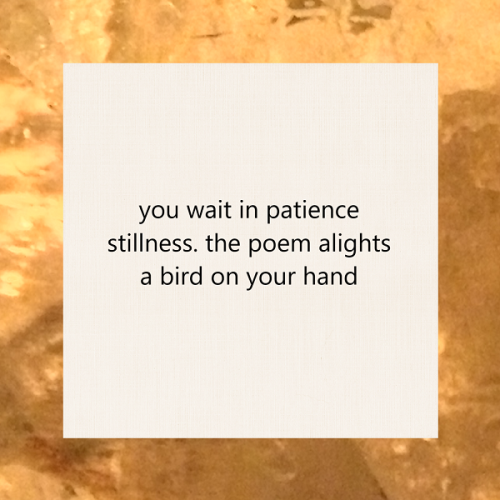


 Peter Galen Massey