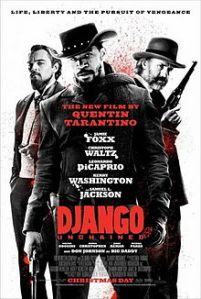
 What is the relationship of movies to reality? In a strict sense, there is no relationship at all. The world of imagination, and the conventions and techniques of movie making, exist entirely on their own terms and make their own reality.
On the other hand, I can’t think of any successful movie that does not deal with the truth, at the very least the emotional truth, of human experience. Music and painting can traffic in abstraction and succeed. But movies? Rarely if at all.
Between art and reality comes the great mediator, the artist, who imposes her or his vision on art and reality. Sometimes the result is a rare gift of sublime pleasure and transcendental insight bequeathed to us, the grateful audience, for all time.
And sometimes the result is a steaming hot mess, dumped in our laps, for us to clean up and figure out. Or not.
Ladies and gentlemen, in case you couldn’t guess, Quentin Tarantino’s Django Unchained is irrefutably the latter. Whether it is a brilliant mess, or simply a mess full stop, is the question.
Django Unchained: The Obligatory Plot Summary
Tarantino’s latest movie primarily concerns Django, a slave played by Jamie Foxx, who is purchased and then freed by a German dentist and bounty hunter, King Schultz, played by Christoph Waltz.
Schultz initially buys Django because he can identify the Brittle brothers, who were brutal overseers at a plantation where Django was enslaved and who Schultz wants to track down and kill to collect the reward. After this is accomplished, Schultz frees Django, trains him as a bounty hunter, and decides to help Django find his wife, who has been sold to a particularly sadistic Mississippi plantation owner, Calvin Candie, played by Leonardo DiCaprio. Django and Schultz agree on a plan to free Django wife’s which does not go smoothly, to say the least.
Like many of Tarantino’s films, Django Unchained is a movie about movies. His famous love of old B movies and exploitation flicks is again on overabundant display, in this case spaghetti Westerns and the 1975 movie Mandingo among others.
Also again, Tarantino demonstrates his inability to distinguish his A material from his B material, which is reflected in the movie’s 180 minute running time; in the conversations which spin on at length; in a story line that manages to be too busy and meandering at the same time; and in the climactic gun fights which continue long after real-world human beings would have run out of bullets and blood.
Complicating Django Unchained, and making it more than a fan-boy exercise and a guilty pleasure (if watching Django is the sort of thing you’d call pleasure) are its anachronistic sense of humor and especially the moments, which are not frequent but are significant, when Foxx’ Django and Waltz’ Schultz step out of their roles as “characters in a B movie” and into scenes that confront the lived horror and violence of slavery.
Even more complicating is Samuel Jackson’s performance as Calvin Candie’s head house slave, Stephen. Jackson makes Stephen an Uncle Tom so malignant, a character so utterly twisted by servitude and yet so utterly invested in the slave system, that he threatens to break the movie apart; similar to the way that Shylock in Shakespeare’s Merchant of Venice can bring the play to a dead stop (at least for modern audiences).
Django Unchained: Blazing Saddles with Blood and Vengeance
There were moments during Django Unchained when I swore I was watching a Mel Brook’s movie.
This was particularly true during the sequences when Django and Schultz visit a Tennessee plantation owned by Big Daddy, who is played by Don Johnson.
There is a long conversation where Big Daddy tries to instruct his slaves how to behave toward Django, who can’t be treated like a slave because he is a freeman, but who can’t be accorded the same courtesy as a white man. There is also an utterly inept Klu Klux Klan raid led by Big Daddy which Tarantino plays for laughs (and which is an example of Tarantino’s ubiquitous and happy indifference to historical accuracy, since the Klan was founded seven years after the movie is stated to take place).
Equal ridiculous are the clothes Tarantino puts on Foxx for him to play the role of Schultz’ “valet” as they visit Big Daddy’s plantation. Django is decked out in a sky-blue satin fop suit complete with knee breeches and an enormous white neck cloth tied in a bow.
But in these clothes, Foxx’ Django simmers with barely contained anger. He and Schultz have come to the plantation to find the Brittle brothers, the men who also savagely whipped Django’s wife.
At the plantation, Django finds two of the brother’s preparing to whip another young black women for the crime of “breaking eggs”. Ignoring the plan, Foxx shoots the first brother, then seizing the whip, beats the second brother into submission with a ferocity founded in authentic anger, then coldly shoots him as he lies prostrate on the ground.
A British critic noted that Jamie Foxx often seems to not be in on the movie’s joke during Django Unchained.
But I think the truth is that neither Django nor Foxx can accept – could make themselves tolerate, if they tried – that the movie is a joke because the experience of African-Americans under slavery in the United States was manifestly not funny.
This approach to violence is not consistent in Django Unchained. In particular, at the end of the film, Django enters a fantasyland of violent revenge. But the cycling between different attitudes toward violence in Django Unchained keeps demanding we try to reconcile its fake artifice and real truth (yes, I know the redundancy is redundant) while guaranteeing that we can’t.
Which is one of the reason I speculated the adjective “brilliant” might apply to the noun “mess” when discussing Tarantino’s film.
And Django isn’t the only character that complicates our judgments about the film.
King Schultz Gets the Joke in Django Unchained … Until He Doesn’t Anymore
In the beginning of the film, Schultz is a dapper, eloquent bounty hunter who is in the business of “selling corpses” as he cheerfully explains to Django.
Schultz may not necessarily enjoy killing men, but he clearly enjoys outwitting and outgunning them, and his good humor doesn’t obscure the fact that he kills ruthlessly. (Schultz goes so far as to persuade Django to gun down a wanted man in front of the man’s young son because this is what bounty hunters do.)
In a similar way, Schultz is perfectly reconciled to the existence of slaves and slavery. He despises slavery, mocks those who engage in it, shoots slavers without compunction when it suits his purposes, and befriends Django against all the customs of the time, but at the end of the day, Schultz sees slavery is a nasty fact that doesn’t have very much to do with him.
Until he meets Calvin Candie, at least. Candie owns Django’s wife, Broomhilda (played by Kerry Washington), and Django and Schultz agree that they will try to rescue her by pretending to be interested in Candie’s “Mandingo” slaves who Candie buys and trains to fight to the death for entertainment.
Schultz can barely disguise the horror he feels watching Candie relish a Mandingo fight, and Schultz is further unnerved the next day as he witnesses Candie taunt a slave who has been traumatized to helplessness by the three matches he’s been forced to fight, then has his dogs tear the man apart.
Still, Schultz retains his humor and his cool enough to carry out their plan, which is to persuade Candie to sell them Django’s wife. The plan goes awry but still succeeds. Candie discovers their intentions, but does sell them Broomhilda at an extortionate price.
Candie draws up the papers nice and legal, Schultz signs them, and then expresses his disgust and contempt for Candie. Candie, in return, demands Schultz shake his hand to finalize the deal.
Instead, Schultz shoots Candie and unleashes a series of events that threaten Django’s life and end in a bloodbath. Just before he is killed in turn, Schultz apologizes to Django, “Sorry, I couldn’t resist.”
What was tolerable to King Schultz at the beginning of Django Unchained became intolerable to him at the end. The violence is “fake fun violence” until it isn’t. We are watching a “movie about movies” until we aren’t. And Tarantino keeps throwing questions at us faster than we can answer them.
Samuel Jackson’s Stephen is the Shylock of Django Unchained
In The Merchant of Venice, Shylock is the villain and an object of “amusing” abuse who refuses to play his role. He insists on his humanity so powerfully that he fatally disrupts the play’s comic and romantic storylines and sours us on the drama’s heroine, Portia.
For modern audiences, Shylock renders the drama almost unplayable. Shakespeare’s treatment of him so offends our fundamental principles that witnessing Shylock’s humiliation and punishment can only be painful; and since we are a willing audience for the play, it also delivers a sense of complicit guilt.
Samuel Jackson’s head-house slave Stephen plays a similar role in Django Unchained. In front of his masters and other white people, Stephen puts on a minstrel show (there really is no other phrase to describe it) that left me squirming in my seat and grabbing my head. And the fact that it was Samuel Jackson playing Stephen – an actor who I am used to see playing characters with power and agency – made it worse.
In the kitchen and servants’ rooms, Stephen was a tyrant every bit as sadistic as his master, Calvin Candie. Stephen also seems to hate Django, a free black man with power, even more than the whites do, and he conspires to think of a punishment for Django more harsh than anything the whites could think up.
Through it all, Jackson makes us feel that Stephen is still a man – not a character in a movie, not stock villain, not a comic type – but a man who has been horribly damaged by a long life of servitude.
At the climax of the movie, after Django has killed all the whites, he and Stephen confront each other in the plantation house. Django shoots Stephen multiple times, then leaves the old slave screaming in pain as he lights the fuse that will blow up the house and Stephen.
Is this justice? Is this mercy? Or is it Tarantino getting rid of a character no one wants to confront? Amid all the B movie artifice and random jokes, Tarantino asks a lot of hard questions.
Django Unchained – Mess or Brilliant Mess? You Decide
My judgment is brilliant mess because I believe as Chekhov believed, that the role of the artist is to ask questions, not answer them; particularly since when people demand that art answer questions, what they really mean is that art should ask THEIR questions and offer THEIR answers. Thus it has always been with philistines, ideologues, and tyrants. That’s why tyrants don’t much like artists, and artists don’t much like tyrants.
I can’t tell if Django Unchained is the result of deliberate strategy, careless accident, unconscious inspiration, or a byproduct of Tarantino’s unrestrained enthusiasms, but whatever the causes – the results are challenging, disturbing, puzzling, funny, sometimes annoying. For me, that’s plenty.
Read Full Post »
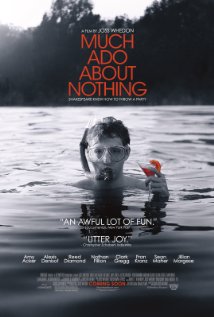 In his new film adaptation of Shakespeare’s Much Ado About Nothing, director Joss Whedon has made a movie which is both funny and affecting – but funnily enough, more affecting than funny.


 Peter Galen Massey