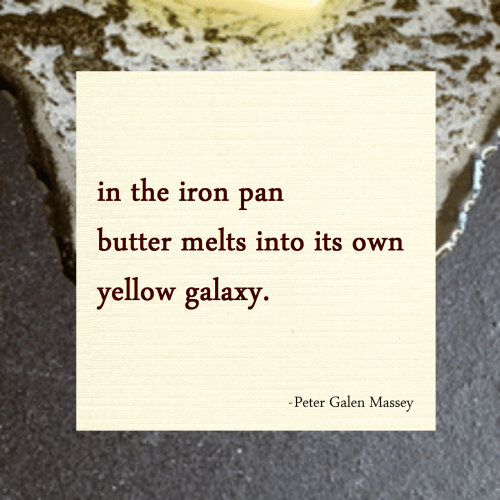
in the iron pan / butter melts into its own / yellow galaxy
in the iron pan / butter melts into its own / yellow galaxy
Posted in Haiku | Tagged haiku, Poems | Leave a Comment »
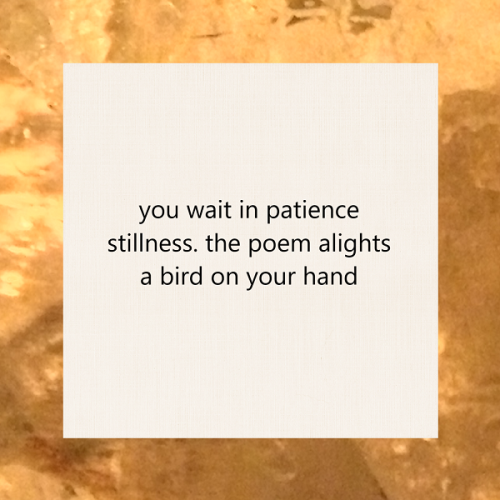
 a fall of moonlight / on the dim stairs was only / a little boy’s sock
Posted in Haiku | Tagged haiku, Poems | 2 Comments »

I marked / These reds / On this canvas / In a place and time / Now forgotten by all save / A few dry scholars. But these / Reds are proof of my living hand, / Colors as alive as the taste of warm / Wine in your mouth.
Posted in Haiku | Tagged Poems | 2 Comments »
Do you want to write a Literary Novel but don’t know how to start? Fear not!
Follow these 11 easy steps and you too can write a masterpiece of fiction. Soon, you will enjoy critical praise, fawning audiences, fancy cocktail parties, cushy academic appointments, prestigious fellowships, and modest sales. Does that sound good? Then let’s get it going!
It’s the rare comic novel that joins the pantheon of literature. Comedy works in your favor if you excel at tragedy too (Shakespeare), if it is suffused with deep undercurrents of sadness (Chekhov), or if it comes with dazzling social insights (Austen). Otherwise, you are condemned to lightweight status no matter how blinding your brilliance.
A corollary to Step 1. No one who is happy is a serious person. Happiness indicates you are entirely lacking in the basic insight necessary to be sad or that you have been hoodwinked by capitalism, the church, the NFL, Cosmo magazine, the makers of antidepressant medication, or the Republican party.
Extroverts don’t sit in rooms by themselves reading about other people’s lives. They are out in the world living their own lives. Always make your Literary Novel about your audience. Your audience is introverts.
A corollary to Step 3. Being an introvert doesn’t do you much good unless you are living your interior life more deeply, more consciously, and more fiercely than everyone else is living theirs. Passionate introspection and self-conscious brooding are to introverts what sky-diving and tech start-ups are to extroverts: high-status ways of demonstrating you are more successful than your peers.
A corollary to Steps 3 and 4. It doesn’t do you much good to live a passionate interior life if you can’t get the damn thing out of your head and into the world prancing around impressing people. So make your characters impossibly articulate especially in circumstances that should render them speechless, such as tumbling inside a fatal avalanche or porking the hottie of their dreams.
This is especially important if you are a male writer. Size definitely DOES matter to the male literary novelist and the bigger the better. You don’t want to be dangling some elegant slender volume praised for its jewel-like perfections when you are standing next to Jonathan Franzen, do you?
If you are a woman, you have it easier. You can say exactly what you want to say, in exactly the number of words you need to say it – and no more – and trust the intelligence and good taste of your readers to recognize your qualities. You should also trust you will hear a lot of sniffing about lady writers.
Never make the mistake of entertaining the reader. You might accidentally become a popular success and popular success is for hacks. (Just ask Shakespeare or Twain or Fitzgerald or Nabokov or … well you get the point.)
The easiest way to make your Literary Novel boring is to assume that every passing thought you have is a rare gift to the world that must be shared. If you’ve ever used social media, this should be simple enough. Another easy way to bore the reader is to avoid plot. Be sure to let people know your book is deliberately boring by giving interviews in which you talk about subverting reader expectations or offering a stinging critique of the zombie-producing distractions of a debased all-for-profit culture.
Hey, we coughed up forty bucks for the hardcover version of your frickin’ doorstop. We want our money’s worth. That means big words and lots of them. Even if they don’t quite work in the sentence.
A corollary to Step 8. One of the most important reasons people read Literary Novels is to look and feel smarter than people who don’t. Obscure references are essential to this process. So make sure you put in plenty. I mean, you do want to be the next Sirin right? (Did you get my reference? You did? Welcome to the club! You didn’t? Ha ha!)
You should always criticize society in your Literary Novel as long as you are criticizing its insidious lack of liberal progress. Never criticize society for being too progressive. That is not literature!
Express outrage no one has fixed the problems you identify. Imply every problem would magically disappear if it weren’t for the malignant, soul-deadening, tyrannical machinations of the power elite. Do not make the mistake of offering solutions to the problems you see. Literary Novels are not in the solutions business.
This is the most important step of all. Your Literary Novel must be difficult to read. Remember, a truly original work of art is indistinguishable from a hot mess to its first audience. Further, no one is going to spend the time carefully reading an interminable and terminally boring new Literary Novel to figure out if it is a hot mess. They are going to play it safe and praise the book instead. This works great for you unless you really are a genius in which case, honey I’m sorry to tell you, you’re screwed.
That’s it! I look forward to your Literary Novel appearing in The New Yorker ten years from now. I did mention these bastards take a long time to write, and cause you unbearable suffering while you write them, didn’t I?
Posted in Literature | Tagged Fiction, Literature | 2 Comments »

The wild air tumbles / the autumn leaves like hard seas / batter fragile boats.
Posted in Haiku | Tagged haiku, Poems | Leave a Comment »
“Texas” (Three Fragments)
Turbines tumble tumble through the hot air,
Like the wings of the archangels who chased
Night and chaos over the rim of the world in
The wrath of God’s creation, and came to rest
In the soft light of the first morning of Texas.There today the light before light with everything
Quiet except for the birds screaming in the dim
Trees and your thoughts wandering after those
Who have died or who are serving overseas or
What you’re chasing and what it pays and why it’s
Necessary, before you rise and dress and in your
Car rushing rushing with all the rest eight lanes
Of impatience furious to eat the endless distance
Between bed and the towering diamond-blue glass
Fortresses of wealth, the office parks with graceful
Trees and glittering fountains, the new merchant
Plazas on the new black roads, the box stores, the
Strip malls wearied by sun and subsistence, the
Cinder-block workshops, steel-tooled and machine
Oiled, the trailer-offices squatting on the site of
New prospect or old defeat, ragged air appliance
Rasping out feeble cool against vinyl-metal heat,
The heavy industry fairie kingdoms cracking crude
To naphtha kerosene paraffin diesel sulfur and tar,
The glinting purgatories of health, the dingy rooms
Machine bedded and ravaged age, the grey cubicles
Of counseled grief, kitchen, corridor, laundry, house
Children, house children, house children, eight lanes
Of hunger blood throbbing through interstates and
Access roads, vivid desire and dull necessity in metal
Boxes rushing everywhere, life mind heart rushing,
Until day ends, retirement eases, or death comes to
Tally his final accounts.***
Nature loves all her children hard, but she loves her
Texas children harder; sends them with a laugh and
A kick out the door to find something for supper.This rich land will wrestle you, take your youth, take
Your strength, give you cash in cattle, cotton, corn,
Sorghum, and wheat. This hard red earth more scab
Than skin will yield hard living if scraped, pierced,
Worked in dust and heat, through relentless sun,
Asphalt fume, with truck and tool and no excuses:
No one to catch you if you fall and no one asking
To be caught.***
There’s no fair fighting for our hard machines:
Time and earth will take them, concrete, circuit,
Polymer, steel, with one puff float all into endless
Mind, soft seeds blown from the dandelion head;
No fair fighting for our tender bodies, time frail,
Flesh blood bone souls man woman child, all
Floating, angels tumbling tumbling through the
Cooling air, the soft light, the last evening of Texas.
Thanks to Blast Furnace for publishing “Texas”.
Posted in Haiku | Tagged Poems | Leave a Comment »
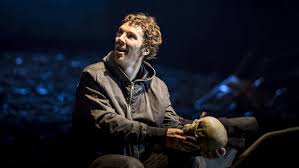 For nearly four acts, Benedict Cumberbatch, starring in the National Theatre Live broadcast around the world yesterday, is the best adjusted – and best – Hamlet I’ve seen. That the production falls flat in Act V is a disappointment, but does not take away from the many accomplishments of this fine staging.
Any performance of Shakespeare’s “Hamlet” succeeds or fails primarily on the strengths of its lead actor and Cumberbatch’s Hamlet is very good indeed. He fully and convincingly engages with all of the character’s emotions: Hamlet’s grief, his sorrow, his anger, and especially Hamlet’s humor which is the lightest and most sparkling of all the readings of the Danish prince I’ve seen.
This is the result of the intriguing choice of making Cumberbatch’s Hamlet extremely well adjusted, considering his circumstances. Hamlet is typically played as having been unhinged by grief over his father’s death, his mother’s quick remarriage, Ophelia’s rejection of his love, and the disturbing appearance of his father’s ghost. (It can be argued that the text demands this reading.)
This leads Hamlet to contemplate suicide and to embrace a half-madness which serves both to disguise the threat a sane Hamlet poses to his uncle’s stolen crown and to disguise the insane parts of Hamlet from easy recognition.
In Cumberbatch’s Hamlet, his madness is all tactic to confuse Claudius. This makes Cumberbatch’s “antic disposition” particularly playful and makes his Hamlet particularly likeable because the whinging, self-importance, and condescension frequently seen in the Danish prince are muted. It does mean, however, that Hamlet’s contemplations of suicide come off as passing thoughts, rather quickly forgotten.
Cumberbatch isn’t the only good performer in this National Theatre Live production. Ciaran Hinds is very good as a false, awkward, and cowardly Claudius unequal to the tasks of playing either the public or the private role of king. Sian Brooke’s is moving as an Ophelia whose vulnerability is evidence from the beginning of the play, and whose descent into madness is credible and heart-breaking. Anastasia Hille’s Gertrude manages to yell at top voice and convince us of her passion in her confrontation with Hamlet.
This is more than I can say for the actors playing Laertes and Horatio both of whom rely on volume when emotional connection with their roles seems to desert them. (Are bellowing Horatios the new style? It’s not a good style.) Polonius, Rosencrantz, and Guildenstern are played for laughs and deliver. The Player King is meant to be a bad actor and succeeds competently.
Like most staging of most Shakespeare, the National Theatre Live production tries new things, some of which work and some of which don’t. The generally accepted version of Shakespeare’s “original” text has been edited more than usual, with many scenes moved around and lines traditionally spoken by one character often spoken by another. This emphasizes the elements of Hamlet the director seems to want to emphasize and works just fine until Act V (more on that in a minute). For many of Hamlet’s soliloquies, Cumberbatch steps out of the action of a scene and is isolated in a spotlight (very effective). There is at least one instance where the characters are running frantically around on stage while music pounds and strobe lights flash (this should be banned from the stage by statute). The duel scene is so rushed and hugger-mugger that it felt like Gertrude and Claudius were alive one moment and dead the next. When Hamlet is exiled to England, the stage is inexplicably filled with black dirt, a gimmick making pretense toward grand visual metaphor though exactly what the metaphor might be, who can tell?
Finally, there is the problem of the Cumberbatch Hamlet in Act V of the National Theatre production. Or rather the lack of problem. The foundation to Hamlet’s universal appeal is his struggle against a life whose pain and demands are more than he can bear, but whose alternative – death – is unappealing. Hamlet’s personal drama comes from his eventual philosophical acceptance of or passive resignation to this condition (take your pick), culminating in Hamlet’s conversation with Horatio that ends with the words, “Let be.”
Since Cumberbatch’s Hamlet bears up reasonably well under his pain and the task of avenging his father’s murder, he never gets to acceptance or resignation. He simply dies from the machinations of Claudius and Laertes, about as happy and unhappy as he ever was.
This does not detract from my forming conviction that Cumberbatch’s Hamlet is the best and most appealing I’ve seen on screen. Not to mention the sexiest. I hope the National Theatre makes this production of “Hamlet” available for streaming eventually. I’d like to see it again.
Check out my other reviews of Hamlet movies starring Laurence Olivier, Mel Gibson, and many more.
Posted in Shakespeare Movies, William Shakespeare | Tagged Literature, William Shakespeare | 1 Comment »
 The simple answer to that question is “yes” if by “modern audiences” we mean anyone without a BA in English Literature or a natural taste for Shakespeare’s plays. The real question is what needs to be done about it.
The occasion of this question is Professor James Shapiro’s Op-Ed piece in the New York Times on the Oregon Shakespeare Festival’s decision to translate all of Shakespeare’s plays into modern English and the commitment of other companies to produce these versions.
As you might expect from a professor of English at an Ivy League school, Shapiro thinks this is a horrible idea. And I agree with the reasons why he thinks it is horrible. We will lose “hints of meaning and shadings of emphasis.” We will certainly lose the “music and rhythm” of the poetry. We will lose the “resonance and ambiguity.”
Professor Shapiro does concede that some of Shakespeare’s language is “difficult” which he qualifies with the word “deliberately.” Then he goes on to make a very particular argument, which is that the fault, dear Brutus, lies not in our Shakespeare – and not in our audiences – but in our actors and directors who “too frequently offer up Shakespeare’s plays without themselves having a firm enough grasp of what his words mean.”
As proof of this thesis, Shapiro presents the example of a performance of “Much Ado About Nothing” at Rikers Island during which the inmates were “deeply engrossed” and “visibly moved”.
Well. I would expect that a Columbia professor would not make arguments in the Times featuring holes big enough to sail a New Panamax ship through but as is frequently the case in life, my expectations were disappointed.
On actors and directors lacking a “firm enough grasp” of Shakespeare’s words, the question is How does Shapiro know this? Has he administered a test to a representative group of actors and directors which reflects the critical consensus of the various professions concerned and which was constructed by psychometricians to ensure its validity?
As you can probably guess from the sarcastic tone of my question, the answer is “no” or Shapiro would have told us about his data. Which makes this statement an opinion though I suppose, based on the professor’s profile, an eminent one.
Opinions are fine of course, and many can be convincingly proven, but one anecdote doth not an argument make, as I would hope any professor teaching any subject at any college would realize, and one anecdote about one performance of one play is all Shapiro offers.
Further, we don’t know if the audience was truly “engrossed” and “moved” as Shapiro claims unless he conducted a survey of the inmates afterwards and like my hypothetical test above, didn’t bother to tell us about it. Otherwise, we are going on his perception, which may very well be correct. I certainly find it plausible that people in prison would respond to a play with great jokes and the suffering of a monstrously misaccused and slandered young woman.
Now Shapiro is surely right that a good performance of a play can make the text transcendent just as a bad performance of the same play can make the text opaque, ridiculous, and tedious. But it is both grossly unfair and grossly simplistic to lay the blame for all the difficulties with Shakespeare’s difficulty at the feet of actors and directors, who have the courage to go out night after night and risk spectacular failure before a live audience, all in pursuit of the elusive alchemy of the sublime.
The fact is that some of Shakespeare’s poetry is difficult to follow on first and second and sometimes third hearing to most people. That is often the nature of poetry. If Hamlet had nothing more to say than “Dude, life sucks” he wouldn’t be worth paying attention to once much less repeatedly. Shakespeare is full of archaic words and ideas and concepts and allusions and references which are simply unfamiliar to audiences 400 years later and not every line is like Hamlet’s “when he himself might his quietus make with a bare bodkin” which is at least amenable to the actor producing a knife and holding it to his throat. (Whether this gesture works or is laughably literal is another matter.)
Finally, many of Shakespeare’s plays feature complicated plots with large numbers of characters that might take a person seeing the play for the first time a couple acts to sort out; and while Shakespeare could count on at least some people in his audience knowing enough about the War of the Roses to make sense of the stories of Richard II, Henry IV Parts I and II, and Henry V easily enough, for example, you are only going to stumble across the occasional modern audience member who knows enough about English history to recognize the characters by name when they first walk on stage.
To put it succinctly in the contemporary vernacular, Shakespeare has a “Who the f**k is that guy and what the f**k is he saying?” problem.
When these issues are ignored or dismissed or denied or excused, as Shapiro largely does in his piece, the net effect is to limit the audience for Shakespeare to intelligent, well educated men and women with a fair amount of specialized knowledge. That is a model that may work to keep your lecture hall full at Columbia but I suspect it is not working for the Oregon Shakespeare Festival. If it were, would they bother rewriting the plays?
Shapiro’s model also has the fault (or is it virtue?) of restricting the audience for Shakespeare to an elite minority. Now many of the members of the elite minority seem to like this situation just fine, and I know people who continue to reflexively dismiss anything popular long after they should have outgrown such pathetic adolescent posturing.
But if the job of teachers and performers includes introducing great works of art to new people – rather than just preserving them as exclusive objects of status for the privileged few – then the efforts of the Oregon Shakespeare Festival look rather noble, even if the results horrify folks like me and Shapiro.
After all, if lots of people see the Oregon Shakespeare Festival’s modern language Shakespeare, or a contemporary adaptation of As You Like It, and some of these people decide to try the real Shakespeare, and some of these come to love the real Shakespeare when they would not have come to love him otherwise – is that such a bad thing?
Posted in William Shakespeare | Tagged Literature, William Shakespeare | 3 Comments »
Henry V may be the most cinematic of all Shakespeare’s plays. It stars a young underdog hero who wins the battle and gets the girl. It is a spectacular piece of theater, with nearly a dozen stand-out scenes, some of Shakespeare’s most famous speeches, and battles just begging to be filmed. Henry V has drama, action, comedy, romance, heartbreak, and a rich vein of ambiguity – all of which give actors and directors wide scope to shape their own versions of the play. Here’s how three of them did it, in order of personal preference.
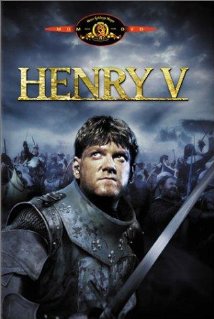 Branagh’s Henry V is not only the best film version of the play by far – it is one of the finest film versions of any of Shakespeare play – because it flawlessly executes Branagh’s vision of the hard consequences of war.
Every element of the film reinforces this theme. Branagh’s screenplay presents many of the play’s darker elements: the English traitors, the hanging of Bardolph, the deaths in battle. The mood and production design are somber throughout: Branagh splashes mud all over Olivier’s bright Technicolor Henry V. Branagh assembles a remarkable cast of A list actors for all the major roles, who all bring their characters to specific human life. Branagh fully exploits the dramatic possibilities of each scene. And he delivers the knock-out punch with a four-minute tracking shot of King Harry carrying the body of a young boy killed by the French across the battlefield and through a tableau of almost every character in the play, living, wounded, or dead, while the non nobius is sung.
If you require nitpicking, there are traces of Branagh the insufferable ham within his very fine performance of Henry V. And Branagh doesn’t quite convince us Harry and his princes go only reluctantly to war. They prosecute their campaign against the French with too much vigor to make us believe that. IMDB page for Branagh’s Henry V.
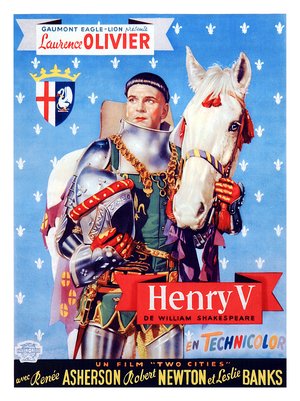 Laurence Olivier’s film version of Henry V was a remarkable achievement, and greeted with great acclaim, when it first appeared during World War II. (The film was intended to raise the morale of wartime Britain.) The problems are that so much of Olivier’s version is out of step with modern taste, and so many of the scenes fail to make effective use of film as a medium, that contemporary viewers will see it as a half-success at best.
This Henry V still makes an impact, however. Olivier is excellent as an unambiguously heroic Henry V playing his role as public leader of the English army to perfection, most especially during the St. Crispin’s Day speech. He is very good showing us the private King Henry the night before Agincourt and the appealing young conqueror who wins the heart of his young French queen. Olivier’s charging knights and mounted sword fights still impress in an era of massive digital special effects. And the diction, presence, and physicality that made Olivier a star on the English stage are all on rich display.
Unfortunately, the phrase “stage star” sums up the difficulties with this Henry V. Much of the acting, including Olivier in many scenes, is the “presentational” style well suited to clearly communicating every word and gesture to the last row of a large theater but which on film comes across as loud, stiff, flat, and dull. Olivier’s clowns are worse. They play their lines for the broadest and most obvious comedy and the clowns include not just Falstaff’s retainers, but also most of the French nobility as well as the English clergy seeking to divert King Henry’s attention from their wealth by provoking a war with France. (The “Salic law” scene is hysterical, though.) All the comedy and the many actors playing “types” rather than individual men and women make this Henry V only rarely moving.
Finally, Olivier’s production design is a fascinating mess. He uses three distinct styles. Most of the scenes in England are played in a reproduction of the Globe Theater, with the actors and audience interacting with each other, and the acting suited to that situation. The sets of the interior scenes in France resemble famous illustrations from Les Tres Riches Heures and the acting is again stage style. Exterior scenes in France, all around the battle, are filmed outside or on realistic sets, and the acting humanizes the characters by taking advantage of the power of the movies to make the smallest gesture big. All this further reduces the emotional impact of the play. But it does prove the old axiom that an interesting failure is superior to a dull success. IMDB page for Olivier’s Henry V.
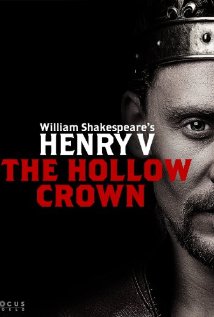 Tom Hiddleston is reasonably good as King Henry in the 2012 BBC production of Henry V (which is part of the “Hollow Crown” series), and many of the actors and scenes are persuasive. Overall, however, director Thea Sharrock has made a cock of her version of the play.
Sharrock doesn’t seem to have quite decided what she wants her Henry V to say or who she wants her King Henry to be. The film starts on promising notes. Sharrock opens with Henry V’s funeral (which The Chorus describes in the closing lines of the play) suggesting we are going to get an “all is vanity” approach. She reinforces this idea by giving us a King Henry who goes to war out of a sense of obligation to his own and his country’s honor.
But then she doesn’t follow through. Instead, much of this Henry V has the look and feel of Branagh’s. Sharrock underplays many of the scenes, most notably the St. Crispin’s Day speech, losing the drama without gaining new insight. And Sharrock muffs the Harfleur scene, where she has Hiddleston threatened the French citizens with genocide from within the walls of their own town if they don’t surrender . Didn’t anyone notice that the English army had already captured Harfleur?
This isn’t the only time Hiddleston’s King Henry shows irrational anger and a taste for violence. He also shows it when he orders the execution of the French prisoners at Agincourt. Then at other times, Hiddleston’s King seems deeply and sincerely pious. Then at other other times, we see flashes of the old charming rake Prince Harry from the Henry IV plays. The total effect of this is not a character who is complex and mercurial. The effect is that Hiddleston’s Henry V comes across as incoherent: a person who can be radically different from scene to scene, sometimes from moment to moment.
Big fans of Shakespeare, and of Tom Hiddleston, will not be unhappy with this version of Henry V. But for those who want to watch just one movie, Branagh’s is the version to choose. IMDB page for Hiddleston’s Henry V.
Posted in Shakespeare Movies, William Shakespeare | Tagged Literature, William Shakespeare | Leave a Comment »
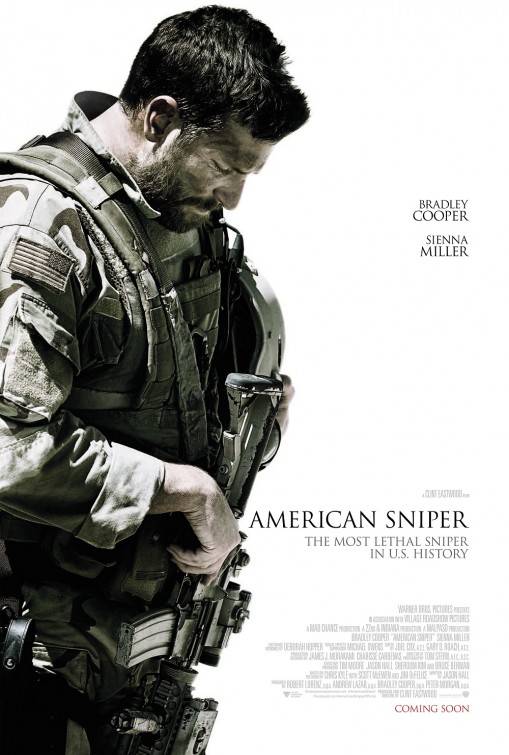 Pretty lies sell. Politicians know it. Hollywood knows it. Clint Eastwood knows it – although perhaps he did not intend to sell pretty lies when he made American Sniper. But pretty lies are what Eastwood delivers. And in them rest the sources of the controversy, and the complications, of the movie.
As you likely know, American Sniper tells the story of Chris Kyle, an American SEAL who is famous for being the “deadliest sniper in American history” with 160 confirmed kills to his name. The movie is far more interested in telling the story of the impact Kyle’s four tours of duty in Iraq had on him and his family, however. Much of that story is not pretty and much of it is true.
There are quite a number of ugly truths wrapped around the pretty lies of American Sniper, which do a good job of giving the pretty lies of the film the appearance of “truth by association”.
Eastwood does not make war look fun. He makes it look like a tough, exhausting, dangerous job — Ann Hornaday of The Washington Post nails it when she called American Sniper a “professional procedural”. (The single exception is the scene where Kyle kills a rival sniper with a headshot from nearly a mile away. We follow the bullet in slow motion as if we were watching The Matrix.)
Eastwood certainly doesn’t make war look pretty. In one scene, one of Kyle’s friends is hit by assault rifle fire that instantly deadens his expression. He dies seconds later. In another scene, one of his friends is shot in the face, and we watch as the man chokes on the blood gurgling in his throat. Kyle’s sniper rifle blows holes the diameter of coffee cans in the bodies of the men, and the woman and the child, he kills.
Eastwood shows us the impact of war on soldiers. We are there outside the operating room when they die. We attend their funerals and see the grief of the family they left behind. We see soldiers trying to recuperate from horrible wounds in hospitals back home, and then try to build a new life with broken bodies and broken spirits.
We see what the war does especially to Chris Kyle’s wife, Taya, played by an excellent Sienna Miller. One of the strengths of American Sniper is just how much attention and respect it pays to the suffering of the wives (all wives in this case) of soldiers at war. And we see the impact of the war on Chris Kyle himself through the outstanding performance of Bradley Cooper – richly deserving his best-actor nomination – who in scene after scene, quietly and almost motionlessly, conveys the anguish of Chris Kyle’s job.
After Kyle shoots an armed enemy, he exhales and drops his head. Then he sniffs and returns to looking through the sight of his rifle, as if each shot were a burden he would need to carry and for which he would need to ultimately answer. This is particularly true after the famous opening sequence, when Kyle has to decide to shoot a young boy who is running toward an American patrol with a grenade, and then shoot the boy’s mother who picks up the grenade after her son is killed.
Later in the film, another boy picks up a grenade launch dropped by a dead fighter and seems to be attempting to aim it at an American patrol. “Put it down, put it down, put it down,” Kyle whispers as he fixes the boy in the sight of his rifle, a look of horror spread across his face. His relief when the boy drops the weapon is palpable.
Balanced against these many ugly truths – and they are very ugly indeed – are the pretty lies of American Sniper. These lies are very pretty indeed. The ultimately overwhelm the counter truths. And these lies start with Chris Kyle.
By all reports, the real Chris Kyle was in many ways the man American Sniper shows him to be. A tough professional elite soldier who joined the military to defend the United States from terrorists. A loyal and unwavering friend. A loving and devoted husband who struggled against the damage the war did to himself and his family, and who then committed himself to helping other veterans with the same struggles – including the man who killed Kyle in 2013.
But there are other parts of Chris Kyle that are absent from American Sniper and which are less than ideal. For example, the movie portrays Kyle as modest and reluctant to discuss his work. The real life Chris Kyle seems to have been much less modest. He actively promoted himself as “America’s most lethal sniper” and made good money doing it.
Kyle’s bragging also extended to things he didn’t do. Kyle claimed to have killed two carjackers in Texas and gone to New Orleans in the aftermath of Hurricane Katrina to shoot looters. No evidence for these claims exists. Kyle also claimed to have punched Jesse Ventura for criticizing the Iraq War. Ventura won a $1.8 million libel judgment against Kyle.
You could say that these were a few moments when Kyle’s mouth got ahead of his brain. You can’t offer the same defense of some of the opinions Kyle published in his autobiography. Such as these:
“I’m not lying or exaggerating to say it was fun. I had the time of my life being a SEAL.” [From the introduction.]
“I missed the excitement and the thrill. I loved killing bad guys.” [On why he wanted to go back to Iraq.]
“It was like a scene from ‘Dumb and Dumber’. The bullet went through the first guy and into the second…Two guys with one shot. The taxpayer got good bang for his buck on that one.” [On firing at two insurgents on a moped.]
These are not the words of a modest and selfless soldier, doing the hard work most people are unable or unwilling to do; not the words of the Chris Kyle portrayed in American Sniper who is celebrated by much of the nation as hero. These are the words of a person who enjoyed being paid by the U.S. government to go on a murder junket. And there is nothing pretty about them.
As amazing as it sounds, the prettied up Chris Kyle isn’t the prettiest – or biggest lie – Eastwood tells in American Sniper. That distinction goes to the justification the movie presents for the Iraq war. Or more precisely, the lack of justification for the Iraq War the film presents.
War is a brutal business and when a war is necessary (and I do believe some wars are necessary) then we need men like Chris Kyle to fight them; and if these men are less than perfect in their motivations, and less than perfect in their actions, it is nonetheless indecent to criticize them for their imperfections. Men like Chris Kyle are the means to the ends we pursue, and if we don’t like the means then we shouldn’t pursue the ends.
The problem is that American Sniper utterly ignores questions like these. Instead, it takes at face value, unexamined and unchallenged, Chris Kyle’s justification for the Iraq War, which is the pretty, glittering, noble-sounding phrase that he was “fighting for freedom”.
But what does “fighting for freedom” mean in the context of the Iraq War? Don’t look for the answers in American Sniper because they ain’t there. Which leaves us to guess.
One possibility is that “fighting for freedom” means protecting the United States from existential threats – that is from enemies that have the ability to destroy America and the freedoms it guarantees its citizens. In this case, there are two important questions: Was Iraq an existential threat? and if so Was invading Iraq the best response to this threat?
The answers to both questions have been definitely settled as “no” for everyone not living inside an intellectually dishonest fantasy land. (They were also clear to many before the war began.) The same answer holds true for the claims that we were fighting for Iraq’s freedom, and that all that was need to create a stable democracy in a peaceful Iraq was to get rid of Saddam Hussein. History – if you wanted to bother looking at it – would have told you otherwise.
In this context, perhaps “fighting for freedom” means we don’t want to admit we launched a war of choice out of a combination of fear, incompetence, stupidity, vanity, bravado, and magical thinking. Or perhaps “fighting for freedom” means that it would be too painful to admit the Iraq War was a mistake after all the sacrifices made by our soldiers and their families.
Or perhaps “fighting for freedom” means that we really just want to kick somebody’s ass; we aren’t too particular about whose we kick; and we need some high-minded sounding excuse to go do it.
This is an offensive suggestion. The problem is … of all the possible definitions, it makes the most sense. If you were really serious about protecting America, you would believe it is worthwhile to carefully assess threats and deliberately choose the best response, weighing risk against benefit. And examine and learn from mistakes. Yes? If you were really serious about spreading freedom, you’d look at the places where it was done successfully, and the many places it wasn’t, then get serious about exactly what it will take and how hard it will be.
If on the other hand, you’re a fan of the shit-kicking approach to foreign policy – Let’s go kill bad guys! – and you see military intervention as simply a whole lot more awesome version of the National Football League – then “fighting for freedom” full stop, end of discussion, is all you need.
Eastwood has claimed in his public statements that American Sniper is a “character study” and that the film is “anti-war”. Neither one of these claims holds up to scrutiny.
In terms of Chris Kyle, not only are the ugly pieces of his character left unstudied in American Sniper, they are substantially prettied up. This idealized Chris Kyle, with all the storytelling and myth-making fire-power of an accomplished director behind him, is made by the movie into “the” portrait of “the real” American soldier. Too tough, too brave, too accomplished, too loyal, too tender, too strong, too steady, too vulnerable, too modest, too selfless – just flawed enough to be too heroic – to be true.
It’s hard to be anti-war if you make the impact of a war ugly (which Eastwood does) but make the reasons for fighting that war noble when they ain’t. Or put it this way. When horrible sacrifices are justified by beautiful lies, the lies don’t become horrible. The sacrifices become beautiful.
Considering the total effect of American Sniper then, the pretty lies are stronger than the ugly truths, and leave the stronger impression. No surprise then either that the film has the knickers of liberals in a twist or that American Sniper is a smash-hit success in Red State America. It’s perfect catnip. It acknowledges the horror of combat and the heavy sacrifices of military families, while telling us soldiers are heroes who volunteered to fight a good and necessary war. Based on all the reports of cheering during the movie, sounds like the shit-kickers got their money’s worth too.
Posted in Film | Tagged movie reviews | 4 Comments »


 Peter Galen Massey